
XV Sudoku 6x6 Online Free - Play X & V Clues Mini Sudoku Puzzle Game
More Sudoku Puzzles
What Is 6x6 XV Sudoku?
6x6 XV Sudoku is a compact version of the classic XV Sudoku variant. It uses a 6x6 grid divided into 2x3 boxes filled with numbers 1-6. The special XV clues still apply: an X between two cells means their numbers add up to 10, and a V means their numbers add up to 5.
All standard Sudoku rules still apply: no repeated numbers in any row, column, or 2x3 region. The name comes from the Roman numerals: X = 10 and V = 5.
Core 6x6 XV Rules
| Mark | Meaning | Valid Pairs (1-6) |
|---|---|---|
| V | Sum = 5 | (1,4), (2,3) |
| X | Sum = 10 | (4,6) |
| No mark | Not 5 or 10 | All other pairs |
⚠️ Important: If there is no mark between two adjacent cells, then neither 5 nor 10 is allowed, even if the digits would otherwise fit.
Why 6x6 XV Sudoku Plays Very Differently
One reason 6x6 XV Sudoku often feels more approachable is hidden in the number system itself. In a 6x6 grid, the digits are 1-6. That means:
A V pair (sum = 5) can only be 1+4 or 2+3
An X pair (sum = 10) can only be 4+6
There are no alternatives. This has a huge impact on solving: X pairs collapse much faster, many candidates disappear instantly, and chains resolve with far less ambiguity. The 6x6 XV Sudoku feels tighter and more tactical.
How to Solve 6x6 XV Sudoku
1. XV-Pair Lock
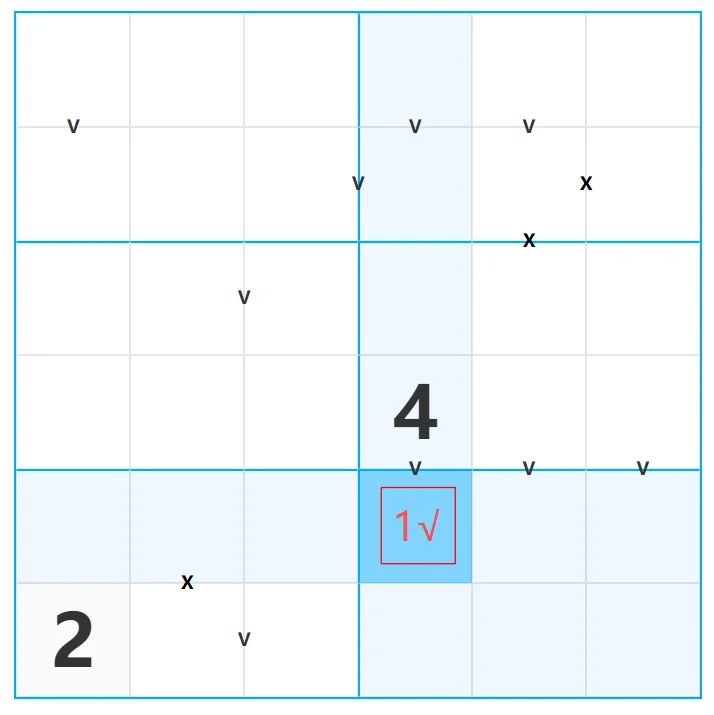
When two adjacent cells are connected by an X or V, they form a locked pair. If either cell is known, the other cell becomes immediately determined. In 6x6, a V pair can only be (1, 4) or (2, 3), and an X pair can only be (4, 6).
V example: If a V-pair contains one cell = 1, the other must be 4; one cell = 2, the other must be 3; and so on.
X example: If an X-pair contains one cell = 4, the other must be 6; one cell = 6, the other must be 4.
The key mindset shift is this: you are not "solving a cell", you are resolving a relationship.
2. No-Mark Exclusion
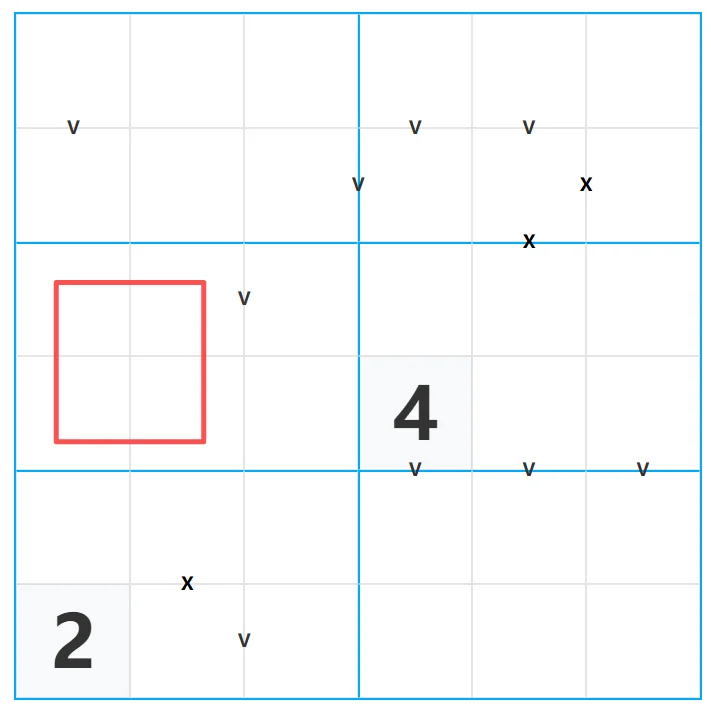
If two adjacent cells have no X and no V between them, that absence is real information: they cannot sum to 5, and they cannot sum to 10. In 6x6, this forbids pairs like (1, 4), (2, 3), and (4, 6). When one cell later gets pushed toward low or high values, the neighbor is immediately restricted.
3. Almost-Full Region Totals
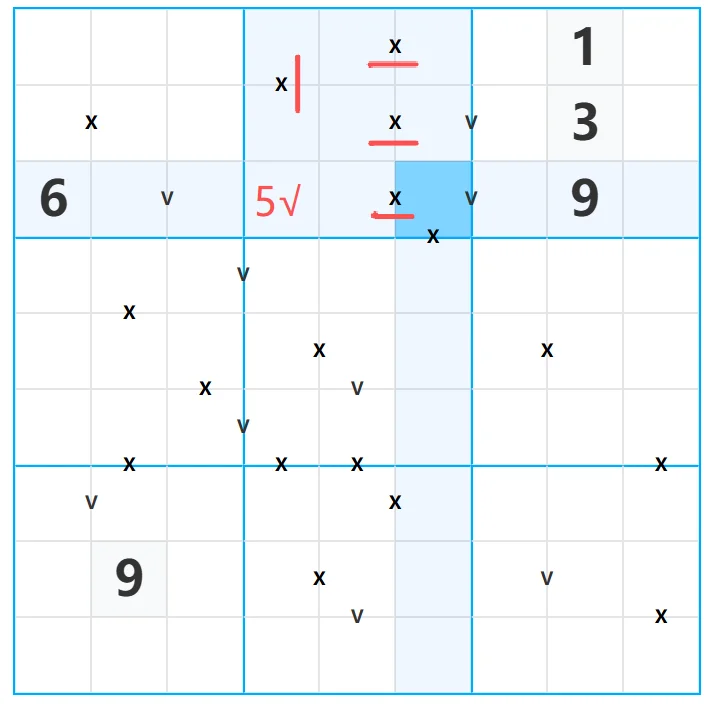
When a row, column, or box is almost fully covered by X or V pairs, stop scanning candidates and calculate. In a 6x6 grid, each row/column/box totals 21. Each X = 10 and each V = 5.
Example: A row contains two X marks and one V mark covering all six cells. Covered sum = 10 + 10 + 5 = 25, which is impossible, so such a configuration cannot occur. But if only some cells are covered, the remaining cells can be calculated as a forced placement.
4. Closed XV Loop
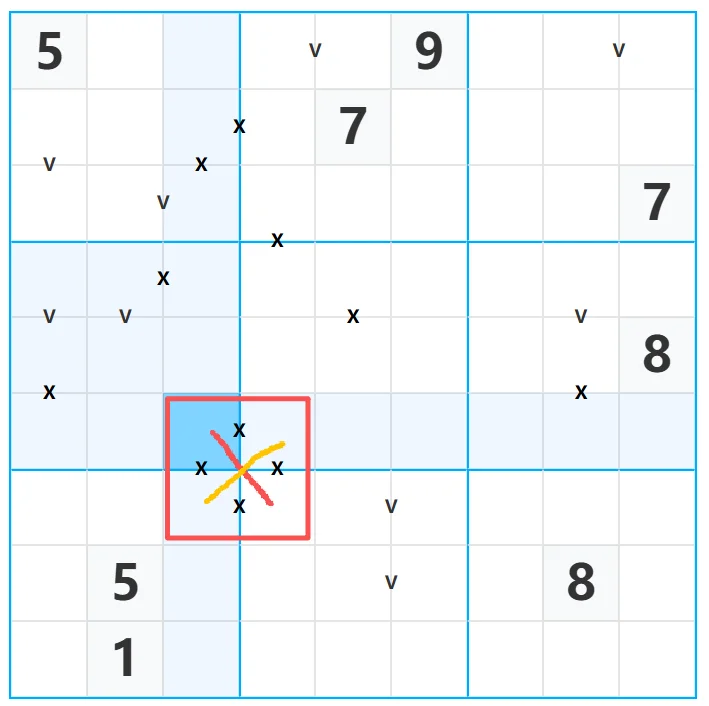
When four cells form a closed loop of X or V relationships, the arithmetic balances perfectly and opposite cells must be equal. Any candidate removed from one cell is removed from its diagonal partner. Once one cell is fixed, the whole loop collapses.
5. Same-Value Chain
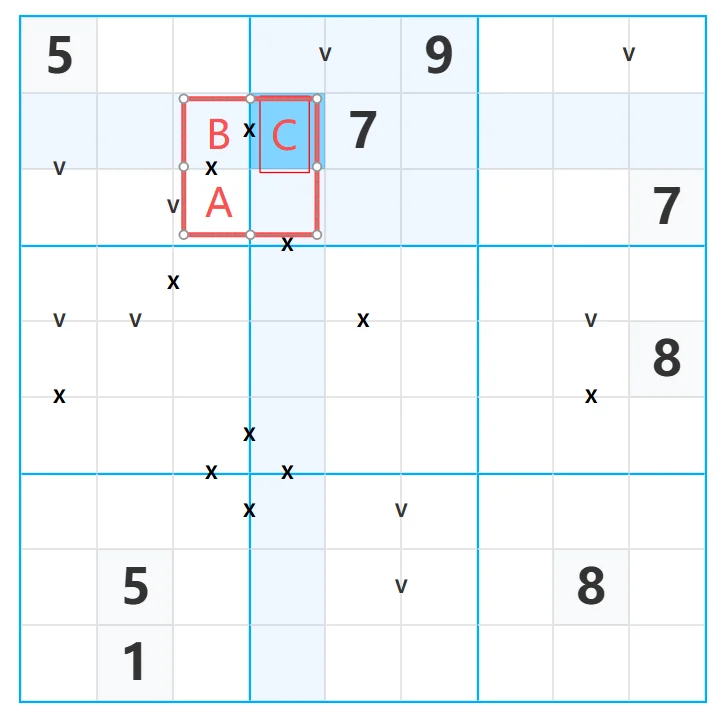
Consider the structure A -X/V- B and B -X/V- C. This forces A = C, and B is fully determined once either side is known. This is one of the most powerful XV patterns, even in a compact 6x6 grid.
6x6 XV Sudoku FAQs
Why is 6x6 XV Sudoku easier than 9x9?
The 6x6 grid uses digits 1-6, so there are far fewer possible pairs. X pairs collapse quickly, and the puzzle feels tighter and more tactical. It is a great warm-up before tackling the full 9x9 version.
Can an X pair be 5 and 5?
No. Digits cannot repeat in any row, column, or region, so an X pair can only be (4, 6) in a 6x6 grid.
Do unmarked adjacent cells really matter?
Yes. In XV Sudoku, the absence of an X or V is an active constraint: the pair cannot sum to 5 or 10. This quietly eliminates many low-high combinations early, especially in 6x6 grids.
What is the most common beginner mistake?
Ignoring missing marks. Many beginners only look at X and V symbols and forget that every unmarked adjacency forbids both sums.