
Play Diagonal Sudoku (X Sudoku) Online Free - Daily Logic Puzzle
More Sudoku Puzzles
What Is Diagonal Sudoku (X Sudoku)?
Diagonal Sudoku, also commonly called X Sudoku, is a Sudoku variant that adds two diagonal constraints to the classic Sudoku rules.
In addition to the standard row, column, and box rules: Both main diagonals must also contain each digit exactly once. The diagonals form an "X" shape across the grid — which is why this variant is widely known as X Sudoku.
Diagonal Sudoku does not introduce extra symbols or numbers. All difficulty comes from how diagonal constraints interact with standard Sudoku logic.
Tips for Solving Diagonal Sudoku (X Sudoku)
Diagonal Sudoku follows the same logic as classic Sudoku, but the two diagonal constraints fundamentally change how candidates interact. The tips below focus on how standard techniques behave differently once diagonals are active.
1. Diagonal Naked Single
This is often the first diagonal-specific placement you will make. While scanning the grid, you may find a cell on a diagonal where every number except one is eliminated by its row, its column, its box, and the diagonal itself.
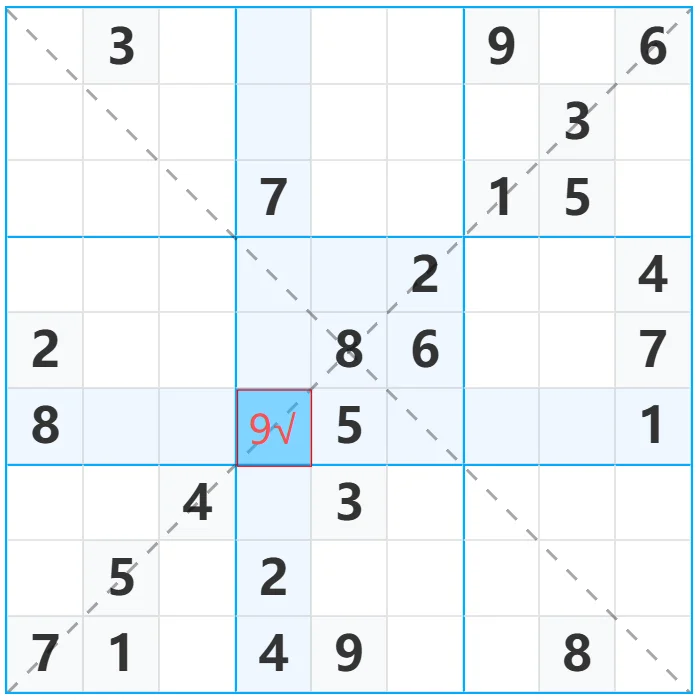
What makes this easy to miss is habit: many solvers finish checking rows and boxes before looking at diagonals. In Diagonal Sudoku, diagonals deserve equal priority.
2. Diagonal Hidden Single
Diagonal Hidden Singles are more subtle — and more important. This happens when a digit appears as a candidate in multiple cells of a row, column, or box, but only one of those cells lies on the diagonal.
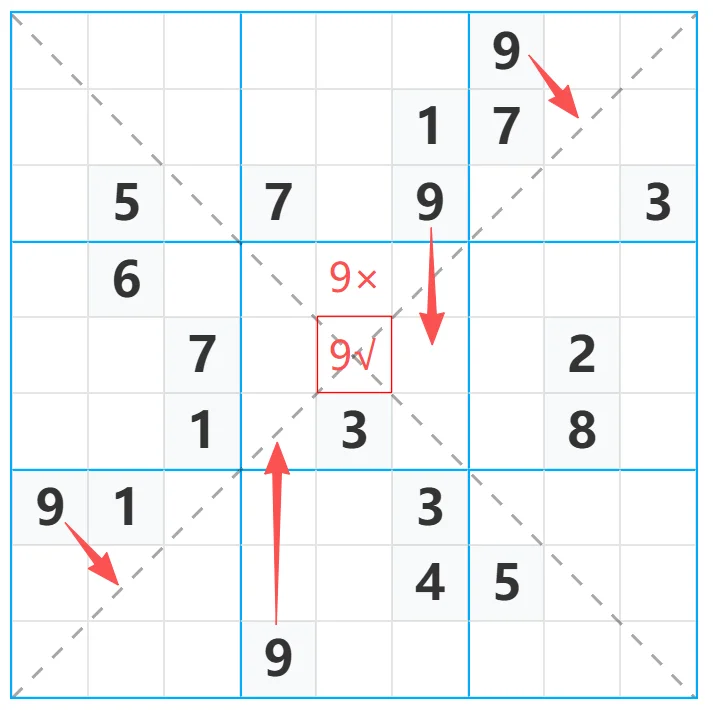
3. Diagonal Locked Candidate (Box–Diagonal Interaction)
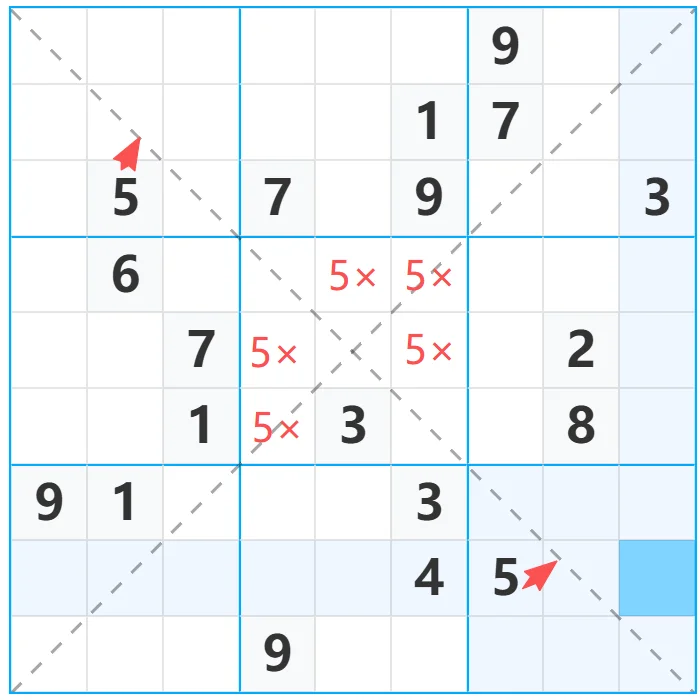
This is where Diagonal Sudoku starts to feel different from standard Sudoku. Sometimes, all possible placements of a number on a diagonal are confined to a single row, column, or box. When that happens, the diagonal behaves like a locking unit.
4. Diagonal Naked Pair
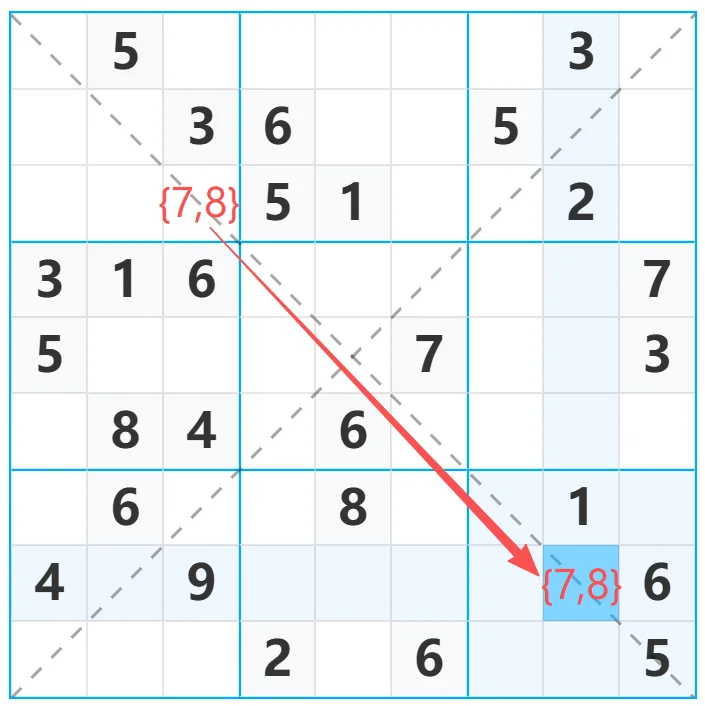
A Diagonal Naked Pair occurs when two diagonal cells contain the same two candidates, and nothing else.
5. Diagonal Hidden Pair
This is one of the most commonly overlooked techniques. A Diagonal Hidden Pair appears when two digits only appear in the same two diagonal cells, even though those cells may contain extra candidates. For example, if on the diagonal only cells A and B can contain {4, 6}, you can safely reduce both cells to {4, 6} even if A currently allows {1,4,6} and B allows {2,4,6}.
6. Diagonal vs Row / Column Tension
Not every diagonal deduction comes from clean patterns. Sometimes a diagonal wants a number in one area, but rows or columns nearby block most options. When you encounter that tension, pause and test the diagonal assumption logically: does it force repetition? Does it eliminate all candidates in a neighboring unit?
Common Beginner Mistakes
Forgetting to enforce diagonal uniqueness
Missing diagonal Hidden Singles
Treating diagonal digits as optional constraints
Ignoring diagonal pairs and groups
Most errors happen because players mentally downgrade diagonals compared to rows and boxes. Treat diagonals with equal priority to rows, columns, and boxes, and you will master Diagonal Sudoku in no time.