
Play Irregular Sudoku (Jigsaw Sudoku) Online Free - Daily Logic Puzzle
More Sudoku Puzzles
What Is Irregular Sudoku (Jigsaw Sudoku)?
Irregular Sudoku, also known as Jigsaw Sudoku, is a Sudoku variant where the familiar square boxes are replaced by irregularly shaped regions.
The core Sudoku rules remain unchanged:
Each row contains every digit exactly once
Each column contains every digit exactly once
Each irregular region contains every digit exactly once
What changes is how those regions are shaped — and how you must think about them. This variant is available in 4×4, 6×6, and 9×9 sizes, making it suitable for both beginners and advanced solvers.
What Makes Irregular Sudoku Different?
In standard Sudoku, box boundaries are predictable. In Irregular Sudoku, regions bend, stretch, and twist across the grid.
This creates two immediate effects:
Visual habits from standard Sudoku no longer work
Region-based logic becomes more important than box-based scanning
Experienced solvers often say Irregular Sudoku feels less mechanical and more logical, because every puzzle demands fresh interpretation.
Why Many Players Find It Hard at First
Most Sudoku players rely on muscle memory: scan boxes, fill easy singles, move box by box. Irregular Sudoku breaks that routine.
The biggest early challenges are:
Misidentifying region boundaries
Forgetting a cell belongs to a region that extends far away
Over-trusting box-like shapes that aren't actual regions
Once those habits are corrected, Irregular Sudoku becomes deeply satisfying.
Tips for Solving Irregular (Jigsaw) Sudoku
Irregular Sudoku looks harder than standard Sudoku mainly because the regions are unfamiliar. Once you stop treating regions as "weird boxes" and start comparing them directly with rows and columns, the logic becomes much clearer.
Most progress comes from spotting mismatches between a row (or column) and the irregular region it passes through.
1. Start with Regions That Have a Clear Shape
Not all irregular regions are equal. Some shapes immediately create strong row or column interactions, especially:
L-shaped regions
T-shaped regions
E-shaped regions
F-shaped regions
These shapes usually have one or more cells sticking out from the main body of the region. Those "extra" cells are where the best deductions happen.
Example 1: L-Shaped Region vs a Row
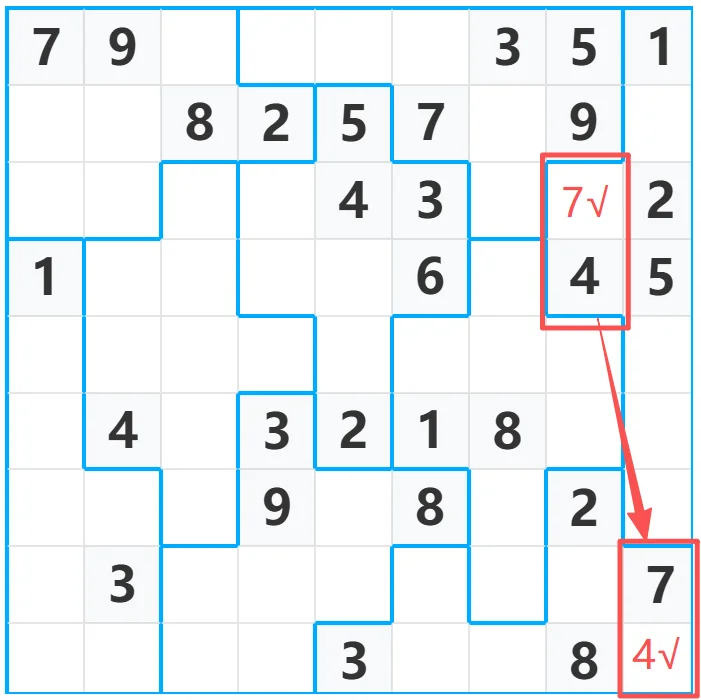
That sticking-out cell is not decoration — it carries information. A good habit is to mentally label cells as: shared cells (belong to both the row and the region), row-only cells, and region-only cells. Once you see that split, eliminations start to feel obvious.
Example 2: T-Shaped Region and a Column
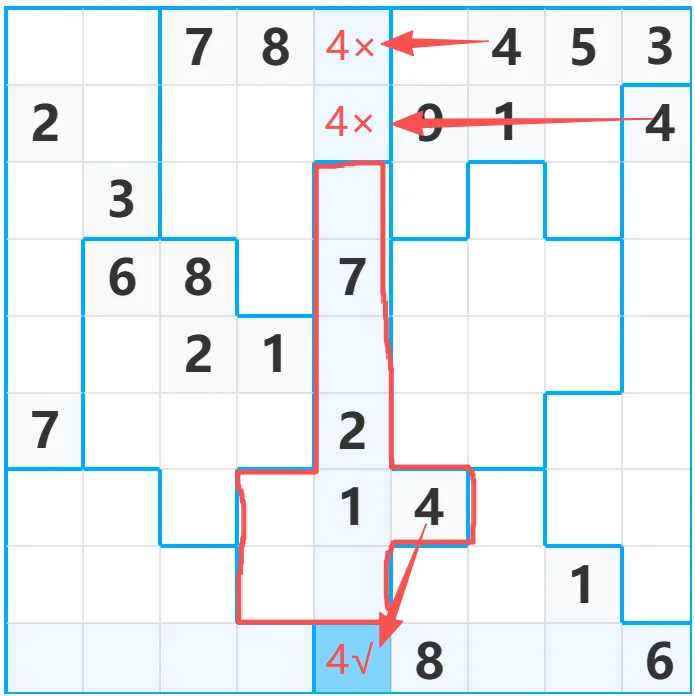
2. When Two Rows / Columns Compare with Two Regions
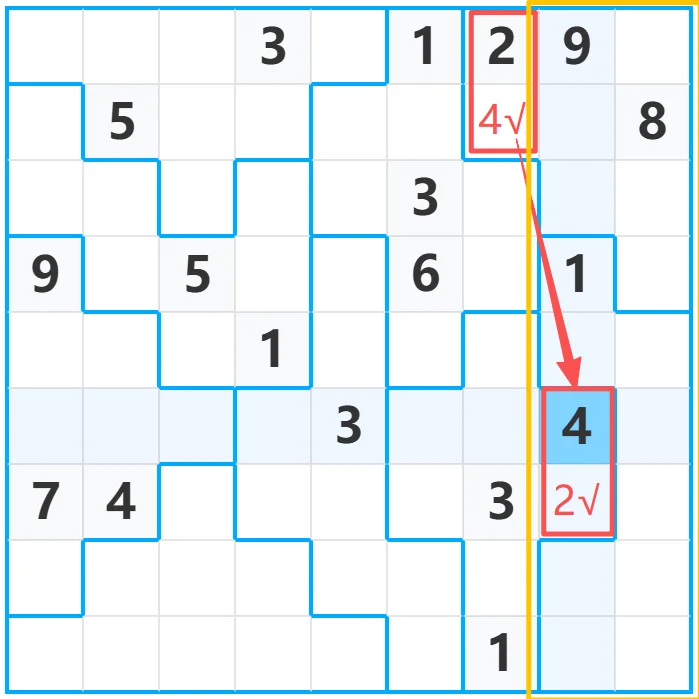
3. Scaling Up: Three or More Rows / Columns
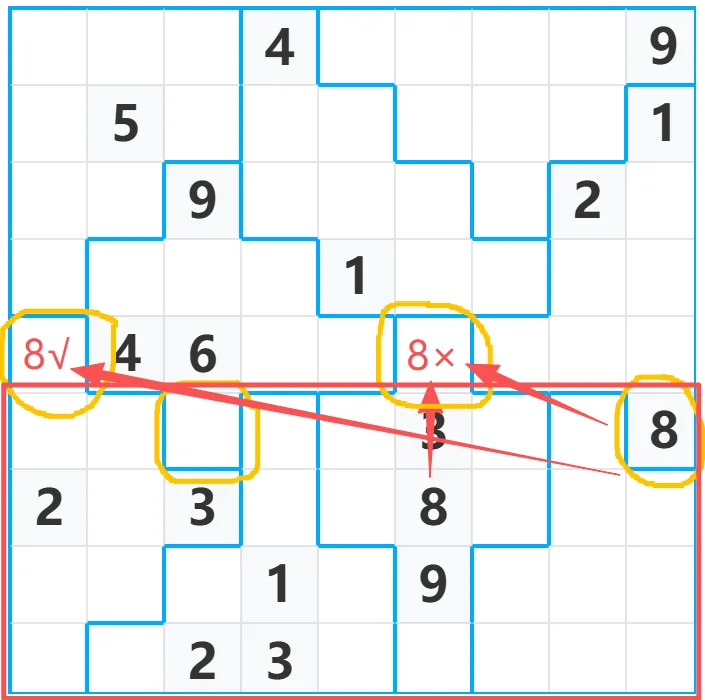
4. Columns Are Often Stronger Than Rows
Many solvers miss good moves because they only scan rows. Irregular regions often stretch vertically in cleaner ways than horizontally. If you are stuck, switch perspective: repeat the same comparison logic but apply it to columns instead. This alone solves a surprising number of "stuck" situations.
Irregular (Jigsaw) Sudoku FAQs
Why does Irregular Sudoku feel harder even when the grid is small?
Because your visual intuition breaks first. In standard Sudoku, your eyes instantly recognize 3×3 boxes. In Irregular Sudoku, the regions don't "read" as units at a glance, so many players miss deductions that are actually simple. The difficulty comes less from logic, and more from learning where to look.
Is Irregular Sudoku more about logic or pattern recognition?
Both — but pattern recognition matters more than people expect. Experienced solvers don't memorize region shapes. Instead, they quickly recognize where a row almost fully overlaps a region, or where a region almost fully overlaps a column. Those "almost" cases are where the strongest deductions appear.
Do standard Sudoku techniques still apply?
Yes — but they are rarely the main source of progress. Techniques like Naked Singles, Hidden Singles, and Pairs still work exactly the same way. However, most Irregular Sudoku puzzles are designed so that standard techniques alone will not finish the puzzle. The key progress usually comes from comparing rows, columns, and irregular regions.
Why do some regions feel much more important than others?
Because not all region shapes create the same constraints. Regions with clear protrusions (L, T, E, F shapes) interact more strongly with rows or columns. Compact or symmetrical regions often behave more like standard boxes and offer fewer unique deductions. Good solvers naturally focus on the "awkward" shapes first.
Is guessing ever required in Irregular Sudoku?
No. Well-constructed Irregular Sudoku puzzles are fully logical. If you feel forced to guess, it usually means a row–region interaction was missed, or you focused too much on one area of the grid. Stepping back and changing perspective often unlocks the next move.
Are columns or rows more important in Irregular Sudoku?
Often columns — but it depends on the region layout. Many irregular regions stretch vertically, making column-based deductions stronger than row-based ones. If you've exhausted rows, switching to columns is a reliable way to regain progress.
What's the single best habit to build for Irregular Sudoku?
Stop treating regions as isolated shapes. Always ask: "Which row or column does this region almost line up with?" That question alone solves more Irregular Sudoku puzzles than any named technique.