
6x6 Sudoku Online Free - Quick Logic Number Puzzle Game
More Sudoku Puzzles
What Is 6x6 Sudoku?
6x6 Sudoku is a medium-sized Sudoku grid designed to bridge the gap between beginner puzzles and the standard 9x9 Sudoku. It uses the numbers 1-6 and introduces rectangular 2x3 boxes, which require more careful attention to box structure and number interaction. This makes 6x6 Sudoku an ideal step for players who already understand the basic rules and want to improve their logical thinking.
6x6 Sudoku Rules
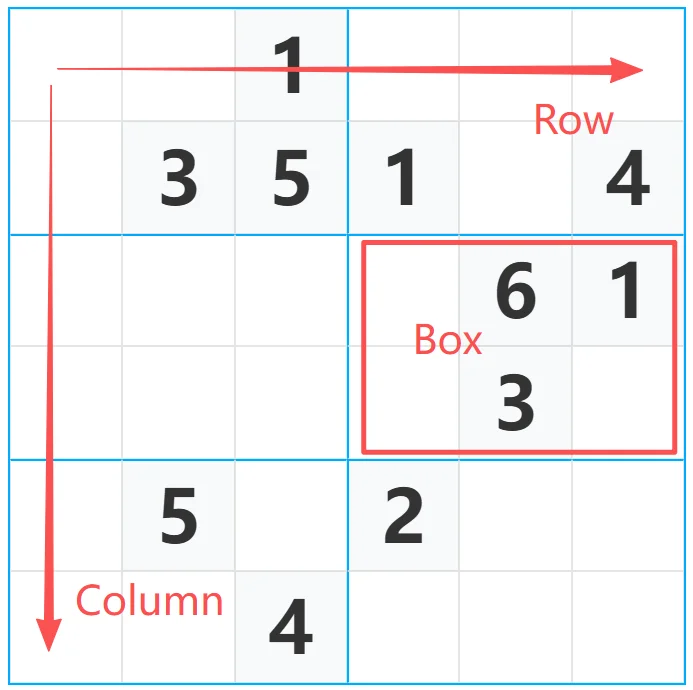
The core rules of 6x6 Sudoku are the same as all Sudoku puzzles:
Each row must contain numbers 1-6 exactly once
Each column must contain numbers 1-6 exactly once
Each 2x3 box must contain numbers 1-6 exactly once
The rectangular box shape is the main difference compared to smaller or larger grids and is what makes 6x6 Sudoku uniquely challenging.
Who Is 6x6 Sudoku For?
6x6 Sudoku is perfect for:
Players who can already solve 4x4 Sudoku
Sudoku beginners who find 9x9 too overwhelming
Players practicing box awareness and elimination skills
Anyone looking for a moderate but satisfying challenge
It offers more complexity than 4x4 without the mental load of a full 9x9 puzzle.
Tips for Solving 6x6 Sudoku
6x6 Sudoku sits between beginner and standard 9x9 puzzles. It introduces more interactions between rows, columns, and boxes, but it is still designed to be solved entirely with logic, not guessing. If you master the techniques below, you can solve any proper 6x6 Sudoku confidently and efficiently.
Tip 1: Start with Naked Singles (Last Digit Still Matters)
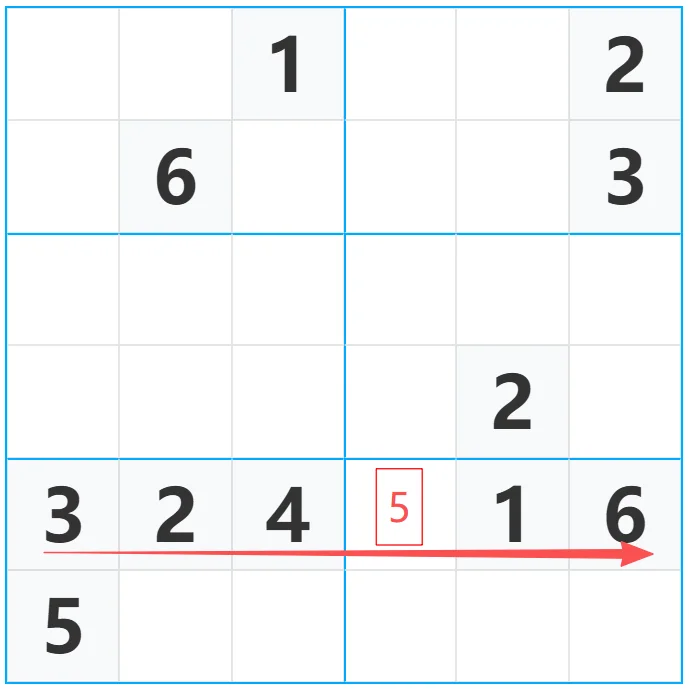
Even in 6x6 Sudoku, the simplest move is often the correct one. Look for rows with five numbers filled, columns with five numbers filled, or boxes (usually 2x3) missing only one number. This is known as a Naked Single, and experienced solvers never skip scanning for it - especially after every placement. In 6x6 puzzles, naked singles appear more often than people expect.
Tip 2: Use Systematic Elimination Before Placing Any Number
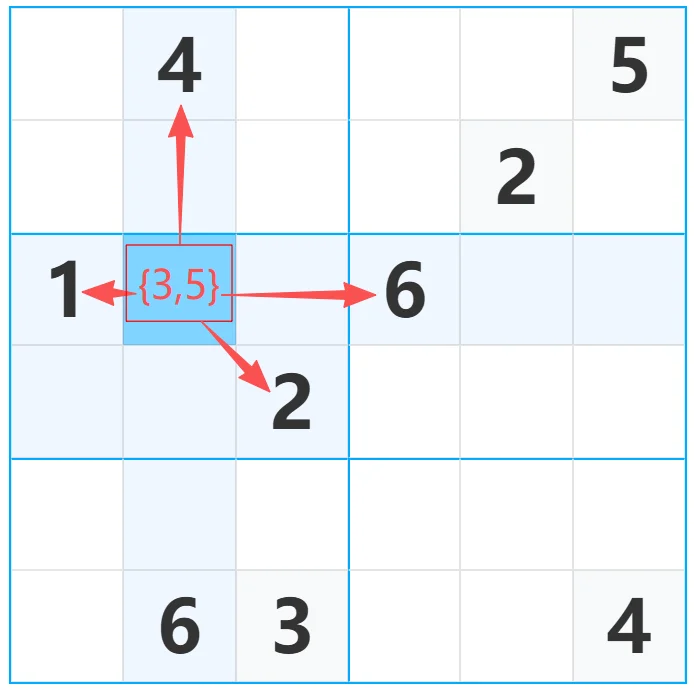
As the grid gets larger, elimination becomes more important than speed. Before placing a number, check: Is it already in the same row? Is it already in the same column? Is it already in the same box? This is basic candidate elimination, and it is the foundation for all higher-level Sudoku techniques.
Tip 3: Track Candidates Mentally (Early Candidate Awareness)
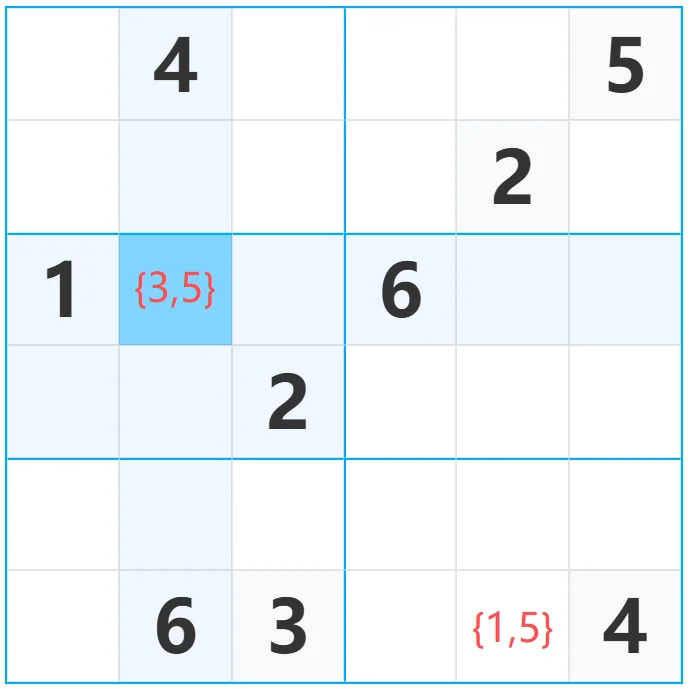
In 6x6 Sudoku, many cells will temporarily allow two or three possible numbers. Instead of guessing, mentally note: "This cell could be 3 or 5" or "That cell could be 1 or 5." You do not need full pencil marks for easy puzzles, but thinking in candidates prevents wrong placements. This habit prepares you naturally for 9x9 Sudoku later.
Tip 4: Use Box Scanning to Restrict Rows and Columns
Boxes in 6x6 Sudoku are larger than in 4x4, which makes box scanning especially powerful. Ask: "Where can this number go inside this box?" If a number can only appear in one row or one column within a box, that restriction affects the rest of the grid. This is a simple form of box-line interaction, and it unlocks many placements in 6x6 puzzles.
Tip 5: Watch for Naked Pairs (Your First Real Pattern)
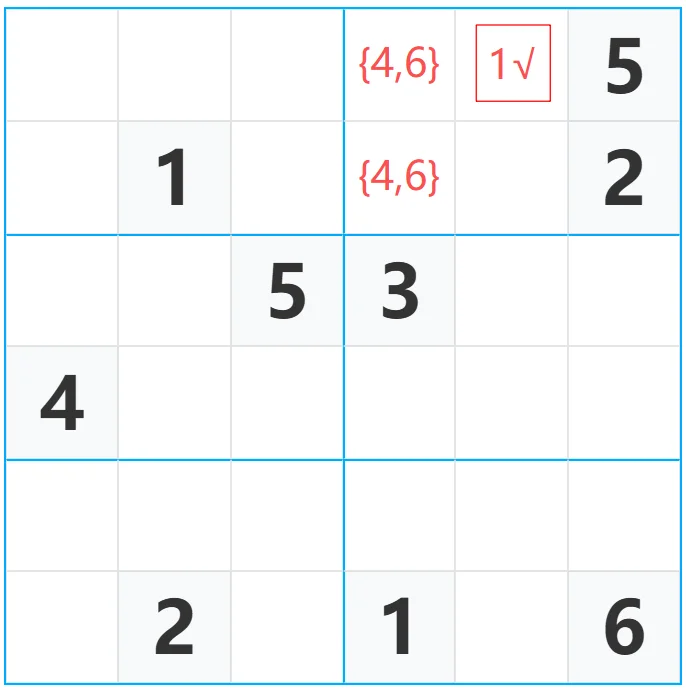
6x6 Sudoku is often the first size where Naked Pairs appear naturally. A Naked Pair occurs when two cells in the same row, column, or box share the same two candidates - and no other candidates. Those numbers cannot appear in any other cell in that unit. This technique does not place a number directly, but it eliminates possibilities, often creating new naked singles.
Tip 6: Use Row-Column Interaction to Break Stalemates
When progress slows, look at how rows and columns limit each other. If a number appears in only two columns of a row, and one of those columns is blocked elsewhere, the placement becomes forced. This type of interaction is subtle but very common in well-designed 6x6 puzzles. Most stuck moments are solved by rechecking interactions, not by guessing.
Tip 7: If You Feel Stuck, Re-scan - Do Not Guess
6x6 Sudoku puzzles are still meant to be purely logical. If you feel stuck: re-scan for new Naked Singles, recheck candidate eliminations, look for pairs you may have missed, and re-examine each box carefully. Guessing usually means a basic constraint was overlooked.
Final Advice: 6x6 Sudoku Teaches Structured Thinking
6x6 Sudoku is where many players first learn to think in candidates, use box-line interaction, and recognize simple patterns like pairs. If you can solve 6x6 Sudoku comfortably, stepping up to 9x9 Sudoku becomes much easier.
Why 6x6 Sudoku Helps You Improve
6x6 Sudoku strengthens skills that are essential for standard Sudoku: understanding non-square box layouts, managing more candidates per cell, and seeing how rows, columns, and boxes restrict each other. Players who master 6x6 Sudoku usually find 9x9 Sudoku much less intimidating.
Frequently Asked Questions
What is 6x6 Sudoku?
6x6 Sudoku is a smaller Sudoku variant played on a 6-by-6 grid using numbers 1 to 6. Each number must appear exactly once in every row, column, and box. Most 6x6 Sudoku puzzles use rectangular boxes, typically 2x3 or 3x2, instead of square boxes.
Is 6x6 Sudoku easier than 9x9 Sudoku?
Yes - but not in a trivial way. 6x6 Sudoku is often used as a bridge between beginner puzzles and standard 9x9 Sudoku. It requires more structured logic than 4x4 Sudoku, but avoids advanced techniques like X-Wing or Swordfish. Many players find 6x6 Sudoku easier to start, faster to finish, and better for learning candidate-based thinking.
Does 6x6 Sudoku require guessing?
No. Well-designed 6x6 Sudoku puzzles are fully solvable using logic alone. If you feel forced to guess, it usually means a Naked Single was missed, a candidate elimination was overlooked, or a pair or box interaction was not noticed. Guessing is a sign to slow down and re-scan, not to take a risk.
What techniques are needed for 6x6 Sudoku?
You typically need only foundational techniques: Naked Singles (Last Digit), Candidate Elimination, Box Scanning, Box-Line Interaction, and Naked Pairs. Advanced 9x9 techniques like X-Wing are not required for standard 6x6 puzzles.
How long does a 6x6 Sudoku puzzle take to solve?
For most players: Easy puzzles take 2-5 minutes, Medium puzzles 5-10 minutes, and Hard puzzles 10-15 minutes. The smaller grid keeps solving time manageable, even at higher difficulties.
Is 6x6 Sudoku good for beginners?
Very much so. 6x6 Sudoku is ideal for beginners who find 9x9 overwhelming, players transitioning from 4x4 Sudoku, and anyone practicing logic without long solving sessions. It teaches the same core skills as 9x9 Sudoku in a more approachable format.
Can I use pencil marks in 6x6 Sudoku?
Yes, and they are strongly recommended. Because 6x6 Sudoku often presents two- or three-candidate cells, pencil marks help avoid mistakes, spot naked pairs, and reduce mental load. They are especially useful when learning the puzzle type.
Try Other Sudoku Sizes
4x4 Sudoku - learn the basics
9x9 Sudoku - the classic full-size challenge