Learn how to play Sudoku step by step: the 3 rules, crosshatching, naked and hidden singles, pencil marks, and the mistakes that keep beginners stuck.
If you have ever stared at a Sudoku grid and wondered where to start, you are in good company. The grid looks like a math exam, and most guides assume you already know half of it. Here is the good news: the entire rulebook fits in three sentences, and the first hour of playing is mostly learning where to look, not what to think.
This guide walks through the rules once, properly, then builds a step-by-step solving routine you can use on your very first puzzle, and finishes with the technique ladder that takes you from easy grids to genuinely hard ones. By the end, you will know exactly what to do on the next 81-cell grid you meet — and what to do when you get stuck halfway through.
What Is Sudoku?
Sudoku is a logic puzzle played on a 9×9 grid. The grid contains 81 cells divided into nine 3×3 boxes. Some cells come pre-filled with digits — these are called givens — and they never change. Your job is to fill every empty cell with a digit from 1 to 9 so that the finished grid obeys one simple constraint.
That constraint produces 27 regions to satisfy: 9 rows, 9 columns, and 9 boxes. Every proper Sudoku has exactly one solution, and that solution can always be reached by logic alone. No guessing required, ever — that is a property of how well-formed puzzles are designed, not a marketing line.
One thing worth clearing up immediately: Sudoku is not a math puzzle. There is no arithmetic anywhere in it. You never add, subtract, or calculate anything. The digits 1 to 9 are just nine distinct symbols — swap them for nine colors or nine animals and the puzzle plays identically. If you can count to nine, you can play Sudoku. What you are actually training is elimination logic: removing impossible options until only one remains.
The 3 Sudoku Rules
The complete rulebook:
Row rule. Each of the 9 rows must contain the digits 1 through 9 exactly once.
Column rule. Each of the 9 columns must contain the digits 1 through 9 exactly once.
Box rule. Each of the nine 3×3 boxes must contain the digits 1 through 9 exactly once.
That is it. There is no fourth rule hiding somewhere.
Every cell sits at the intersection of exactly one row, one column, and one box. Solvers call any of these three regions a house, which means a 9×9 grid contains 27 houses, and the same rules apply to every one of them. The word matters more than it looks: when you later ask "where can the 7 go in this house?", you are using the single most productive question in beginner Sudoku.
A move is legal only when the digit you place appears nowhere else in its row, its column, or its box — all three at once. Beginners most often check two of the three and trip on the third, which is why the box rule deserves special attention even though it looks obvious on paper.
How to Solve Sudoku Step by Step: Your First Puzzle
Knowing the rules and knowing where to make your first move are two different skills. Here is a repeatable routine that works on nearly every easy puzzle.
Step 1: Sweep the grid for almost-complete houses. Before anything clever, look for any row, column, or box with eight of its nine cells filled. The empty cell must hold the one missing digit — a free placement, sometimes called a last free cell. Easy puzzles usually hand you two or three of these right at the start, and each one you place changes the grid around it.
Step 2: Pick the most frequent digit and crosshatch. Scan the grid for the digit that appears most often in the starting clues — say it is the 5. Now pick a box that is missing a 5. Every 5 already placed in a neighboring row or column "shoots a line" through that box, eliminating cells. If those lines eliminate every cell but one, the 5 goes there. Repeat this digit-by-digit sweep across the whole grid, and you will often place five to ten numbers without any advanced technique at all. This method is called crosshatching, and it is the workhorse of easy puzzles.
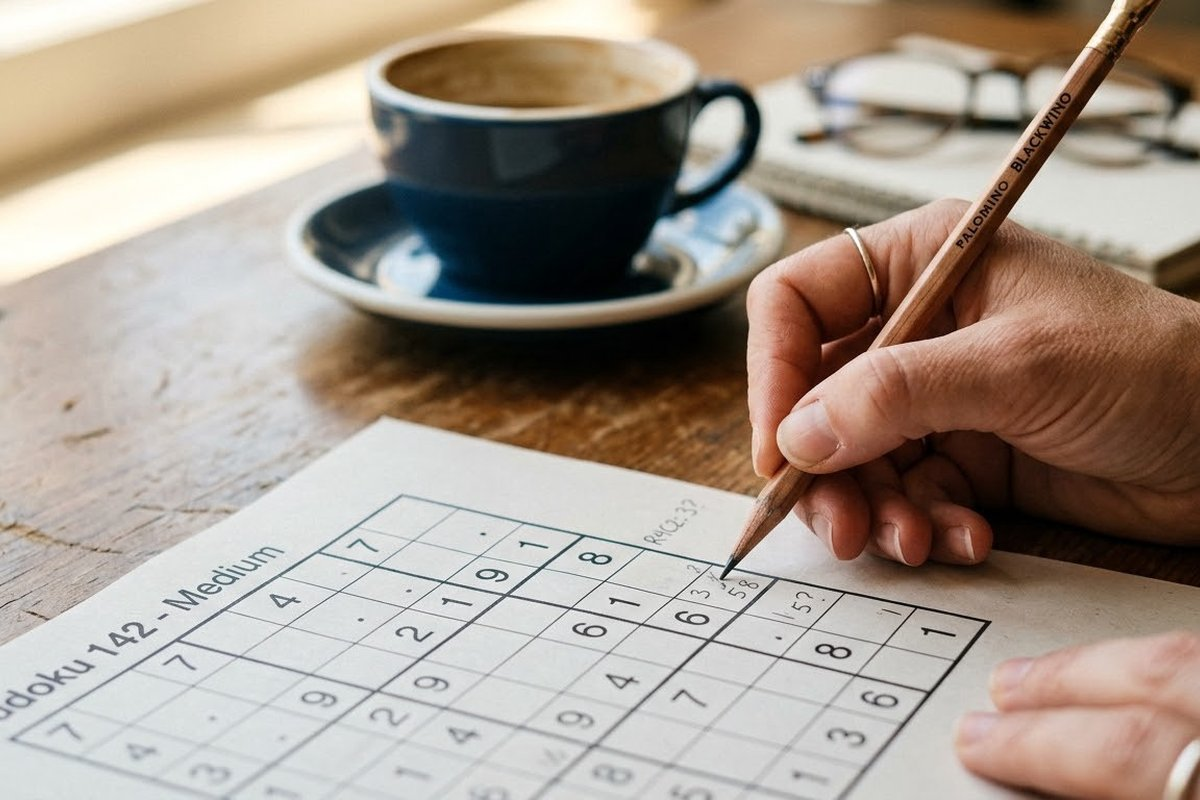
Step 3: Switch from reading digits to reading cells. When digit-sweeping stalls, flip your perspective. Pick an empty cell, look at its row, column, and box, and mentally cross off every digit that already appears in those three houses. If exactly one digit survives, the cell is solved — a naked single. Late in a puzzle these appear constantly, and they chain: each number you place blocks that digit in up to 20 other cells, frequently creating the next naked single immediately.
Step 4: Repeat the cycle until the grid is done. Almost-complete-house scan → digit sweep → cell reading → repeat. Every placement rewrites the possibilities around it, so progress in Sudoku is a cascade rather than a straight line. A cell that was impossible two moves ago often becomes trivial after you place a number on the other side of the grid.
That is the entire beginner workflow. If a move ever feels like it requires a coin flip, stop — a well-made puzzle never demands it, which means there is a deduction you have not spotted yet.
The Beginner Technique Ladder
Most guides list techniques in a random order. Learning them in difficulty order works better, because each level is enough to finish puzzles at its tier.
Level 1 — Last free cell and naked singles (easy puzzles). Everything from the step-by-step section above. At this level the grid hands you forced moves constantly, and crosshatching does the rest. Stay here until an easy puzzle takes you under ten minutes without hesitations.
Level 2 — Hidden singles (medium puzzles). Sometimes a cell shows two or three possible candidates, but one of those candidates can go nowhere else in its house. Ask: "where in this box can the 7 go?" If only one cell can legally hold the 7, the 7 goes there — even though that cell also has other candidates penciled in. Hidden singles are invisible from a cell's perspective and obvious from a digit's perspective, which is exactly why beginners miss them: they stop sweeping digits once they discover cell-reading. Both scans matter.

Level 3 — Pencil marks done right. When scanning stops producing moves entirely, start writing small candidate numbers in the corners of unsolved cells. Two rules keep them useful: mark after scanning has run dry, not before — a fully-annotated grid buries the obvious moves in noise — and update them immediately after every placement, because a stale pencil mark is worse than none. It lies to you. Most apps and sites have a notes mode that fills candidates and erases them as you play.
Level 4 — Pairs and pointing pairs (the gateway to hard puzzles). When two cells in the same house both hold the same two candidates and nothing else — a naked pair — those two digits are locked into those two cells in some order, so neither digit can appear anywhere else in that house. A related pattern, the pointing pair, occurs when a candidate inside a box can only sit in one row or column of that box: the digit is eliminated from that same row or column outside the box. Both moves rarely solve a cell directly, but they trigger eliminations that collapse other cells into naked singles. This is where Sudoku stops being a casual pastime and starts being genuinely interesting.
5 Beginner Mistakes That Ruin Grids
These five habits cause more stuck puzzles than any lack of technique:
Guessing. The most common error of all. A guess that works was luck; a guess that fails contaminates the grid, and you will not discover the damage until everything downstream stops making sense. If you feel the urge to guess, the correct move is always: re-scan.
Forgetting the box constraint. Beginners reliably check the row and the column and skip the 3×3 box. Many naked singles are only visible when all three houses are checked together.
Stale pencil marks. Notes you wrote five moves ago and never updated will confidently point you toward placements the grid no longer allows. Cross off candidates the moment a number is placed.
Tunnel vision on one region. Ten minutes in one stubborn box feels productive and usually is not. If a region stalls, sweep a different digit across the whole grid — progress elsewhere often unlocks the region you abandoned.
Jumping to expert difficulty too early. Expert grids hand you barely two dozen givens and expect chains of reasoning well beyond singles. The frustration there is not a skill problem; it is an ordering problem. Build speed and confidence on easy and medium first.>
Stuck on a Puzzle? The 4-Minute Rescue Routine
When a grid stops moving, run this checklist in order instead of staring:
Re-scan for singles. Sweep every digit 1–9 once for hidden singles, then read every empty cell for naked singles. Stuck puzzles almost always hide at least one missed single.
Audit your pencil marks. Look for any note that is now illegal — a candidate that appears in its own row, column, or box. Fix it, then check whether that creates a single.
Switch perspective. If you have been reading cells, sweep digits. If you have been sweeping digits, read cells. The two scans find different things.
Hunt for a pair. Check each house for two cells sharing the same two candidates. Eliminating that pair elsewhere frequently restarts the cascade.
If all four fail on a beginner-tier puzzle, you probably have an error somewhere earlier in the grid — check completed houses for duplicates. If it fails on a genuinely hard grid, the puzzle may simply require a technique you have not learned yet. That is a curriculum problem, not a personal one.
How Long Does It Take to Solve Sudoku?
There is no single answer, but realistic ranges look like this: a beginner on an easy puzzle takes roughly 15–30 minutes; a practiced solver finishes the same grid in 4–8 minutes. Medium puzzles run about 10–20 minutes at intermediate level, hard puzzles 20–45 minutes, and expert grids can exceed an hour. Difficulty matters less than familiarity with the technique ladder — a solver who knows hidden singles and pairs will beat a faster hand that does not.
If you want a concrete progression, this one works: spend your first week on easy puzzles using only scanning and singles, no notes. In week two, move to medium puzzles and allow pencil marks. From week three, add one medium and one harder puzzle per day and deliberately practice the technique you are worst at. Most people find easy grids routine within two or three weeks of daily play — and Sudoku's real payoff, the quiet focused half hour, starts long before you are fast.

FAQ
Is Sudoku a math puzzle?No. There is no arithmetic in Sudoku. The digits are symbols, and the puzzle is pure logic — it would play identically with letters or colors.
Can a number repeat in Sudoku?Not within a row, column, or box. Each of the 27 houses must contain 1 through 9 exactly once.
Is guessing allowed in Sudoku?Nothing stops you, but it is the weakest way to play. Every proper puzzle is solvable by logic alone, so a needed guess means a missed deduction.
Are pencil marks cheating?Not at all — they are standard equipment. Most strong solvers use notes on anything harder than easy. The only mistake is letting them go stale.
What difficulty should I start with?Easy. Those grids have more givens and can be solved with scanning and singles alone. Move up when easy puzzles stop feeling like puzzles.
Where can I practice these techniques?You can play free 9×9 Sudoku daily on iQiQGame, or start smaller with 6×6 Sudoku and 4×4 Sudoku for beginners before working up to variants like Killer Sudoku.