
Make 10 Solver - Free Online Make 10 Puzzle Solver
What Is Make 10?
Make 10 is a quick-fire number puzzle: you are given a handful of digits - classically four numbers from 1 to 10 - and your task is to combine every one of them, each used exactly once, with addition, subtraction, multiplication and division (plus parentheses) so the result is exactly 10. Given 5, 4, 8 and 2, for example, you can play 5 × 4 − 8 − 2 = 10.
It is the little sibling of the 24 game, but the smaller target changes the flavour completely. Ten is the base of our number system, so every hand is really a workout in number bonds - the pairs and clusters that add, subtract, multiply or divide their way to 10 (1+9, 2×5, 20÷2, 8−(−2)...). That makes Make 10 the perfect on-ramp to arithmetic puzzles: easy to start, yet still hiding monster hands like 1, 1, 5, 8, whose only solution runs straight through a fraction. This Make 10 solver handles both ends of that range.
Make 10 Rules
Use every number exactly once. All of the given numbers must appear in your expression, and none may be used twice.
Use any of the four operations. +, −, × and ÷ are allowed, in any order, grouped however you like with parentheses.
Intermediate values may be fractions. A step like 1 ÷ 5 is perfectly legal - and some hands depend on it.
Exact 10 wins. The final value must be exactly 10 - 9.9 does not count.
Classic digits. The standard game deals numbers from 1 to 10; this solver accepts any whole numbers from 1 to 99.
How to Use the Make 10 Solver
Choose how many digits. Tap 3 up to 6 - the classic game is 4.
Enter your numbers. Type each number into its cell (whole numbers from 1 to 99).
Press Solve. Every distinct way to make 10 appears instantly as a list of expressions, shortest ones first.
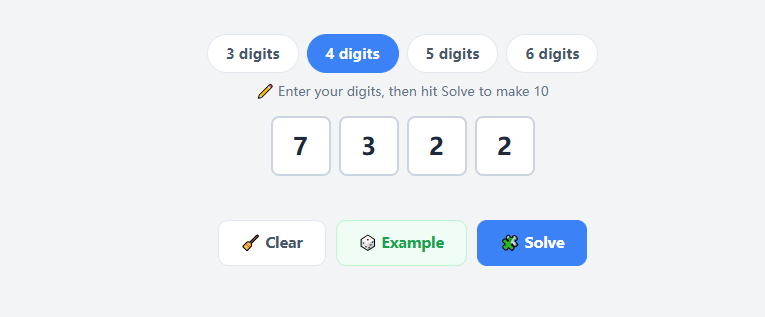
Read the solutions. Each line is a complete recipe, like (7 + 3) ÷ (2 ÷ 2) = 10. If there are more than 50 solutions, the shortest 50 are shown.
No solution? If the digits cannot reach 10, the solver says so outright - that is a proof, not a guess.
Reset or explore. Clear wipes the cells, and Example deals a random, guaranteed-solvable hand.
What the Solver Tells You
When solutions exist, they appear as ready-to-copy expressions, each verified to evaluate to exactly 10 using every number once. The notorious hand 1, 1, 5, 8 has exactly one solution - and it only works through a fraction:
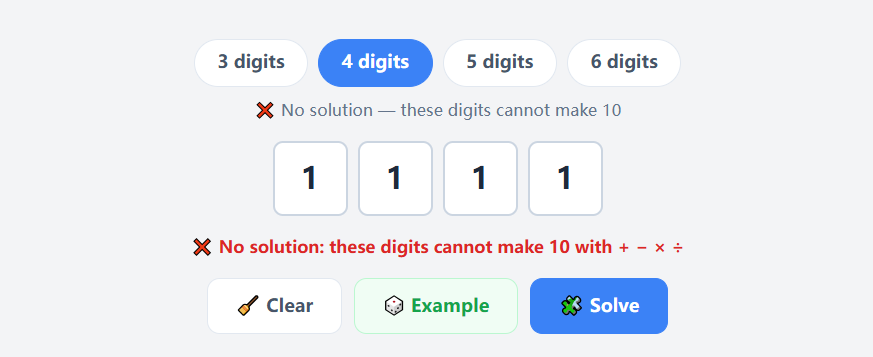
If a hand cannot reach 10, the solver says so immediately. Hands like 1, 1, 1, 1 can never get there - the very best they can produce is 2 - so recognising impossibility is part of the game:
How the Make 10 Solver Works
The solver runs the same pairwise reduction search that powers our 24 game solver: pick any two numbers, combine them with one of six operations (a+b, a×b, a−b, b−a, a÷b, b÷a), and repeat on the remaining list until a single number is left. If that number is 10, the trail of operations is a solution. Trying every pairing and every operation covers the whole game tree, so no answer can slip through.
All intermediate values are kept as exact fractions rather than decimals, so hands like 1, 1, 5, 8 - whose only route to 10 passes through four-fifths - are solved precisely. Equivalent branches are deduplicated (2+3 and 3+2 count once) and repeated states are pruned with memoisation, which keeps even six-digit hands down to milliseconds. Everything runs inside your browser, with no sign-up and nothing to install.
Worked Example: The Sneaky Hand 1, 1, 5, 8
Most Make 10 hands fall to simple number bonds. Then you meet 1, 1, 5, 8. The obvious tries collapse: 5+8 = 13 leaves nothing useful from 1 and 1; 8+1+1 = 10 leaves the 5 unused; 5×1×1×8 = 40; 8×5 = 40 needs ÷4, and 1 and 1 refuse to make 4. The single winning line divides by a fraction:
1 ÷ 5 = 1/5 - deliberately break a number into a fraction.
1 − 1/5 = 4/5 - the two 1s and the 5 condense into four-fifths.
8 ÷ 4/5 = 10 - dividing by four-fifths multiplies by five-quarters.
So the full answer is 8 ÷ (1 − 1 ÷ 5) = 10 - and the solver confirms it is the only solution. It is the Make 10 twin of the famous 24 game hand 3, 3, 8, 8: both teach the same lesson, that division is a way to build fractions, not just split integers.
Tips for Winning Make 10
Spray the number bonds first. Scan for the classic pairs to 10 - 1+9, 2+8, 3+7, 4+6, 5+5 - and for 2×5 and 20÷2. A large share of hands contain one directly.
Work backwards from 10. If three numbers can make 8, hunt for a 2 with the last one; if they can make 12, look for −2 or ÷... subtracting your way down is faster than poking forward.
Manufacture a 1 or a 0. a÷a makes 1 (multiply to keep a target intact) and a−a makes 0 (add it to discard an awkward number). Hands like 2, 2, 3, 7 become (7 + 3) ÷ (2 ÷ 2) = 10.
Two-group thinking. Split the digits into two clusters that produce 5 and 2 (multiply), 15 and 5 (divide), or 12 and 2 (subtract). Most four-number hands are really a two-number ending in disguise.
Fractions are legal moves. When integers stall, build 1/2 or 4/5 and divide by it - 8 ÷ (1 − 1 ÷ 5) is the canonical example.
Watch the extremes. Big digits want dividing (9 ÷ 3, 8 ÷ 4); lots of 1s are dead weight unless you can multiply them into a division trick. If the whole hand caps out below 10 - like 1, 1, 1, 1 - stop early: it is impossible.
Is Make 10 Good for Your Brain?
Make 10 trains the single most reused skill in mental arithmetic: number bonds to 10. Instant recall of 7+3 or 8−5 is the foundation of column addition, change-making and estimation, and this puzzle drills it inside a game instead of a worksheet. It also stretches flexible thinking - the same digits keep recombining into new pairs - and the fraction hands introduce multiplicative inverses (dividing by 4/5 is multiplying by 5/4) long before the classroom does. Because hands range from toddler-easy to genuinely sneaky, the whole family can play the same puzzle at different depths.
Frequently Asked Questions
What is Make 10?
A number puzzle where you combine the given digits - classically four numbers from 1 to 10 - with +, −, × and ÷ so that the result is exactly 10, using every number exactly once.
How is Make 10 different from the 24 game?
Identical rules, different target. Reaching 10 is generally easier than reaching 24, which makes Make 10 a friendlier starting point - but its hardest hands still require fraction tricks.
Can every hand of digits make 10?
No. Hands like 1, 1, 1, 1 top out below 10 and are provably impossible. A solver that can prove impossibility saves you from chasing dead ends.
Do you have to use all the numbers?
Yes - every given number appears exactly once in the expression. Dropping an awkward number does not count.
Are fractions allowed in Make 10?
Yes - intermediate values may be any fraction, as long as the final result is exactly 10. The hand 1, 1, 5, 8 cannot be solved any other way.
Can the solver handle more or fewer than 4 digits?
Yes - it accepts 3, 4, 5 or 6 numbers, so you can check homework hands or custom house rules.
What ages is Make 10 for?
Anyone comfortable with basic arithmetic. Kids practising number bonds love the direct addition hands, while adults get their challenge from the multiplication, division and fraction solutions.
Is this Make 10 solver free?
Completely free with no sign-up. Solving runs entirely in your browser after the page loads, so it even works offline.
Play Make 10 Online
Want to chase 10 against the clock? Play our free make 10 puzzle, level up with the 24 game solver, or explore more tools like the Sumplete Solver.