
24 Game Solver - Free Online 24 Points Solver
What Is the 24 Game?
The 24 game is a classic arithmetic card puzzle: you are given four numbers, and your task is to combine all of them - each used exactly once - with addition, subtraction, multiplication and division (plus parentheses) so that the final result is exactly 24. Given 4, 7, 8 and 8, for instance, you can play (7 − 4) × 8 × (8 ÷ 8) = 24 - the spare 8s are turned into a harmless 1. Every hand has its own twist, and that is the fun of it.
The game was popularised in 1988 by inventor Robert Sun as a classroom maths card game, and it has been a staple of maths competitions ever since. The number 24 is chosen on purpose: it is divisible by 1, 2, 3, 4, 6, 8 and 12, so it can be reached through a rich variety of factor pairs (1×24, 2×12, 3×8, 4×6) as well as countless sums and differences. Not every hand can be solved - and some that can require genuinely sneaky maths, which is exactly what this 24 game solver is for.
24 Game Rules
Use every number exactly once. All of the given numbers must appear in your expression, and none may be used twice.
Use any of the four operations. +, −, × and ÷ are allowed, in any order, with parentheses to group however you like.
Intermediate values may be fractions. Nothing forbids a step like 8 ÷ 3 - and some hands are impossible without it.
Exact 24 wins. The final value must be exactly 24 - not 24.5, not 'close enough'.
Classic deck. Traditional play uses cards valued 1-13 (Ace = 1, King = 13); simpler editions use 1-10. This solver accepts any whole numbers from 1 to 99.
How to Use the 24 Game Solver
Choose how many numbers. Tap 3 cards up to 6 cards - the classic game is 4.
Enter your numbers. Type each number into its cell (whole numbers from 1 to 99).
Press Solve. Every distinct way to make 24 appears instantly as a list of expressions, shortest ones first.
Read the solutions. Each line is a complete recipe, like (4 + 2) × (9 − 5) = 24. If there are more than 50 solutions, the shortest 50 are shown.
No solution? If the numbers cannot make 24, the solver says so directly - that is a guarantee, not a guess.
Reset or explore. Clear wipes the cells, and Example deals a random, guaranteed-solvable hand.
What the Solver Tells You
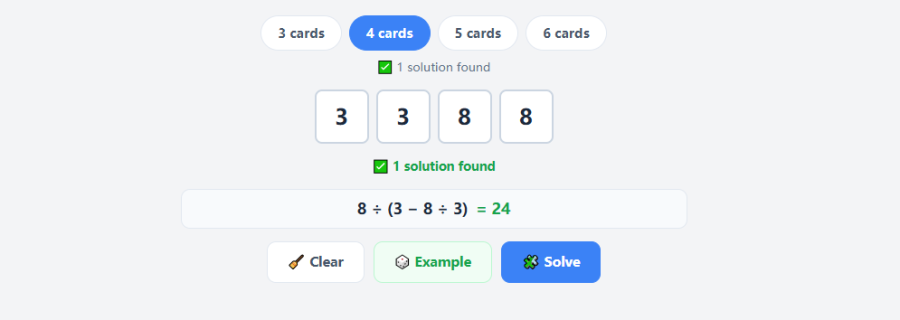
When solutions exist, they appear as a list of ready-to-copy expressions, each one verified to evaluate to exactly 24 using every number once. The famous hand 3, 3, 8, 8 has exactly one solution - and it requires fractions:
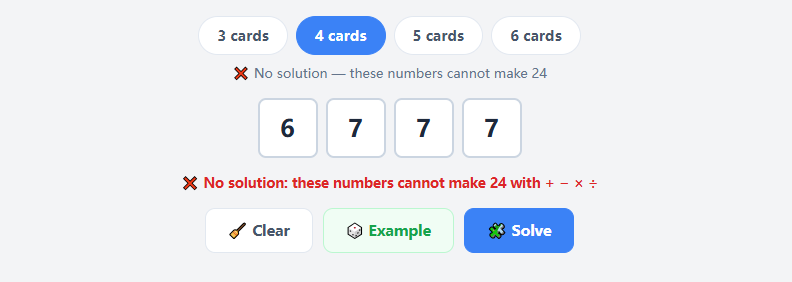
If a hand cannot reach 24, the solver says so immediately. Hands like 1, 1, 1, 1 simply cannot get there - the largest value they can ever produce is 2 - and no amount of trying will change that. Knowing a hand is impossible is just as valuable as knowing the answer:
How the 24 Game Solver Works
The solver uses a pairwise reduction search, the same strategy experienced players run mentally: pick any two of the numbers, combine them with one of six operations (a+b, a×b, a−b, b−a, a÷b, b÷a), and repeat on the remaining list until a single number is left. If that number is 24, the trail of operations is a solution. Exhaustively trying every pairing and every operation covers the entire game tree, so nothing is missed.
Two engineering details make the answers trustworthy. First, all intermediate values are stored as exact fractions, not decimals - so the hand 3, 3, 8, 8 is solved through one-third exactly, where a floating-point solver might round the wrong way and miss the only solution. Second, equivalent branches are deduplicated (2+3 and 3+2 are the same move) and repeated states are pruned, which keeps even six-number hands down to milliseconds - all inside your browser, with nothing to install.
Worked Example: The Famous 3, 3, 8, 8
The hand 3, 3, 8, 8 is legendary among 24 game players. Every ordinary attempt fails: 3×8 = 24 uses two numbers, but the remaining 3 and 8 refuse to make a 1 or a 0 to scale it back... or do they? There is no way to turn 3 and 8 into exactly 1, so multiplication alone never works. The escape route is division that lands on a fraction:
8 ÷ 3 = 8/3 - a deliberately awkward intermediate value.
3 − 8/3 = 1/3 - the two 3s and the second 8 combine into a tiny fraction.
8 ÷ 1/3 = 24 - dividing by one-third multiplies by 3.
So the full answer is 8 ÷ (3 − 8 ÷ 3) = 24 - and the solver confirms this is the only solution to the hand. It is the perfect illustration of why exact fractions matter: any solver (or player) that rounds 8÷3 to 2.67 loses the answer entirely.
Tips for Winning the 24 Game
Think in factor pairs of 24. Aim to split your numbers into two groups producing 3 and 8, 4 and 6, 2 and 12, or 1 and 24. Most solutions are two halves multiplied together.
Build from what 24 needs. If you can see 18 in three numbers, hunt for a way to make 6 with the rest... or make 25 and subtract 1, or 48 and halve it. Working backwards from nearby totals (20, 22, 25, 27, 48, 72) is faster than random probing.
Manufacture a 1 or a 0. a÷a makes 1 (multiply to keep a target intact) and a−a makes 0 (add it to discard an awkward number - as long as every number still gets used).
Fractions are legal moves. When integer play fails, try building 1/2, 1/3 or 2/3 and dividing by them - that is where hands like 3,3,8,8 hide.
Reduce the board early. Combine two numbers into something useful and simplify: solving 4 numbers is really solving a 2-number ending, so aim for a final act like a × b, a + b or a − b that lands on 24.
Memorise common endings. Patterns such as (a − b) × (c + d), a × b + c − d and (a + b) × c ÷ d cover a huge share of real hands - recognising them beats brute force.
Is the 24 Game Good for Your Brain?
Yes - it is mental arithmetic with a puzzle on top. The 24 game drills number sense (seeing 6 hiding inside 2 and 3, or inside 18 and 3), order of operations (parentheses become second nature), and working memory as you juggle which numbers are still on the table. Teachers use it from primary school upwards precisely because one hand contains easy wins and deep tricks at the same time, and the competitive "first to 24" format keeps practice fast and fun.
Frequently Asked Questions
What is the 24 game?
A maths puzzle in which you combine four given numbers with +, −, × and ÷ so that the result is exactly 24, using every number exactly once. It was popularised as a classroom card game in 1988.
Who invented the 24 game?
The modern card version was created by Robert Sun and launched in 1988. Similar "make a target number" puzzles had circulated for decades - a well-known variant appears in puzzle books from the 1960s - but the 4-numbers-make-24 format is his.
Can every set of 4 numbers make 24?
No. Hands like 1, 1, 1, 1 can never reach 24 no matter what you do. A meaningful share of random hands are unsolvable, which is why a solver that can prove impossibility is handy.
Do you have to use all four numbers?
Yes - in the standard rules every number is used exactly once. Using only three of them (like 3 × 8 from a hand containing 3, 8, 3, 8) does not count.
Are exponents or roots allowed?
In the classic rules, no - only +, −, ×, ÷ and parentheses. This solver follows the classic rules and finds every solution they allow.
Why is 3, 3, 8, 8 so hard?
Its only solution passes through a fraction: 8 ÷ (3 − 8 ÷ 3) = 24. Nearly every tempting integer path dead-ends, so players who avoid division rarely find it.
Can the solver handle more or fewer than 4 numbers?
Yes - it accepts 3, 4, 5 or 6 numbers, so you can check homework hands, harder variants, or custom house rules.
Is this 24 game solver free?
Completely free with no sign-up. Solving runs entirely in your browser after the page loads, so it even works offline.
Play the 24 Game Online
Ready to race the clock? Play our free 24 points game, sharpen up with our guide to 24 game strategies, or explore more tools like the Sumplete Solver.