
XV Sudoku Online Free - Play X & V Sum Clues Sudoku Puzzle Game
More Sudoku Puzzles
What Is XV Sudoku?
XV Sudoku is a Sudoku variant where some adjacent cells are marked with X or V:
X means the two cells must add up to 10
V means the two cells must add up to 5
Adjacent cells without any mark must not add up to 5 or 10
All standard Sudoku rules still apply: no repeated numbers in any row, column, or 3x3 region. The name comes from the Roman numerals: X = 10 and V = 5.
What makes XV Sudoku interesting is that the marks themselves carry information, even before any numbers are placed. You are often solving relationships first, and placing digits later.
This page supports 6x6 and 9x9 XV Sudoku, with an interactive play area, practical solving tips, and examples that focus on real grid progression rather than abstract theory.
Core XV Rules
| Mark | Meaning | Valid Pairs |
|---|---|---|
| V | Sum = 5 | (1,4), (2,3) |
| X | Sum = 10 | (1,9), (2,8), (3,7), (4,6) |
| No mark | Not 5 or 10 | All other pairs |
⚠️ Important: If there is no mark between two adjacent cells, then neither 5 nor 10 is allowed, even if the digits would otherwise fit.
Why 6x6 XV Sudoku Plays Very Differently
One reason 6x6 XV Sudoku often feels more approachable is hidden in the number system itself. In a 6x6 grid, the digits are 1-6. That means:
A V pair (sum = 5) can only be 1+4 or 2+3
An X pair (sum = 10) can only be 4+6
This has a huge impact on solving: X pairs collapse much faster, many candidates disappear instantly, and chains resolve with far less ambiguity. In contrast, 9x9 XV Sudoku allows many more X combinations, which makes deductions broader but slower. Neither is easier - they simply reward different kinds of thinking.
How to Solve XV Sudoku
1. XV-Pair Lock
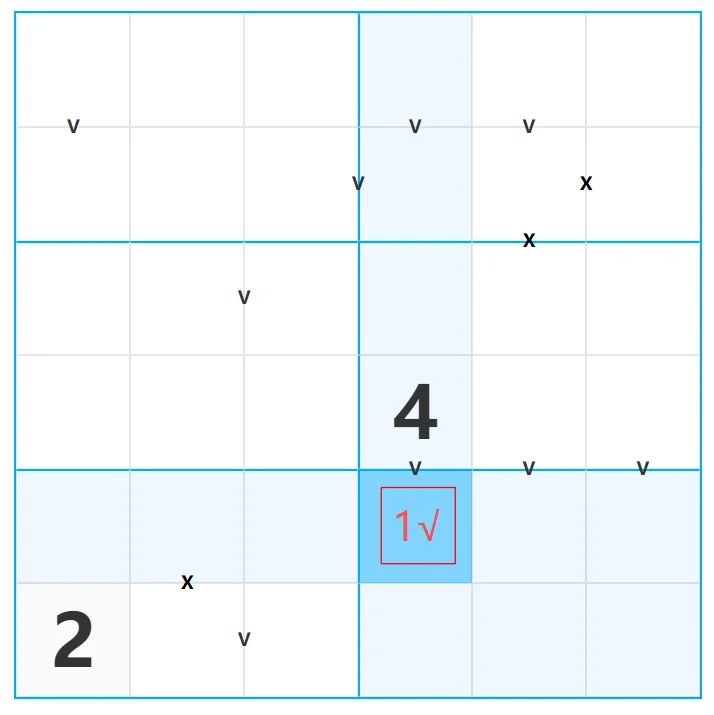
When two adjacent cells are connected by an X or V, they form a locked pair. If either cell is known, the other cell becomes immediately determined. This is the most basic - and most reliable - way XV Sudoku places numbers.
V example (sum = 5, 9x9): If a V-pair contains one cell = 1, the other must be 4; one cell = 2, the other must be 3; and so on. No other values are possible.
X example (sum = 10, 9x9): If an X-pair contains one cell = 6, the other must be 4; one cell = 7, the other must be 3; one cell = 8, the other must be 2; one cell = 9, the other must be 1.
The key mindset shift is this: you are not "solving a cell", you are resolving a relationship.
2. No-Mark Exclusion
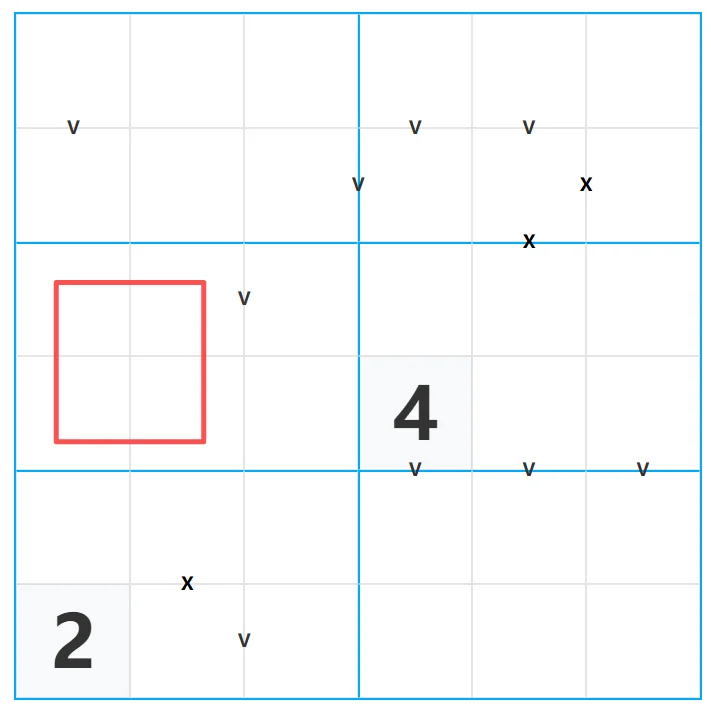
If two adjacent cells have no X and no V between them, that absence is real information: they cannot sum to 5, and they cannot sum to 10. This forbids common pairs like (1, 4), (2, 3), (1, 9), (2, 8), etc. When one cell later gets pushed toward low or high values, the neighbor is immediately restricted.
3. Almost-Full Region Totals
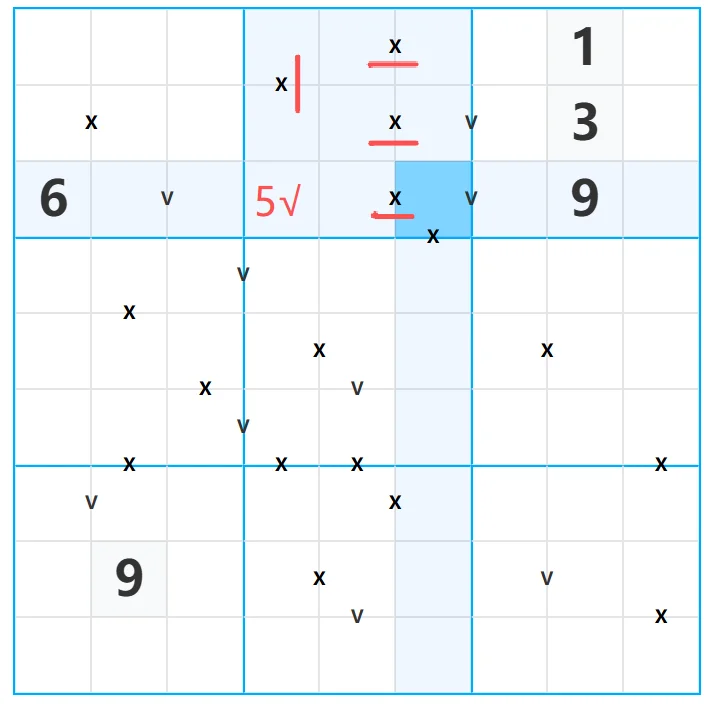
When a row, column, or box is almost fully covered by X or V pairs, stop scanning candidates and calculate. In a 9x9 grid, each row/column/box totals 45. Each X = 10 and each V = 5.
Example: A row contains four X marks covering eight cells. Covered sum = 40, so the remaining cell must be 5. This is a forced placement, not a guess.
4. Closed XV Loop
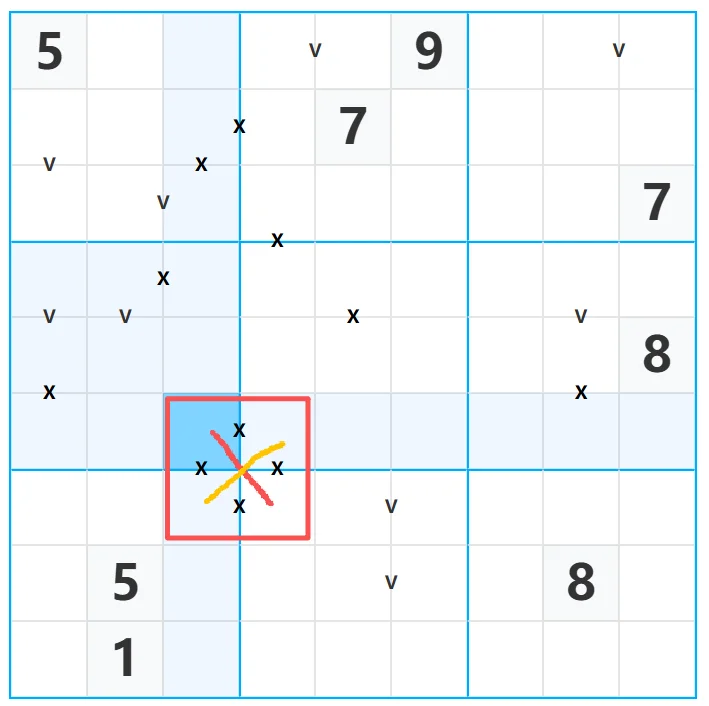
When four cells form a closed loop of X or V relationships, the arithmetic balances perfectly and opposite cells must be equal. This doesn't always place a digit immediately, but any candidate removed from one cell is removed from its diagonal partner. Once one cell is fixed, the whole loop collapses.
5. Same-Value Chain
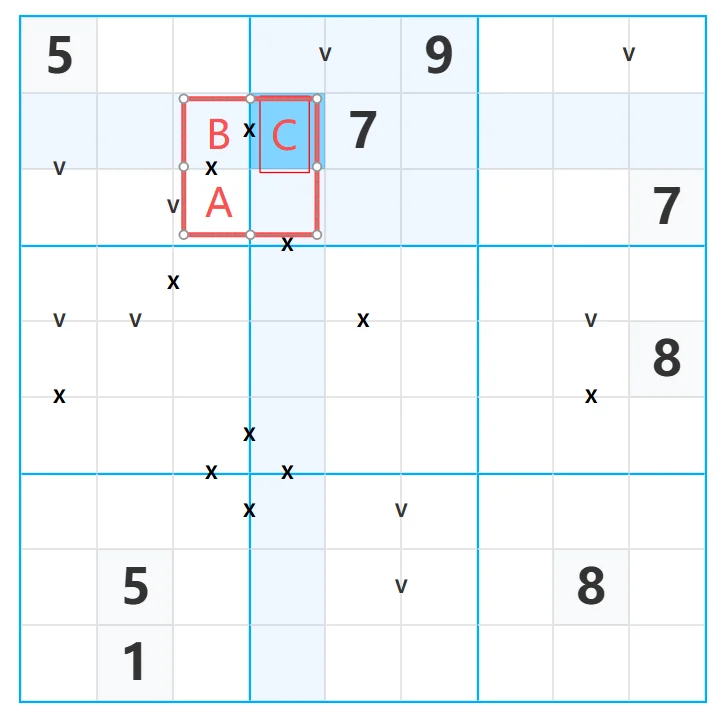
Consider the structure A -X/V- B and B -X/V- C. This forces A = C, and B is fully determined once either side is known. If A cannot take certain values due to row or box conflicts, C - even far away - loses those values too. This is one of the most unintuitive but powerful XV patterns.
6. Boxes Before Rows
Dense XV logic tends to form inside boxes first. If rows and columns feel stuck, switch to boxes and find the highest XV density. Very often, the next move is already waiting there.
XV Sudoku FAQs
What makes XV Sudoku different from Killer or Kropki Sudoku?
XV Sudoku uses sum constraints, not equality or ratio constraints. The absence of a mark is as important as the presence of one, which creates strong negative constraints early in the puzzle.
Are X and V the only allowed sums?
Yes. V = 5 and X = 10. No other sums are permitted, and no mark explicitly forbids those sums.
Do XV pairs allow repeated digits?
No. All standard Sudoku rules still apply - digits cannot repeat in any row, column, or region.
Do unmarked adjacent cells really matter that much?
Yes. In XV Sudoku, the absence of an X or V is an active constraint: the pair cannot sum to 5 or 10. This quietly eliminates many low-high combinations early, especially in 6x6 grids. Experienced solvers frequently start by scanning unmarked edges to shrink candidate ranges before touching any marked pairs.
Can an XV pair force a value immediately?
Only when combined with standard Sudoku restrictions. An X or V mark alone usually limits candidates, not values. A value becomes forced when one cell of the pair is already restricted by its row, column, or box, and only one complementary value remains for the partner.
What is the most common beginner mistake in XV Sudoku?
Ignoring missing marks. Many beginners only look at X and V symbols and forget that every unmarked adjacency forbids both sums. This leads to missed eliminations and the false impression that guessing is required.