
Play Arrow Sudoku Online Free - Sum-Based Number Puzzle Game
More Sudoku Puzzles
What Is Arrow Sudoku?
Arrow Sudoku is a popular Sudoku variant that adds a new constraint based on number sums. In addition to standard Sudoku rules — each row, column, and box must contain the digits exactly once — Arrow Sudoku introduces arrows drawn across the grid: a circle at the base of the arrow contains a number, and the digits along the arrow must sum to the number in the circle. This simple idea creates deep logical challenges and forces players to think about number combinations, not just placements.
Tips for Solving Arrow Sudoku
Arrow Sudoku does not reward guessing or number sense. Progress comes from understanding capacity and extremes: how many digits an arrow can physically contain, and where the largest and smallest digits cannot go.
1. Immediate Completion Rule
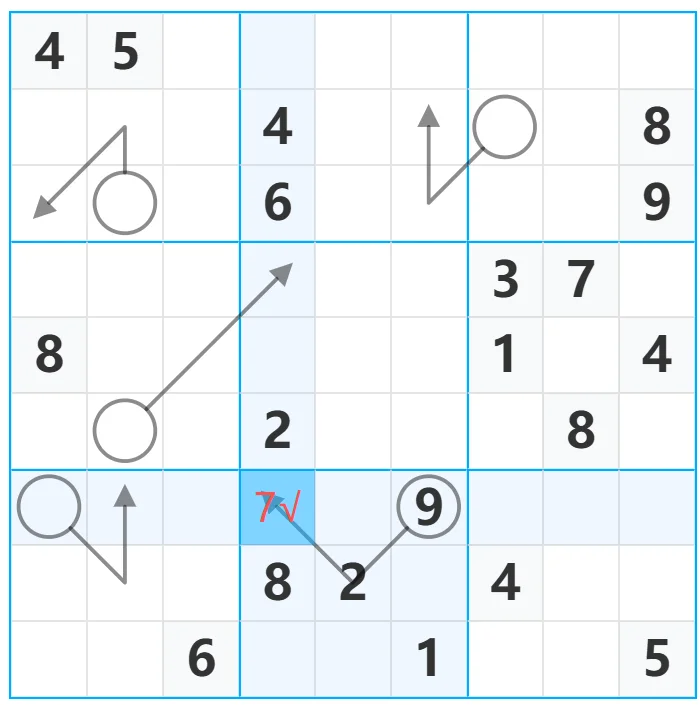
If an arrow (circle + arrow cells) has only one unfilled digit left, that digit can be placed immediately. This is the most basic and most overlooked Arrow Sudoku operation. For example: Circle = 9, arrow has two cells, one arrow cell is already 2 — the remaining arrow cell must be 7, because 2 + 7 = 9. Always scan arrows for near-completion before anything else.
2. Minimum Sum Capacity
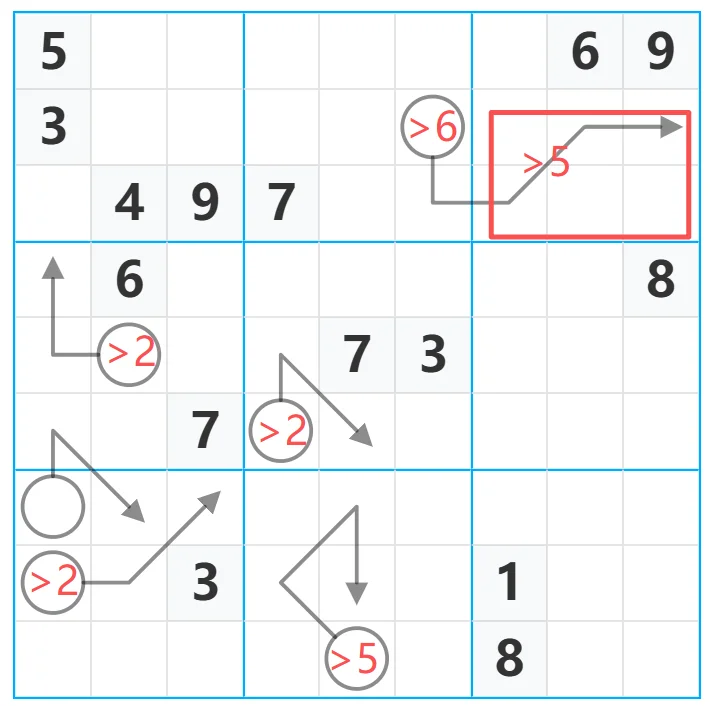
When all arrow cells lie in the same row, column, or box, digits cannot repeat. This gives a hard minimum for the circle value. For an arrow of length n in the same unit: Minimum sum = 1 + 2 + ... + n. Length 2 → minimum sum = 3, Length 3 → minimum sum = 6. If the circle value is smaller than this, the configuration is impossible — and any candidate placement causing that situation can be eliminated.
3. Maximum Digit Exclusion
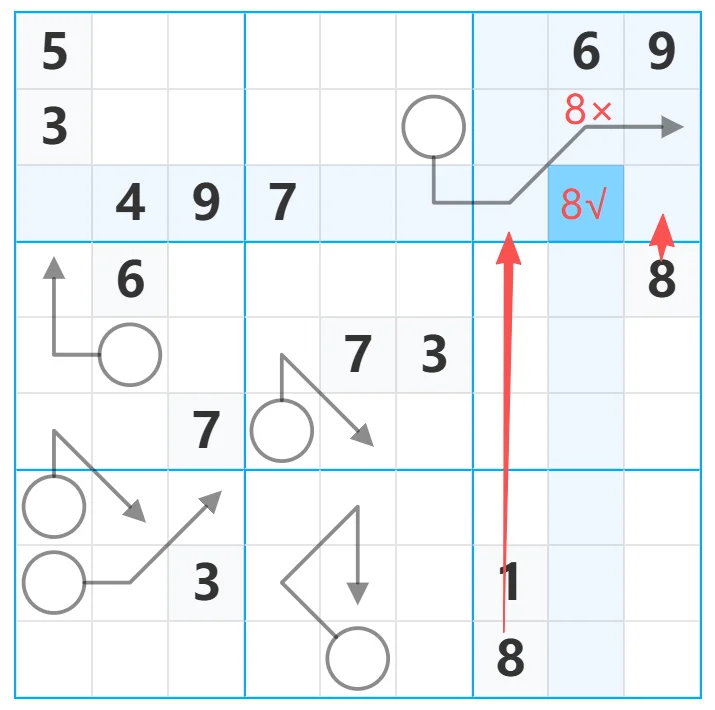
Large digits often cannot physically fit on an arrow, especially short ones. General rule: Length 2 → 9 cannot be on the arrow, Length 3 → 8 and 9 cannot be on the arrow, Length 4 → 7, 8, 9 cannot be on the arrow. If the arrow cells are also in the same unit, the restriction becomes even stronger. Key insight: The largest digits usually belong in the circle or elsewhere in the grid — not on short arrows.
4. Circle Digit Exclusion
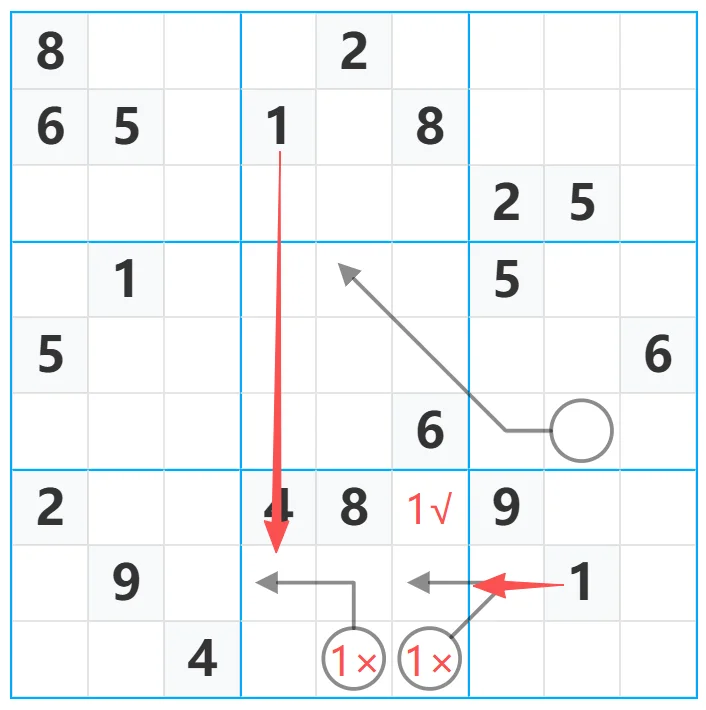
The circle represents the sum of at least two digits. Therefore: 1 can never appear in a circle. This simple fact is extremely powerful. In 6x6 grids, circles often collapse to 1 or 6 conflicts. In 9x9 grids, circles often collapse to 1 or 9 conflicts. Use this early to decide where extreme digits must go — on the arrow or outside it.
Common Beginner Mistakes
Including the circle number in the arrow sum
Forgetting that arrow digits may repeat unless Sudoku rules prevent it
Ignoring whether arrow cells share a row, column, or box
Ignoring arrow length when evaluating sums
Assuming all arrow sums behave the same way across grid sizes
Most errors come from misapplying standard Sudoku logic, not from arrow math.
Supported Grid Sizes
4x4 Arrow Sudoku — ideal for learning arrow logic
6x6 Arrow Sudoku — balanced difficulty, strong logical interactions
9x9 Arrow Sudoku — full-depth Arrow Sudoku experience
Frequently Asked Questions
Is Arrow Sudoku harder than standard Sudoku?
In most cases, yes. Arrow Sudoku adds sum constraints, which means you are often solving groups of cells together instead of one cell at a time. That said, Arrow Sudoku is not about harder arithmetic — it is about learning to think in ranges and combinations, which is a different skill from standard Sudoku.
Can I use standard Sudoku techniques in Arrow Sudoku?
Yes — and you absolutely should. Techniques like Naked Singles, Hidden Singles, and Pairs still apply. However, Arrow Sudoku often blocks progress unless arrow logic is used first. Think of arrow logic as unlocking the grid, and standard Sudoku techniques as cleaning it up.
Can arrow digits repeat?
Sometimes — but only when Sudoku rules allow it. Arrow cells may repeat digits if they do not share a row, a column, or a box. If all arrow cells lie inside one unit, repetition is impossible. This distinction is one of the most important things to check early.
Does the circle count as part of the sum?
No. The circle only shows the target value. Only the digits along the arrow path are added together. This may sound obvious, but miscounting the circle is a common beginner mistake.
Are Arrow Sudoku puzzles solvable without guessing?
Yes — properly designed Arrow Sudoku puzzles are fully logical. If you feel forced to guess, it usually means an arrow's length or sum range hasn't been fully used, or an interaction between arrows was overlooked.
Which grid size should I start with?
4x4: Best for learning how arrow sums work. 6x6: Ideal for building confidence with combinations. 9x9: Full Arrow Sudoku experience with deeper interactions. Starting small helps train sum intuition.
Is Arrow Sudoku more about math than logic?
Not really. The arithmetic involved is very simple. What makes Arrow Sudoku challenging is logical filtering, not calculation. You are rarely "adding numbers" — you are mostly eliminating impossibilities.