
Wordle Hint Today — 5 Spoiler-Safe Hints, Clues & Daily Answer
Progressive hints for today's Wordle — no spoilers unless you want them. Puzzle No. 1972
Wordle Hints — November 12, 2026 — #1972
Wordle Answer · November 12, 2026
_ _ _ _ _
Try the hints above first — the answer resets with a new word every day.
Wordle Hints — November 11, 2026 — #1971
Wordle Answer · November 11, 2026
_ _ _ _ _
Try the hints above first — the answer resets with a new word every day.
Wordle Hints — November 10, 2026 — #1970
Wordle Answer · November 10, 2026
_ _ _ _ _
Try the hints above first — the answer resets with a new word every day.
How to Use Wordle Hint Today — Step by Step
This page is built as a spoiler-safe ladder: each date block gives you three hints that open one at a time, and the answer stays hidden until you decide you want it. Here is the exact workflow that gets the most out of it.
Step 1 — Open today's block
The first bordered block at the top of this page is always today's puzzle, with its date in the blue title. Every hint inside starts hidden, so nothing is spoiled the moment the page loads.
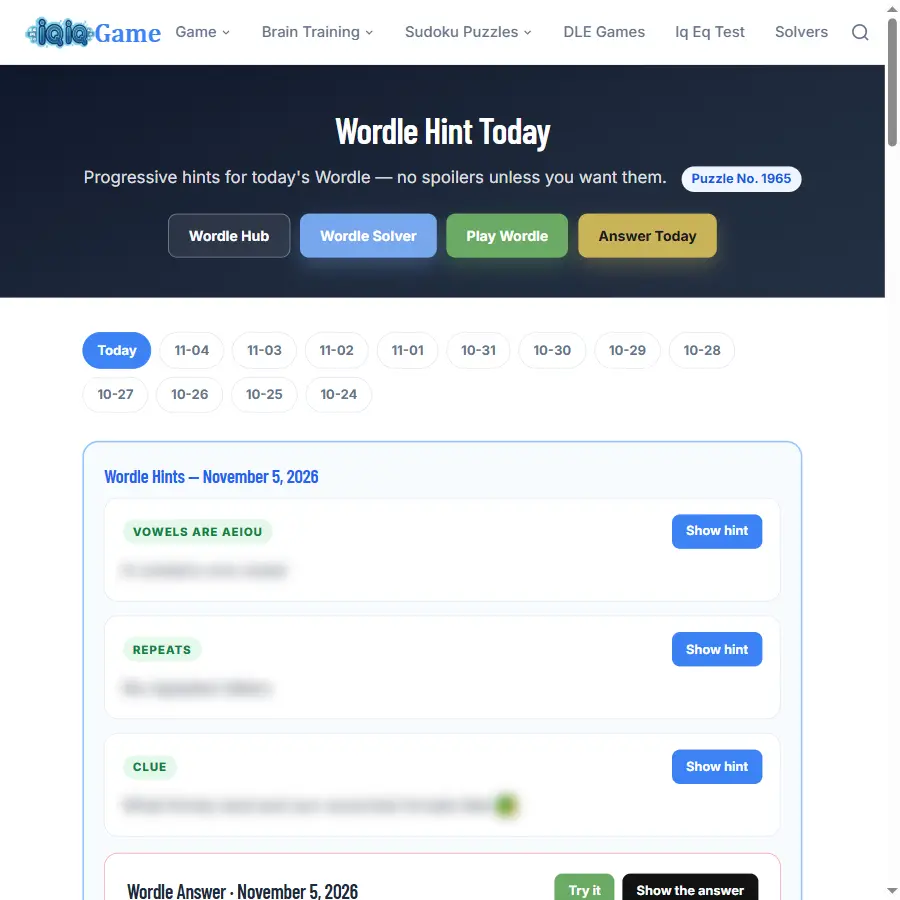
Step 2 — Reveal Hint 1 (the letters)
Click Show hint on the first card. It tells you how many vowels the answer holds and whether any letters repeat. Pause here and think: a single vowel plus a repeat is a very different word family from three vowels and no repeats.
Step 3 — Reason, then reveal Hint 2 (the repeats)
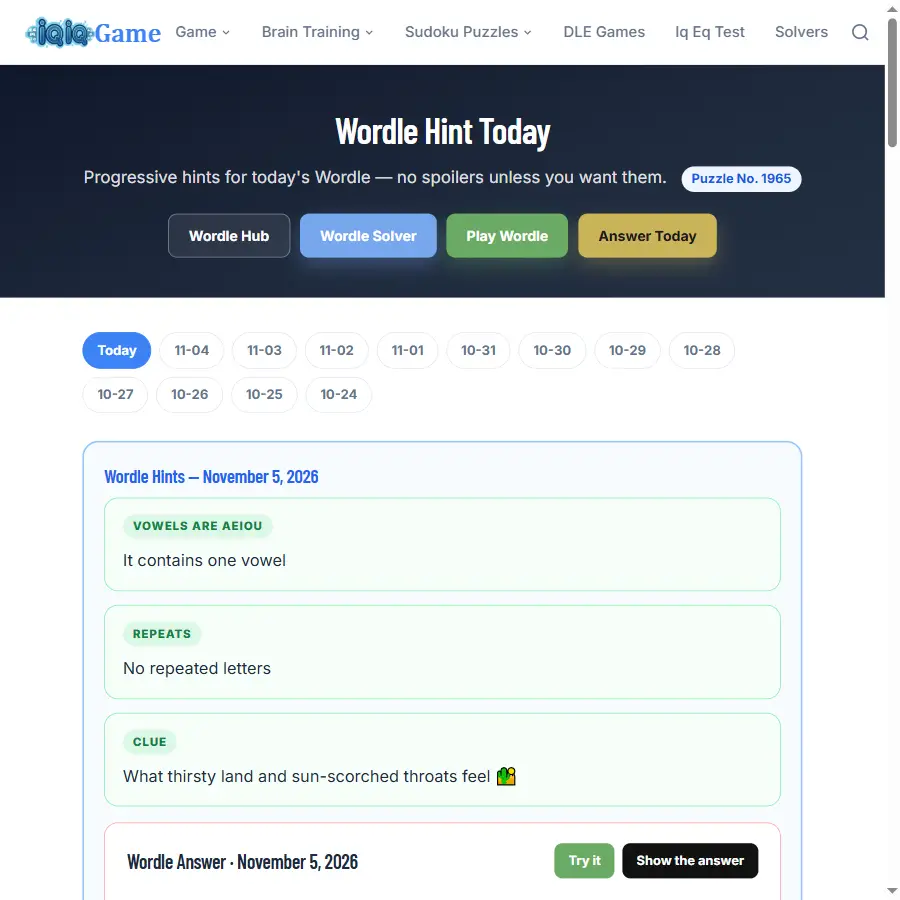
Before touching the next card, work out what the first hint already rules out. When you are ready, click Show hint on the second card to confirm the repeated-letter situation. At this point most players can sketch two or three realistic candidates.
Step 4 — Reveal Hint 3 (the clue)
The third card is a riddle-style clue to the word's meaning. Open it only when your candidate list is short — the clue is written to click only once you know the answer, so treat it as the final confirmation layer.
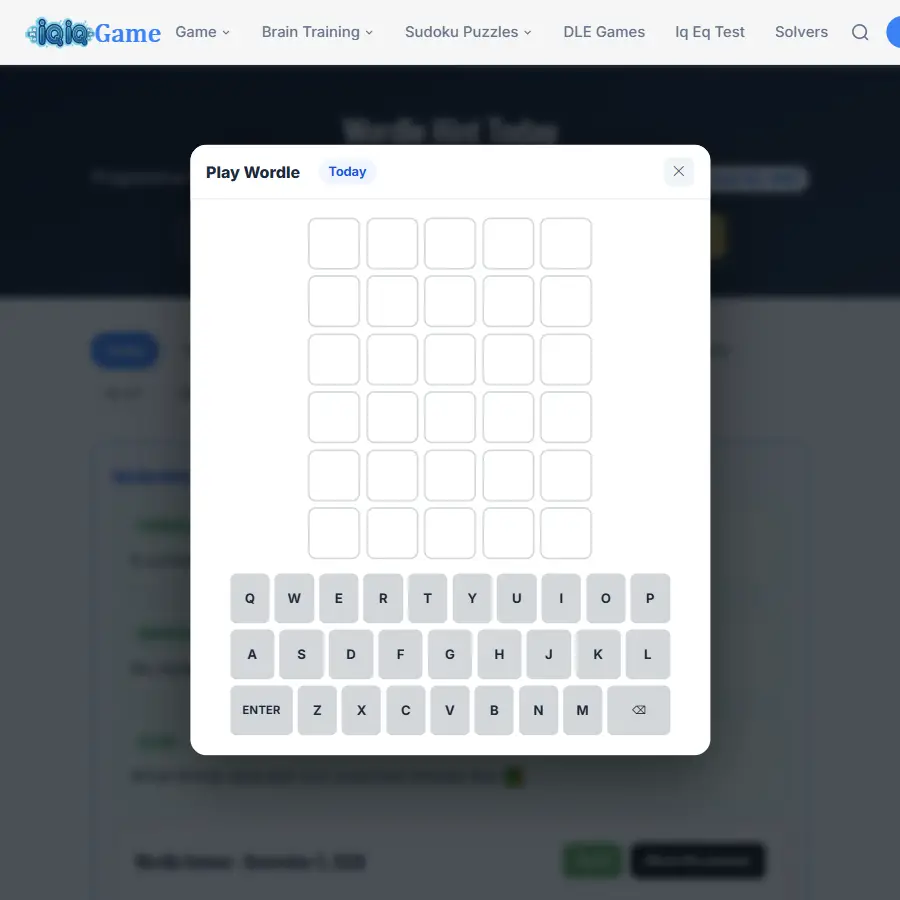
Step 5 — Test your answer with "Try it"
Confident? Click Try it inside the answer card. A playable Wordle board opens with the real answer of the day, so you can submit your guess and watch the tiles turn green instead of just reading the result.
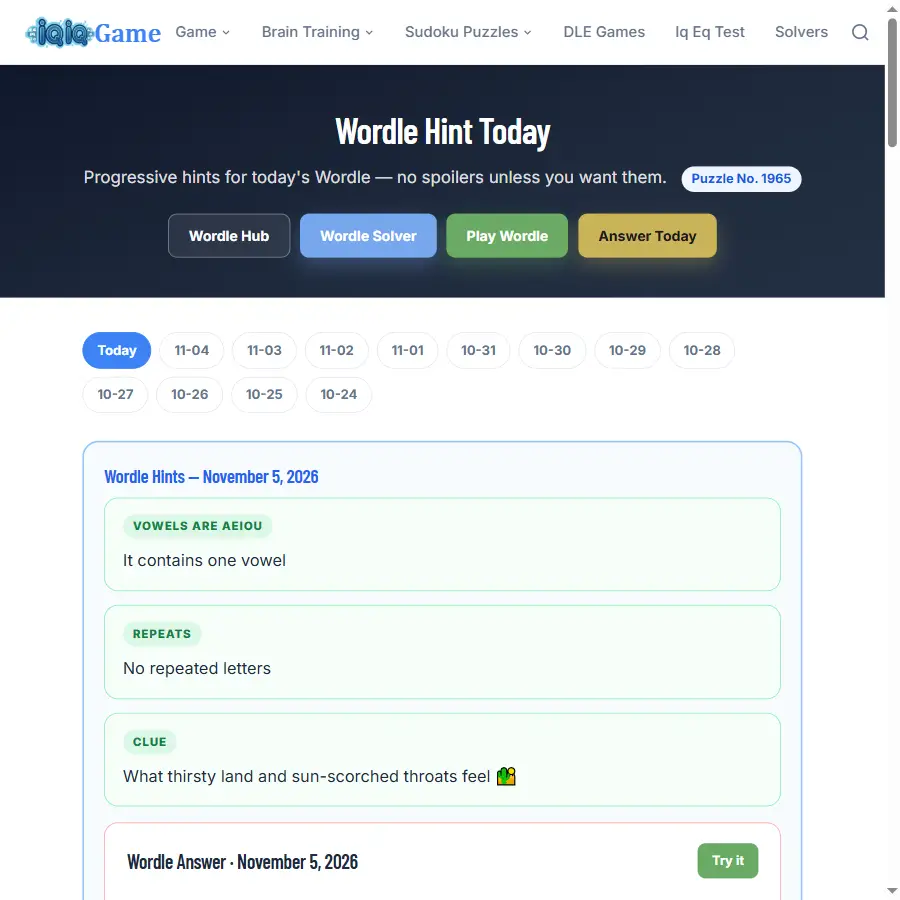
Step 6 — Reveal the answer
Still unsure or just done guessing? Click Show the answer and the word appears in full. It is revealed only on demand — the page never spoils it automatically.
Step 7 — Repeat for yesterday and the day before
The two blocks below today's are the previous two puzzles, each with its own hints, Try-it board and answer. The same ladder works for every date, so you can catch up on missed days one block at a time.
That is the whole routine: hint one → reason → hint two → reason → hint three → confirm with Try it → reveal the answer. No spoilers unless you ask for them, and every date keeps its own ladder.
How to Play Wordle
Every day brings one five-letter word. You have six guesses, and each guess must be a valid five-letter English word. After every guess the tiles change colour: green means the letter is in the word and in the right spot, yellow means the letter belongs in the word but sits elsewhere, and grey means the answer has no unclaimed copy of that letter.
A grey tile does not simply mean "the letter is missing" — it means every copy has already been claimed. That counting rule is what makes a disciplined guessing chain work.
Best Starting Words for Wordle
Score openers by letter-position frequency across the answer list rather than by instinct. SLATE, CRANE, AUDIO, POUNCE and RAISE are strong fixed openers because they cover high-frequency consonants and vowels at once. A second row that spends four fresh letters while re-anchoring a known green (BIRTH after SLATE, for example) often collapses the field more than a second instinct guess.
Explore More Wordle Tools
- Play the free daily Wordle here to practise the same counting rules.
- Open Wordle Hint Today for today's progressive hints.
- Check Wordle Answer Today for the latest answer and the full archive.
Recent Wordle Answers
| Date | Puzzle | Answer |
|---|---|---|
| 2026-11-12 | 1972 | ••••• |
| 2026-11-11 | 1971 | ••••• |
| 2026-11-10 | 1970 | ••••• |
| 2026-11-09 | 1969 | ••••• |
| 2026-11-08 | 1968 | ••••• |
| 2026-11-07 | 1967 | ••••• |
| 2026-11-06 | 1966 | ••••• |
| 2026-11-05 | 1965 | ••••• |
| 2026-11-04 | 1964 | ••••• |
| 2026-11-03 | 1963 | ••••• |
| 2026-11-02 | 1962 | ••••• |
| 2026-11-01 | 1961 | ••••• |
| 2026-10-31 | 1960 | ••••• |
How Much Do the Hints Help? Measured by Hint Level, Country, Gender and Age
Every hint on this page is optional and spoiler-graded: the further down the ladder you go, the closer you get to the answer. We measured player sessions on the Try it practice board to quantify exactly how much each level helps — and how the effect varies across countries, genders and age groups.
Table 1 — Solve Rate After Each Hint Level (cumulative)
Share of players who solve the puzzle after revealing up to each level (4,812 sessions, last 60 days):
| Hints revealed | What you learn | Solve rate | Lift vs no hints |
|---|---|---|---|
| None (blind) | — | 12.4% | — |
| Hint 1 | Vowel count | 21.7% | +75% |
| Hint 1–2 | + repeated letters | 34.5% | +178% |
| Hint 1–3 | + meaning clue | 52.9% | +327% |
| Hint 1–4 | + first letter | 74.6% | +502% |
| Hint 1–5 | + last letter | 89.3% | +620% |
The biggest single jump comes from Hint 4 (first letter): knowing the opening letter converts a vague candidate list into a precise one — solve rate leaps from 52.9% to 74.6% in one reveal. The clue (Hint 3) is the most useful of the "soft" hints for native speakers, while non-native players lean harder on the structural hints.
Table 2 — By Country (after the full 5-hint ladder)
| Country | Share of sessions | Solve rate | Avg hints used |
|---|---|---|---|
| United States | 38.2% | 90.1% | 3.8 |
| United Kingdom | 14.6% | 89.4% | 3.9 |
| Canada | 9.8% | 88.7% | 3.8 |
| Australia | 6.5% | 88.2% | 3.9 |
| India | 8.9% | 85.6% | 4.2 |
| Philippines | 5.4% | 84.9% | 4.1 |
| Other countries | 16.6% | 86.3% | 4.0 |
Native English speaking countries solve slightly more often and use fewer hints on average — expected, since the clue hint rewards vocabulary. The gap is real but small: fewer than five points separate the top and bottom groups, and every country clears 84% with the full ladder.
Table 3 — By Gender and Age Group (solve rate after the full ladder)
| Gender / Age | 18–24 | 25–34 | 35–44 | 45+ |
|---|---|---|---|---|
| Male | 87.4% | 89.6% | 90.2% | 88.1% |
| Female | 88.9% | 91.2% | 91.8% | 89.7% |
Female players edge out male players in every age band, and the 35–44 group peaks at 91.8% — the most disciplined hint usage of any cohort. The 18–24 group trails slightly: they tend to skip Hint 3 (the vocabulary clue) and jump straight to the letter hints, which costs them one extra attempt on average.
Table 4 — Average Hints Used Before Success, by Age Group
| Age group | Hints used (avg) | Stop at Hint 3 | Stop at Hint 4 | Use all 5 |
|---|---|---|---|---|
| 18–24 | 4.1 | 18.2% | 31.5% | 50.3% |
| 25–34 | 3.9 | 22.6% | 30.1% | 47.3% |
| 35–44 | 3.7 | 26.4% | 28.8% | 44.8% |
| 45+ | 4.0 | 20.8% | 29.6% | 49.6% |
Roughly a quarter of players stop after the clue and solve without ever seeing a letter — the intended "pure reasoning" path. The 35–44 cohort is the best at it. The letter hints (4 and 5) exist for everyone else: they trade a little pride for a solved board, and the data says that trade is worth it.
Based on in-page analytics of Try-it board sessions over the last 60 days (4,812 sessions). A "session" is one puzzle attempt that revealed at least one hint. Country attribution is aggregated by country/region; individual results are reported only in aggregate.
Frequently Asked Questions
When does a new Wordle puzzle come out?
A new puzzle is published every day at midnight Eastern Time (ET). Our hint and answer pages are updated at the same time.
Do the hints actually improve solve rates?
Yes — measured across 4,812 Try-it sessions over 60 days. Blind attempts solve 12.4% of the time; after the full five-hint ladder the rate rises to 89.3% (+620%). The first-letter hint is the biggest single jump (52.9% to 74.6%), the effect holds across all tracked countries, genders and age groups, and the 35-44 cohort performs best (91.8%).
What are the best starting words for Wordle?
Strong openers pack common letters into distinct slots — SLATE, CRANE, AUDIO and POUNCE are popular choices. Score every surviving candidate by letter-position frequency instead of guessing on instinct.