
Mulplete Solver - Free Online Mulplete Puzzle Solver
What Is Mulplete?
mulplete is a number-logic puzzle played on an N×N grid. Every cell contains a number, every row shows a target product on the right, and every column shows a target product along the bottom. Your goal is to delete numbers from the grid so that the numbers left over in each row multiply to that row's target, and the numbers left over in each column multiply to its target. The name is a blend of MULtiply and deLETE - precisely the two things you do.
Mulplete is the multiplication-loving sibling of sumplete - the puzzle invented in March 2023, when a Reddit user challenged ChatGPT to design a brand-new logic game. Swap the plus signs for times signs and the whole character of the puzzle changes: instead of chasing a total, you chase factors. A row reading 8, 2, 8, 2 with a target of 16 has four different ways to reach it; a row with a prime target pins you to a single number. Big boards hide enormous decision trees - a 9×9 grid has more than 10²⁴ possible deletion patterns - which is exactly why a solver comes in handy.
Mulplete Rules
Row targets. The numbers you KEEP in each row must multiply to the target product on the right of that row.
Column targets. The numbers you keep in each column must multiply to the target product at the bottom of that column.
Delete freely. You may cross out any numbers you like - there is no limit on how many. Deleting every number in a line leaves an empty product of 1, so a target of 1 means "delete the whole line".
The number 1 is neutral. A kept 1 does not change a product, so 1s are always safe to keep and never help you reach a target.
Exact match wins. The puzzle is solved only when every row AND every column hits its target product exactly.
How to Use the Mulplete Solver
Choose a grid size. Tap 3×3 up to 9×9 in the toolbar. Start with 4×4 if you are new - it is the classic starting point.
Enter the grid numbers. Type the puzzle numbers into the white cells, one per cell (values from 1 to 99).
Enter the row targets. Each row's target product goes into the blue cell on the far right of that row.
Enter the column targets. Each column's target product goes into the blue cell along the bottom.
Press Solve. The numbers you should delete turn red with a strikethrough; everything else stays. The solver verifies that every row and column multiplies exactly to its target.
Reset or explore. Clear wipes the board for a fresh entry, and Example loads a random, guaranteed-solvable puzzle so you can see a full solution in one tap.
What the Solver Tells You
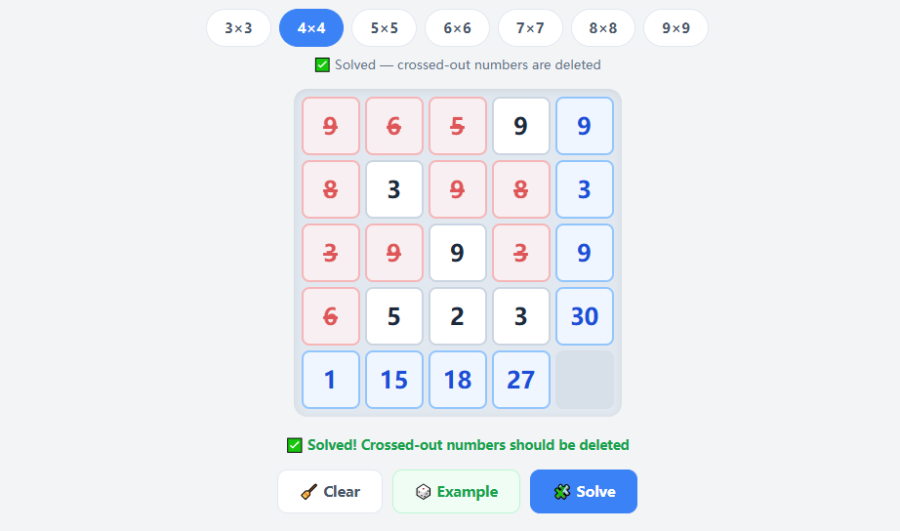
When a solution exists, deleted numbers appear crossed out in red and the status line confirms the result. In the solved 4×4 below, seven numbers are struck out and every remaining row and column multiplies exactly to its target:
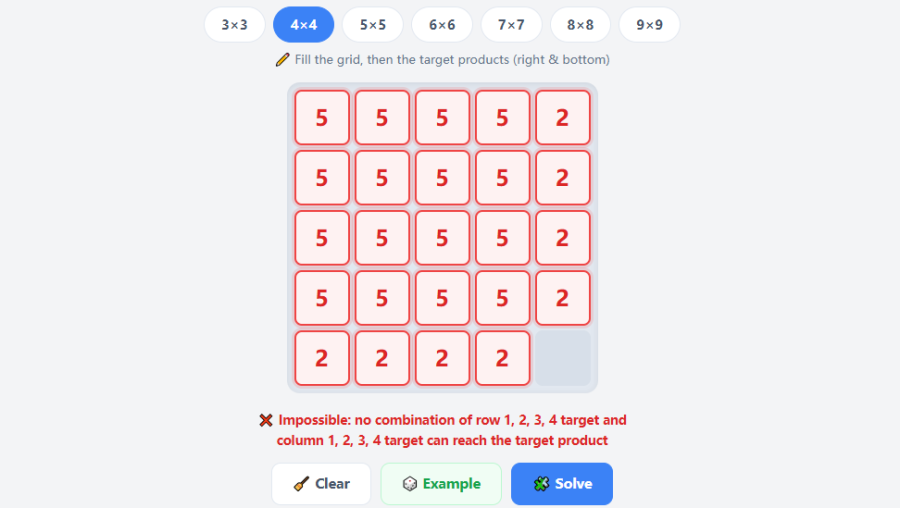
When no solution exists, the solver says so and highlights the guilty row and column targets in red. A target turns red when no combination of its own numbers can ever multiply to it - for example, a row of 5, 5 and 5 can only produce products of 1, 5, 25 or 125, so a target of 2 is impossible - or when it conflicts with the other targets. Checking the red cells is the fastest way to spot a typo:
How the Mulplete Solver Works
Behind the scenes the solver runs a two-stage search that mirrors how strong human players think. First, for every row it enumerates all 2ⁿ possible keep/delete combinations (up to 512 subsets on a 9×9 row) and keeps only the ones whose product hits the row target exactly. A row with no valid combination is reported immediately - that is what the red row highlights come from.
Second, it combines the candidate rows with a depth-first search, tracking a running product for every column. Multiplication gives the solver a sharper pruning tool than addition: a partial column must divide the column target exactly, and whatever is still missing must be achievable with the numbers left. The moment either check fails, the whole branch is abandoned. This prune-early strategy cuts the search space from up to 10²⁴ possible deletion patterns on a 9×9 grid down to something that resolves in milliseconds in your browser. If several solutions exist, the first one found is shown; every solution the solver returns is fully verified before it is displayed.
Worked Example: Solving a 4×4 Mulplete
Here is a complete 4×4 puzzle. The four row targets are 15, 16, 36 and 270; the four column targets are 8, 36, 135 and 60:
| 7 | 3 | 3 | 5 | 15 |
| 8 | 2 | 8 | 2 | 16 |
| 7 | 4 | 9 | 1 | 36 |
| 1 | 9 | 5 | 6 | 270 |
| 8 | 36 | 135 | 60 |
Deleting the seven struck-out numbers solves it. Check it with multiplication: row 1 keeps 3×5 = 15; row 2 keeps 8×2 = 16; row 3 keeps 4×9 = 36; row 4 keeps 9×5×6 = 270. The columns then confirm it - column 1 keeps only 8, column 2 keeps 4×9 = 36, column 3 keeps 3×9×5 = 135, and column 4 keeps 5×2×6 = 60. Notice how factor thinking unlocks it: 15 = 3×5 (row 1 has exactly one 3 and one 5, so both stay), 36 = 4×9 (both sit in row 3), and column 1's target of 8 can only come from the single 8 in that column - everything else there must go.
Tips for Solving Mulplete by Hand
Factor the target first. Break each target into prime factors - 270 = 2×3³×5 tells you exactly which numbers a row can keep. Numbers that do not fit the factorisation must be deleted.
Use divisibility as a filter. If a row's target is not divisible by a number in that row, the number can never stay - cross it out immediately. A row of 3, 4, 7 with target 21 forces the 4 out before you think about anything else.
Primes pin numbers down. A prime target (7, 11, 13...) can only be reached by keeping that exact number and 1s - a free, guaranteed placement.
Treat 1s as wildcards. Keeping or deleting a 1 never changes a product, so ignore 1s until the real numbers are placed, then keep them wherever you like.
Lock the extremes. A target of 1 means the whole line is deleted; a target equal to the product of the whole line means everything stays. Both are free information.
Cross-validate both directions. Every deletion affects one row AND one column. After locking a row, re-divide the column targets by what you kept - if a column target is no longer divisible by its remaining numbers, you made a mistake somewhere.
Is Mulplete Good for Your Brain?
Yes - and arguably harder work than its addition cousin. Mulplete trains factorisation and prime number recognition, two skills at the heart of number theory and IQ-style quantitative tests, alongside multiplicative reasoning: tracking eight running products at once forces a different kind of mental arithmetic than tracking sums. Because numbers multiply explosively, small boards already feel rich - a 3×3 grid is a gentle warm-up for kids who know their times tables, while 5×5 and beyond demand serious deduction.
Frequently Asked Questions
What is Mulplete?
Mulplete is a grid-based number puzzle where you delete numbers so that the remaining numbers in every row and every column multiply to the given target products. It is the multiplication version of the puzzle Sumplete.
How is Mulplete different from Sumplete?
Same grid, same cross-out mechanic - different operation. Sumplete asks the kept numbers to add up to each target; Mulplete asks them to multiply to each target. That single change turns it into a factorisation puzzle: you think in divisors and primes instead of running totals.
How do you win at Mulplete?
Cross out numbers until the product of the remaining numbers in each row equals that row's target AND the product of the remaining numbers in each column equals that column's target - all at the same time.
Can a Mulplete puzzle have more than one solution?
Yes. A row reading 8, 2, 8, 2 with target 16 can keep either 8×2 pair, for example. This solver returns the first valid solution it finds and verifies every row and column before showing it.
Why does the solver say my puzzle is impossible?
Either one or more row/column targets cannot be produced by any combination of their own numbers (those targets are highlighted in red), or the targets conflict with each other. Double-check the red cells first - a mistyped number is the most common cause.
What grid sizes does the solver support?
3×3, 4×4, 5×5, 6×6, 7×7, 8×8 and 9×9. Most published Mulplete games stop at 5×5, so the solver has room to spare, and larger grids solve just as instantly thanks to the pruning search.
Is this Mulplete solver free?
Completely free with no sign-up. Once the page has loaded, solving runs entirely inside your browser - no server round trips, so it even works offline.
Is Mulplete good for kids?
Yes, once times tables are solid. The 3×3 grid with small numbers is a friendly introduction to factors and primes, and the delete mechanic makes every step reversible - kids can experiment without penalty.
Play Mulplete Online
Prefer playing to solving? Try our free Mulplete game with daily puzzles and multiple difficulty levels, warm up on the addition original with the Sumplete Solver, or explore more tools like the Sliding Puzzle Solver.