
Matchstick Equation Solver - Free Online Matchstick Puzzle Solver
What Is a Matchstick Equation Puzzle?
A matchstick equation is a classic brain teaser: an arithmetic equation built from matchsticks - digits formed in seven-segment style plus the +, − and = signs - is deliberately false, and you must move exactly one matchstick to make it true. For example, given 6+4=4, moving the vertical stick of the + sign turns the + into a −, and placing that stick on the 6 turns the 6 into an 8 - giving the true equation 8−4=4.
The puzzle is older than most brain teasers and survives because its rule is brutally simple and its search space is not: one stick, any source, any destination. This matchstick equation solver enumerates every possible single-stick move and returns only the ones that produce a true, properly formatted equation - no leading zeros, exactly one equals sign.
Matchstick Puzzle Rules
Move exactly one matchstick. Take one stick from anywhere in the equation and place it somewhere else - the stick count of the whole equation never changes.
Digits use the seven-segment shape. Removing or adding a stick must leave a valid digit: an 8 loses its middle bar to become 0, a 9 loses its lower-left bar to become 3, and so on.
Signs can transform too. The + loses its vertical stick to become −; the − gains a parallel bar to become =; the = loses one bar to become −.
The result must be a true equation with exactly one equals sign and no leading zeros.
How to Use the Matchstick Equation Solver
Type the equation exactly as your puzzle shows it - digits, + and −, and one =.
Press Solve. The solver enumerates every single-stick move and lists each true equation it can produce.
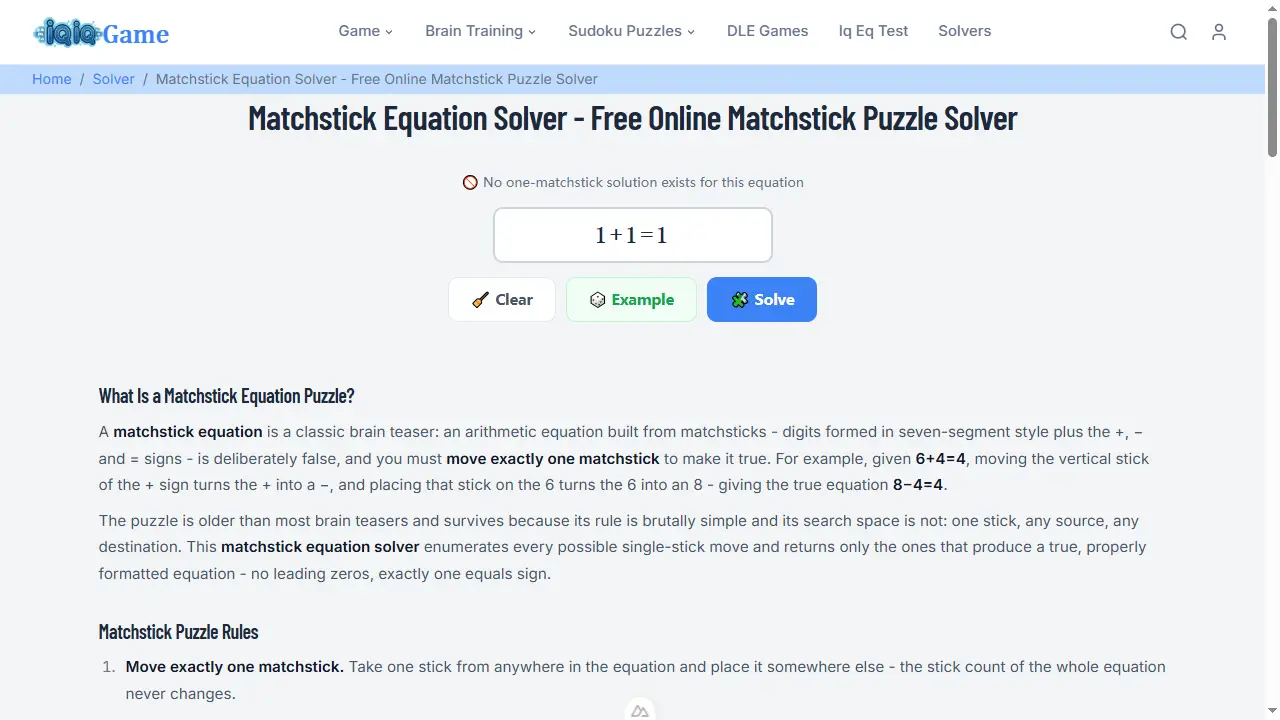
No solutions? Then this equation genuinely cannot be fixed with one move - try the puzzle's two-move variant instead.
Reset or explore. Clear empties the input, and Example loads the classic 6+4=4.
What the Solver Tells You
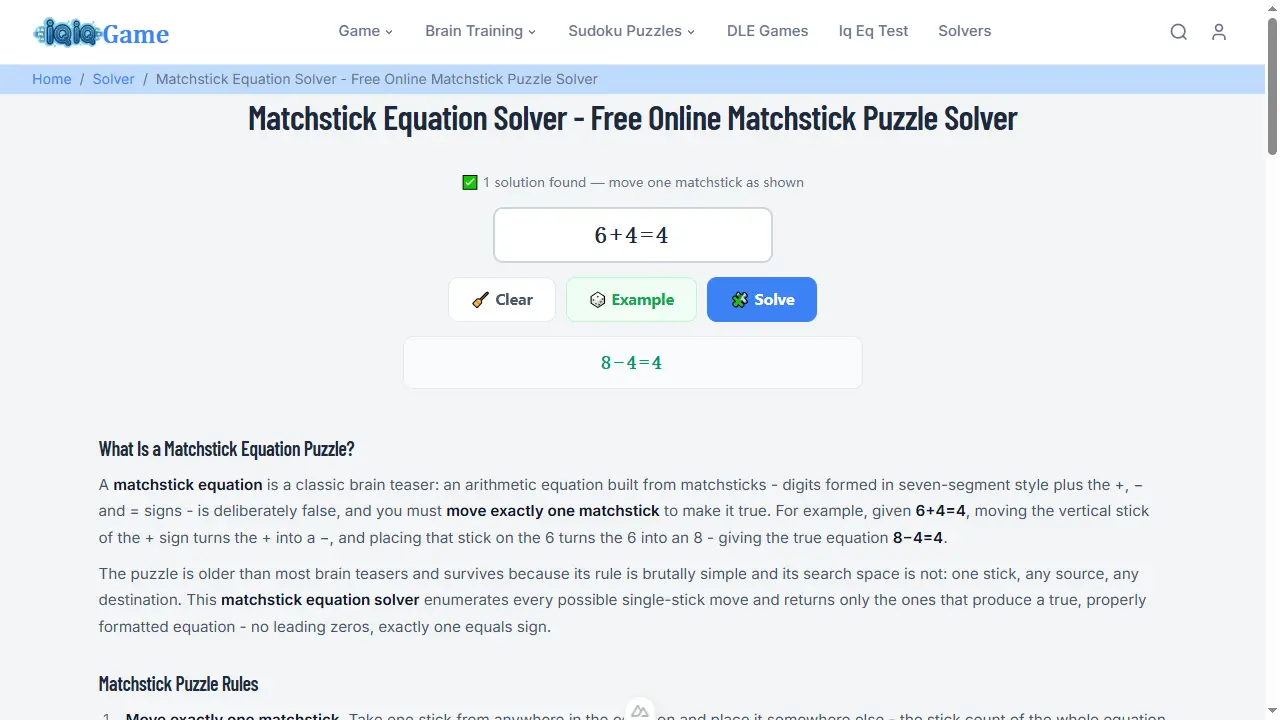
For the classic 6+4=4, the solver finds the one-stick fix:
Not every equation has an answer - and the solver proves it by exhausting all moves:
How the Matchstick Solver Works
Every character in the equation is modelled as a set of matchsticks: digits use the seven-segment layout (an 8 is all seven sticks, a 1 is just two), the + is a horizontal and a vertical stick, the − is one horizontal stick, and the = is two horizontal sticks. A "move" is then pure set arithmetic: remove one stick from any character (the remainder must still form a valid character) and add one stick to any character (the result must also be valid). The solver enumerates every source-every stick-every destination-every adding-stick combination - at most a few thousand for typical equations - re-parses each resulting string as an equation, evaluates it, and keeps only the true ones without leading zeros.
The enumeration is exhaustive, so the solver finds every one-move solution - including clever internal moves where a stick slides within the same digit (the 6-to-5 trick, the 9-to-3 trick) and sign transformations (+ to −, − to =).
Worked Example: The Classic 6+4=4
The equation 6+4=4 looks hopeless - 6+4 is 10, nowhere near 4 - but the matchsticks disagree. The solver reports exactly one solution: turn it into 8−4=4. Here is the move in stick terms:
Take the vertical stick from the + sign. The + becomes a −, and the equation temporarily reads 6−4=4 - still false, but now the + has a free vertical stick in hand.
Add that stick to the upper-right of the 6. A 6 is missing only its upper-right segment, and adding it turns the 6 into an 8.
Read the result: 8−4=4 - true.
That is the essence of matchstick puzzles: the stick you move almost always changes two things at once - one character loses its false promise, another gains the missing piece. Train your eye to ask "what could this character become if I took one stick away?" and "what could that character become if I added one?" - then intersect the two lists.
Tips for Solving Matchstick Puzzles
Know the one-stick digit pairs. 8→0 (remove the middle), 9→3 (remove the lower-left), 6→5 (remove the lower-left), 3→2 (remove the lower-right), 7→1 (remove the top). Learn this table cold - it is the backbone of every matchstick puzzle.
Signs are sticks too. + ↔ − ↔ = transformations are one-move operations and often the key.
Target the arithmetic gap. If the false equation is off by a large margin, look for moves that change a digit by a lot (8↔0, 9↔3); if it is off by a little, look for small tweaks.
Check leading zeros. Moving a stick that turns 12 into 102 is legal, but turning 12 into 012 is not - the solver rejects those automatically.
Squares and corners. A 1 (two sticks) can grow into a 7 by adding the top, or into a 4 by adding two - so 1s are flexible only for one specific addition.
Is the Matchstick Puzzle Good for Your Brain?
Matchstick puzzles exercise visual-structural reasoning: you must see characters not as fixed symbols but as assemblies of parts that can be disassembled and reassembled. That flexibility - holding a shape and asking what one change could do to it - is the same cognitive move behind engineering, design and error-finding. The arithmetic layer adds quick mental calculation, and the "only one move" constraint forces exhaustive-but-organised search instead of flailing.
Frequently Asked Questions
How does this matchstick solver work?
It models every character as a set of matchsticks (seven-segment digits plus sign sticks), enumerates every single-stick move - remove one here, add one there - and keeps the moves whose result is a true, well-formed equation.
Can I add or remove a matchstick instead of moving one?
This solver implements the classic "move exactly one" rule, which keeps the total stick count constant. Add/remove variants change the stick count and are a different puzzle family.
Why does the solver reject some of my ideas?
Because the resulting character is not a valid seven-segment digit, the equation has a leading zero, or the arithmetic does not actually hold. The solver checks all three automatically.
Can the + sign change into something else?
Yes - removing its vertical stick turns + into −, and it can also participate in other one-stick sign transformations such as − becoming =.
Does the solver find every solution?
Yes - the enumeration is exhaustive over all single-stick moves, so the list you see is the complete set.
Is this matchstick solver free?
Completely free with no sign-up. Solving runs entirely in your browser after the page loads, so it even works offline.
Play the Matchstick Game
Want the interactive version? Play our free Matchstick Equation game, exercise your arithmetic with the 24 Game Solver, or explore more tools like the Make 10 Solver.