

What Is the Matchstick Equation Puzzle?
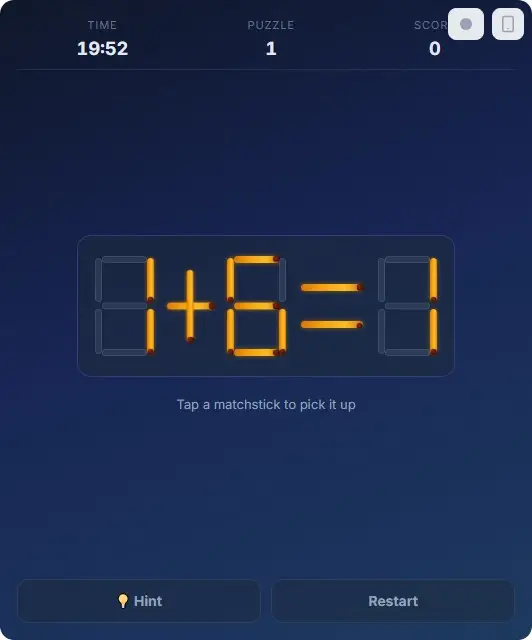
The matchstick equation is a classic brain teaser: an equation is spelled out in matchsticks — like 6+1=1 — and it is wrong. Your job is to move exactly one matchstick so the equation becomes mathematically true. The total number of sticks never changes, and the answer is rarely the first move you try. It plays free in your browser, no download and no sign-up.
How to Play the Matchstick Equation
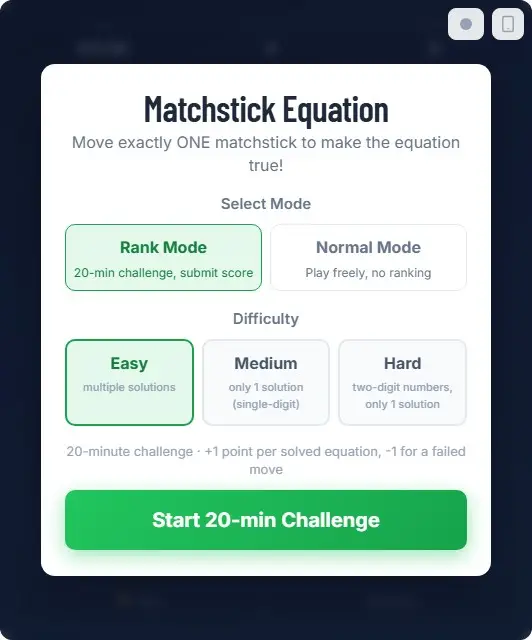
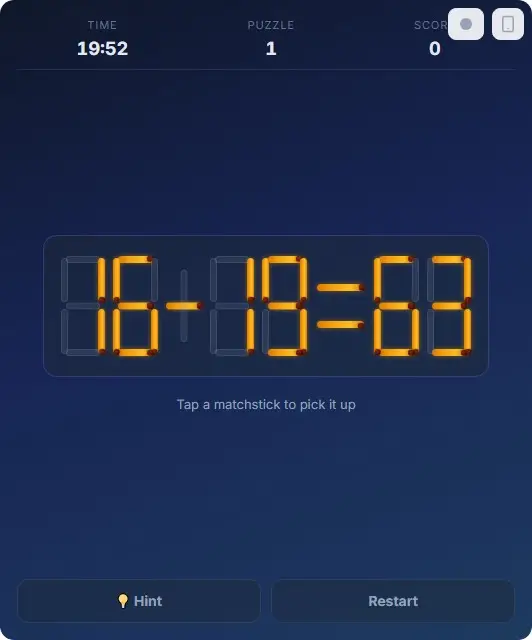
Choose a difficulty — Easy (multiple solutions), Medium (only 1 solution, single-digit) or Hard (two-digit numbers, only 1 solution).
Read the false equation. Digits are drawn in classic seven-segment style; + uses two sticks and − uses one.
Move exactly one matchstick. Tap a stick to pick it up, then tap an empty slot to place it — you may move sticks between digits and signs.
Keep every character valid. After your move, each digit and sign must still be a legal symbol.
Make the equation true. A correct move scores +1 and the next puzzle loads; a failed move costs −1 and the stick bounces back.
Matchstick Equation Rules at a Glance
| Rule | Detail |
|---|---|
| Move | Exactly one matchstick, total never changes |
| Digits | Seven-segment style — 0:6, 1:2, 2:5, 3:5, 4:4, 5:5, 6:6, 7:3, 8:7, 9:6 sticks |
| Signs | + uses 2 sticks, − uses 1 stick |
| Difficulty | Easy (2+ solutions) / Medium (unique solution, single-digit) / Hard (two-digit, unique solution) |
| Normal Mode | 5-minute session, pure practice, nothing submitted |
| Rank Mode | 20-minute challenge, score submitted to the leaderboard |
| Scoring | Correct +1, failed −1 (stick bounces back) |
| Cost & access | Free, no download, no sign-up |
How to Solve: A Worked Example
Suppose the puzzle on the board reads 6+1=1. That is obviously wrong — 6+1 is 7. You get exactly one move.
Step 1: Count the sticks
The digit 6 uses 6 sticks and 8 uses 7 — so a 6 is exactly one stick away from an 8. The sign + uses 2 sticks and − uses 1 — so the operator can donate exactly one stick. Those two facts together are the whole solution.
Step 2: Move the stick
Take one stick from the + (turning it into −) and place it on the 6 (turning it into 8). The right-hand side stays untouched.
Step 3: Verify
The equation now reads 8−1=7 — mathematically true, every character is still a legal symbol, and only one matchstick moved. Solved!
Strategy Tips
Count sticks before you move. Each digit has a fixed stick count (0=6, 1=2, 8=7 …), and a move keeps the total constant — so an 8 (7 sticks) can only become a digit with 6 or 8 sticks after one move.
Watch the sign. Removing a vertical stick from + turns it into −; adding a stick to − makes +. The operator is often the answer.
Check the target side first. The right-hand result usually needs one stick added or removed — start your search there, and remember same-digit morphs like 9→0 or 6→0.
Why This Puzzle Is Great Brain Training
The matchstick equation is a compact workout for arithmetic fluency and spatial reasoning at the same time: you mentally track how many sticks each digit owns, imagine shapes rotating and morphing, and test arithmetic hypotheses — all under a countdown. Because every puzzle takes seconds to attempt, it is a perfect bite-sized daily exercise for working memory and mental flexibility.
Game Modes: Normal vs Rank
Normal Mode — a free 5-minute session with no leaderboard. Pick a difficulty and solve as many equations as you can; nothing is submitted anywhere.
Rank Mode — the ranked challenge. Pick a difficulty, then you get a 20-minute countdown with random puzzles of that difficulty. Every solved equation adds +1 (a failed move costs −1); when the clock hits zero you can submit your result.
Scoring Rules
Rank Mode scoring: every equation you solve within the 20-minute limit adds +1; every failed move subtracts 1 and returns the stick, so precision matters as much as speed.
Leaderboards are per difficulty. An Easy run competes on the Easy board, a Hard run on the Hard board — the three difficulties (easy / medium / hard) are separate ranked events with the same 20-minute format.
Submitting: when time runs out, press Submit Score on the results panel. You need to be logged in; if you are not, a login window appears first and your submission continues automatically after you sign in.
Personal best: your best score for each difficulty is saved, and the results panel flags a new record the moment you beat it.
Normal Mode scoring: none. Normal Mode is pure practice — no score, no leaderboard and nothing is sent anywhere.
Matchstick Equation FAQ
Is the Matchstick Equation free?
Yes — it is completely free on this site. No paywall, no download and no account; open the page and start solving.
Can I move more than one matchstick?
No. The whole challenge is solving it with exactly one matchstick moved, keeping the total count constant. Move two and the trick is gone.
What do the difficulty levels change?
Easy puzzles have two or more valid solutions, so a good first try often lands. Medium puzzles are single-digit equations with exactly one solution. Hard puzzles use two-digit numbers and still have only one solution — precision is everything.
What happens if my move is wrong?
The stick bounces back to where it was, your score drops by 1 in Rank Mode, and the board is ready for the next attempt — there is no penalty beyond the point and the lost seconds.