



What Is the Slide Puzzle?
The Slide Puzzle - best known in its 4×4 form as the 15-puzzle - is a classic sliding-block puzzle: numbered tiles sit on a grid with one empty space, and you slide tiles into the gap until the numbers run in order. It looks simple and is famously tricky, and here you can play it in sizes from a quick 3×3 up to a 9×9 marathon, free in your browser.
Game Modes
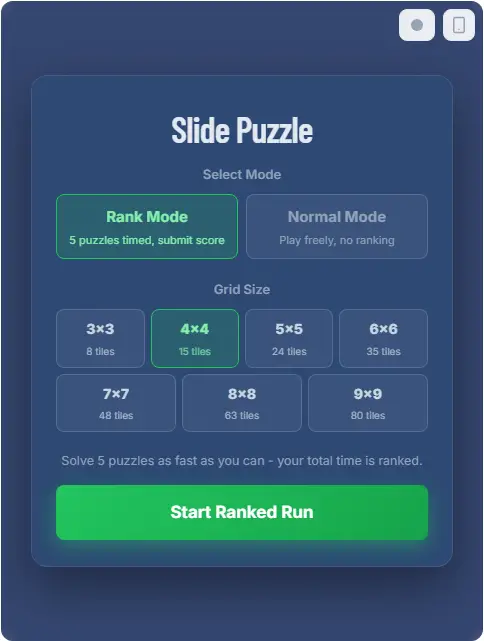
Before you start, choose how you want to play. Both modes let you pick any grid size, and you can switch modes between runs.
Rank Mode - a timed 5-puzzle run
- You solve 5 puzzles in a row on the grid size you picked.
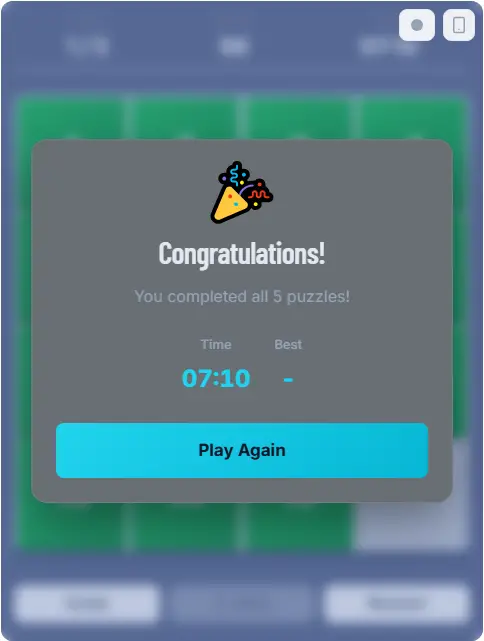
- The clock starts the moment you press Start and runs continuously across all five puzzles - it does not reset between them, so every second spent on puzzle one counts against puzzle five.
- When the fifth puzzle is solved, your total time is submitted to the leaderboard for that grid size.
- Lower is better: the fastest total time wins, which is why board sizes are ranked separately - a 9×9 run is a very different race from a 3×3 sprint.
Normal Mode - untimed practice
- No timer pressure and no leaderboard submission. The clock on screen is for information only.
- Puzzles keep coming one after another with no five-puzzle limit, so you can drill the technique for as long as you like.
- This is the mode to use while learning the row-by-row solving method - the moves that actually make you fast.
Grid Sizes
The grid size is your difficulty setting. Each size is a separate leaderboard in Rank Mode:
- 3×3 - 8 tiles (the 8-puzzle). A handful of moves; good for learning the interface.
- 4×4 - 15 tiles. The classic 15-puzzle and the most-played size. Solving it in under a minute is a solid benchmark.
- 5×5 - 24 tiles. The jump in effort is steep: more rows to lock in and much more shuffling.
- 6×6 to 9×9 - 35 to 80 tiles. Endurance territory. These boards reward method over speed, and finishing one at all is an achievement.
How to Play - Step by Step
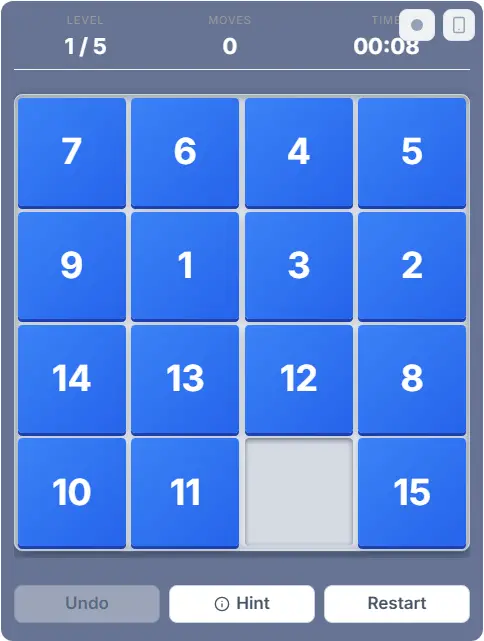
- Read the board. The tiles are scrambled and exactly one square is empty. That empty square is your only room to move.
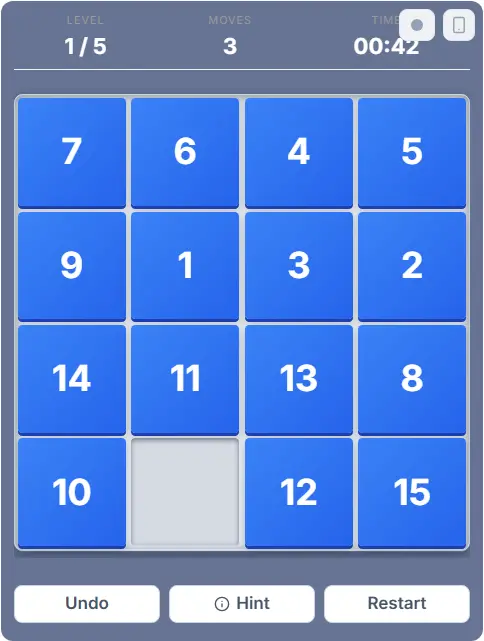
- Slide a neighbouring tile into the gap. Tap any tile directly next to the empty square (horizontally or vertically) and it slides into it, leaving its own spot empty.
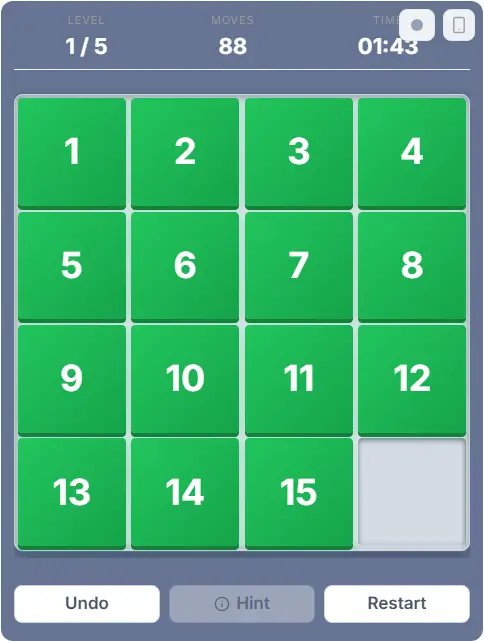
- Follow the target order. Arrange tiles 1 to N²−1 reading left to right, top to bottom, with the empty square last. On a 4×4 that means 1 through 15.
- Lock rows as you finish them. Once a top row is complete, stop disturbing it - work in the rows below.
- Use Undo, Hint and Restart. Undo steps back a move, Hint highlights a useful tile, and Restart reshuffles the current puzzle.
- Finish the run. In Rank Mode the clock stops after your fifth solve; in Normal Mode you simply carry on to the next board.
How Scoring Works
- Rank Mode value = total time for solving five consecutive puzzles, measured from the moment you press Start to the moment the fifth board is solved.
- Lower is better. The leaderboard sorts ascending, so the fastest run sits at the top.
- Boards are separate. Each grid size (3×3 through 9×9) has its own leaderboard, so you only compete against players on the same board.
- The clock never pauses between puzzles inside a run - the few seconds it takes the next board to appear are still on your time.
- Undo is free in terms of scoring: only time matters, so undo rather than thrash around looking for a way out.
- Normal Mode is not scored. Nothing is submitted, so it cannot affect any ranking.
Strategy: the row-by-row method
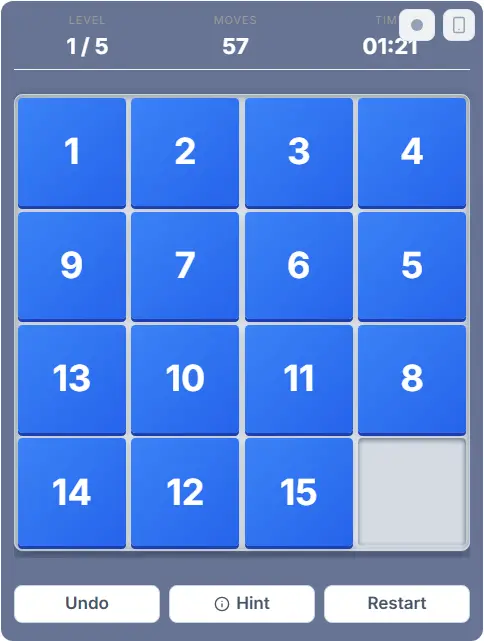
Random sliding works on 3×3 and falls apart immediately on 4×4 and above. What actually makes you fast is solving in rows:
- Solve the top row first. Get 1, 2, 3 (or as many as fit) into the top row, left to right, and lock it. Do not touch those tiles again.
- Then the left column. With the top row done, complete the leftmost column of the remaining rows and lock that too.
- Work in a shrinking rectangle. Every completed row and column reduces the area you are solving, until the last 2×2 or 2×3 block is all that remains.
- Solve the final block by rotation. Small blocks are solved by cycling tiles around the empty square rather than trying to place them one by one.
- Count your moves, not your time. Chasing the clock leads to wasted sliding. Clean, deliberate moves finish faster than frantic ones.
What a finished 4x4 looks like
When the method works, the board collapses into order: 1 to 15 reading left to right, top to bottom, with the gap tucked into the bottom-right corner and every tile highlighted.
Why Play It
- Planning under constraint: every move changes the board, so you learn to think a few steps ahead.
- Working memory: you hold a target arrangement in mind while physically rearranging pieces toward it.
- Patience and method: large boards punish improvisation and reward a consistent system.
- A genuinely classic puzzle: the 15-puzzle has fascinated mathematicians for over a century - including the famous parity rule that makes exactly half of all arrangements unsolvable.
Slide Puzzle FAQ
- Is it free? Yes - free to play in your browser, no download and no account needed. An account is only required to submit a Rank Mode score.
- What is the difference between the two modes? Rank Mode is a timed five-puzzle run whose total time goes to a leaderboard; Normal Mode is untimed practice that never submits anything.
- How long is a Rank Mode run? Five puzzles, with one continuous clock across all of them - there is no fixed time limit, only the clock you are racing.
- What grid size should I start with? 3×3 to learn the controls, then 4×4 - the classic 15-puzzle - as your main board.
- Which way is the leaderboard sorted? Ascending: the shortest total time ranks first.
- Can I use hints during a ranked run? Yes. Hints cost no points, but they do cost you time, since the clock never stops.
- Is every board solvable? Yes. Every scrambled layout on this site is generated to have a solution.
- Why does the clock keep running between puzzles? Because a Rank run is measured end to end - the total time for five boards, not the average of five separate attempts.