
Kakuro Solver - Free Online Kakuro Puzzle Solver
What Is Kakuro?
Kakuro - also called Cross Sums - is the crossword of the number world: a grid of white and blocked cells where every horizontal and vertical run of white cells must add up to the clue printed at its start, using the digits 1 to 9 without repeats inside a run. It has been a staple of Japanese puzzle magazines since the 1980s and of newspapers worldwide since the 2000s.
It looks like Sudoku's older cousin, but the reasoning is all about combinations: a run of four cells summing to 18 can only be {1,4,6,7}, {1,5,5...} no - repeats banned - so the possible digit sets are limited, and intersecting runs crush the possibilities fast. This free Kakuro solver takes your run clues and returns the finished grid, with a uniqueness verdict.
Kakuro Rules
Fill the white cells with digits 1 to 9. Blocked cells stay empty.
Run sums. The digits in each horizontal run add up to its clue; the same for every vertical run.
No repeats in a run. A digit may appear only once per run.
Every white cell belongs to exactly two runs - one horizontal, one vertical.
How to Use the Kakuro Solver
Enter the run clues. In the Run clues box write one run per line: H2:3-6=17 means row 2, columns 3 to 6, digits summing to 17; V3:2-5=12 means column 3, rows 2 to 5, summing to 12.
The grid builds itself. White cells appear wherever a horizontal and a vertical run overlap; everything else is blocked.
Optionally add givens. Type known digits into white cells.
Press Solve. The grid completes in green and the status line reports whether the solution is unique.
Reset or explore. Clear wipes everything, and Example generates a random 6×6 puzzle with a guaranteed unique solution.
What the Solver Tells You
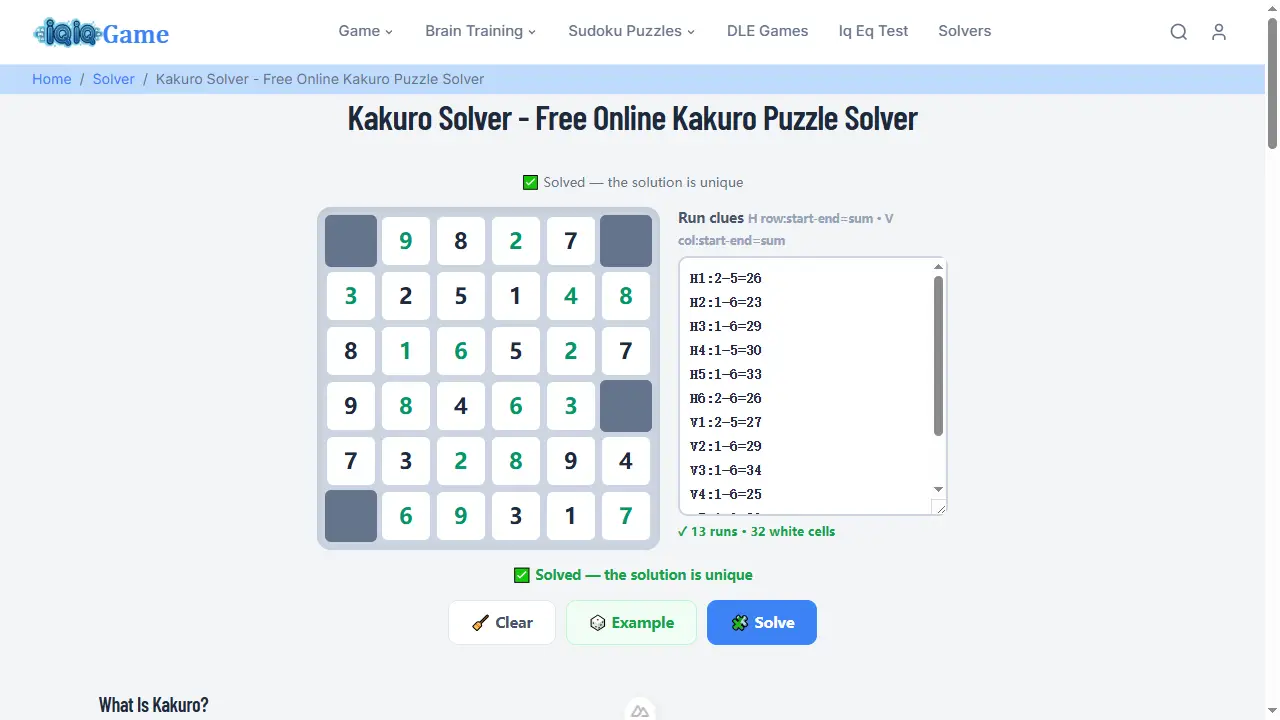
Here is a 6×6 Kakuro with thirteen runs and eighteen givens, solved live:
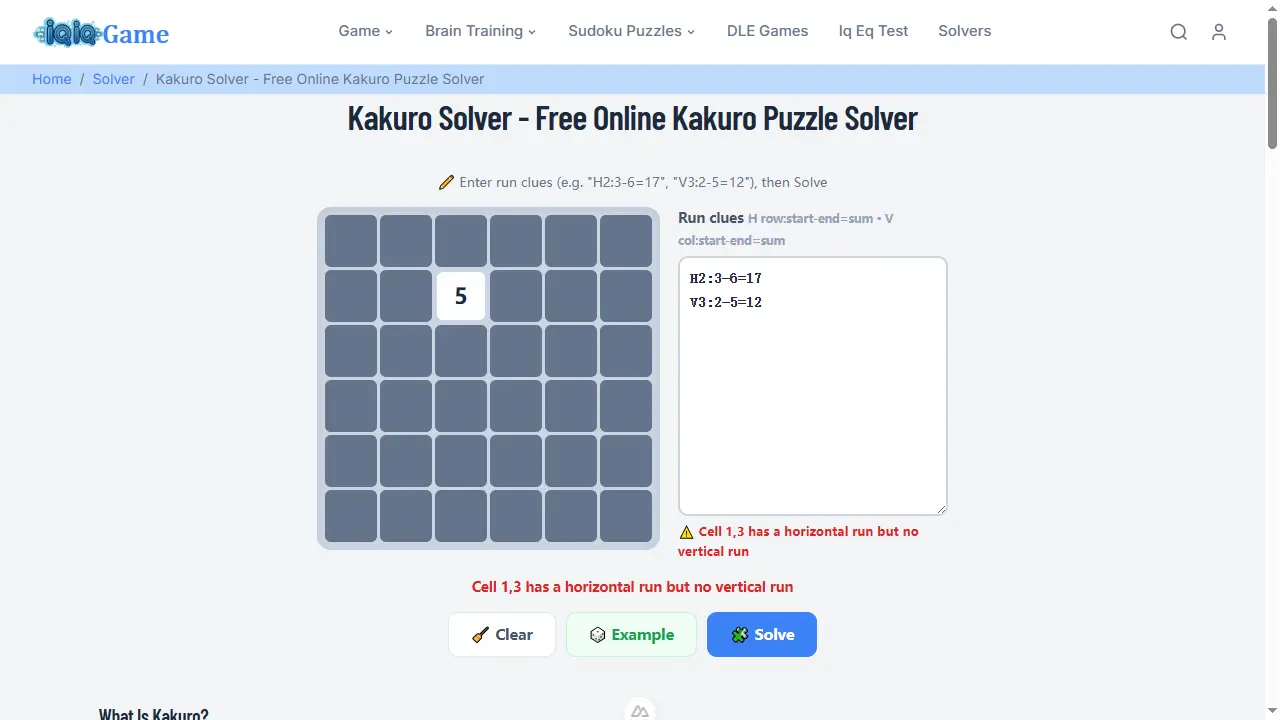
If the clues contradict each other - a run whose target is out of reach for its length, or cells with only one orientation - the solver flags the exact problem:
How the Kakuro Solver Works
Every run maintains a bitmask of used digits and a running sum. For each white cell the candidate list is the digits 1-9 that are unused in both its horizontal and its vertical run, then two bounds prunes are applied: after placing a candidate, the remaining sum must be reachable by the remaining cells - at least 1+2+... for k distinct digits, at most 9+8+... - and if the run is on its last cell, the sum must land exactly. The solver backtracks through the cells until two solutions are found (proving non-uniqueness) or the grid is complete.
The Example generator fills a classic 6×6 pattern with random valid digits, derives the clue sums from its own solution, and adds givens until the puzzle is provably unique - all in a few tens of milliseconds in your browser.
Worked Example: Reading the Clues
Take the example puzzle's opening clue H1:2-5=30: four cells summing to 30. The possible digit sets are limited - 6+7+8+9 = 30 is the only combination of four distinct digits that reaches it, so row 1 must contain {6, 7, 8, 9} in some order. Cross it with V2:1-6=27 (five cells summing to 27, which forces {3,4,5,7,8} or {2,5,...}-style sets) and most of the opening row resolves before you touch anything else. That is Kakuro in miniature: combination tables plus intersection solve everything.
Tips for Solving Kakuro
Learn the extreme combos. A run of 2 cells: 3=1+2, 4=1+3, 16=7+9, 17=8+9. 3 cells: 6=1+2+3, 7=1+2+4, 22=6+8+9? (6+7+9), 23=6+8+9, 24=7+8+9. Extreme clues have exactly one combination.
Use the corner trick. When a set of runs tiles a full row/column segment plus one crossing cell, the crossing cell equals the difference of the clue sums.
Track used digits per run. A digit placed in a run is dead for the rest of that run - keep a mental mask like the solver does.
Length-2 runs are pairs. They have at most 8 combinations and often only one that survives the crossing run.
Big sums mean big digits. A clue of 32 in a 6-cell run forces 9 and 8 into the run; a clue of 10 forces small digits.
Is Kakuro Good for Your Brain?
Kakuro is mental arithmetic with a crossword mask. Every clue is a mini combinatorics problem - which distinct digits make 17 in four cells? - and every intersection is an elimination exercise. Regular play builds addition fluency, subset reasoning and the discipline of tracking what has been used, which is why it has survived decades of newspaper puzzle pages.
Frequently Asked Questions
What is Kakuro?
A logic puzzle where white cells are filled with digits 1-9 so that every horizontal and vertical run adds up to its clue, with no digit repeated inside a run. Also known as Cross Sums.
How is Kakuro different from Sudoku?
Sudoku constrains 3×3 boxes and row/column permutations; Kakuro constrains sums of runs with no repeats. They share the Latin-square spirit but the reasoning is arithmetic-first.
Can a digit repeat in a Kakuro run?
No - digits 1-9, each used at most once per run. Repeats across different runs are fine.
What are the combination tables?
Precomputed lists of which distinct digit sets sum to a clue for a given run length - e.g. four cells summing to 30 must be {6,7,8,9}. They are the fastest solving shortcut.
Can the solver handle givens?
Yes - type any known digits into white cells and they are respected during the search.
Can a Kakuro puzzle have multiple solutions?
Under-clued ones can. This solver searches for a second solution to verify uniqueness before showing the answer.
What grid size does the solver support?
A 6×6 layout with 32 white cells - the classic small-paper format. More sizes are planned.
Is this Kakuro solver free?
Completely free with no sign-up. Solving runs entirely in your browser after the page loads, so it even works offline.
More Logic Puzzles to Explore
Enjoy number logic? Try the Sudoku Solver, the arithmetic-flavoured KenKen Solver, or play our free Killer Sudoku game.