
Takuzu Solver - Free Online Takuzu Binairo Puzzle Solver
What Is Takuzu?
Takuzu - also known as Binairo, Binario or the binary puzzle - is a minimalist logic puzzle played on an even-sized grid (6×6, 8×8, 10×10) filled entirely with 0s and 1s. Three simple rules create surprising depth: every row and column must be balanced (exactly half 0s and half 1s), no three identical digits may appear consecutively in a row or column, and no two rows or columns may be identical.
Despite having only two symbols, Takuzu rewards the same disciplined elimination as Sudoku - arguably more so, because every empty cell has exactly two candidates and every clue is a hard constraint. This free Takuzu solver takes the 0s and 1s you know and completes the grid, with a uniqueness verdict.
Takuzu Rules
Balanced rows and columns. In a 6×6 grid every row and column contains exactly three 0s and three 1s; an 8×8 grid has four of each, and so on.
No three in a row. You may never place three identical digits consecutively - 00110 is legal, 00010 is not.
No duplicate lines. Two rows may never be identical, and two columns may never be identical, in any order.
How to Use the Takuzu Solver
Choose a grid size. Tap 6×6, 8×8 or 10×10.
Click cells to cycle them: empty → 0 → 1 → empty. Enter every 0 and 1 the puzzle gives you.
Press Solve. Empty cells fill in green and the status line reports whether the solution is unique.
Reset or explore. Clear wipes the grid, and Example generates a puzzle with a guaranteed unique solution.
What the Solver Tells You
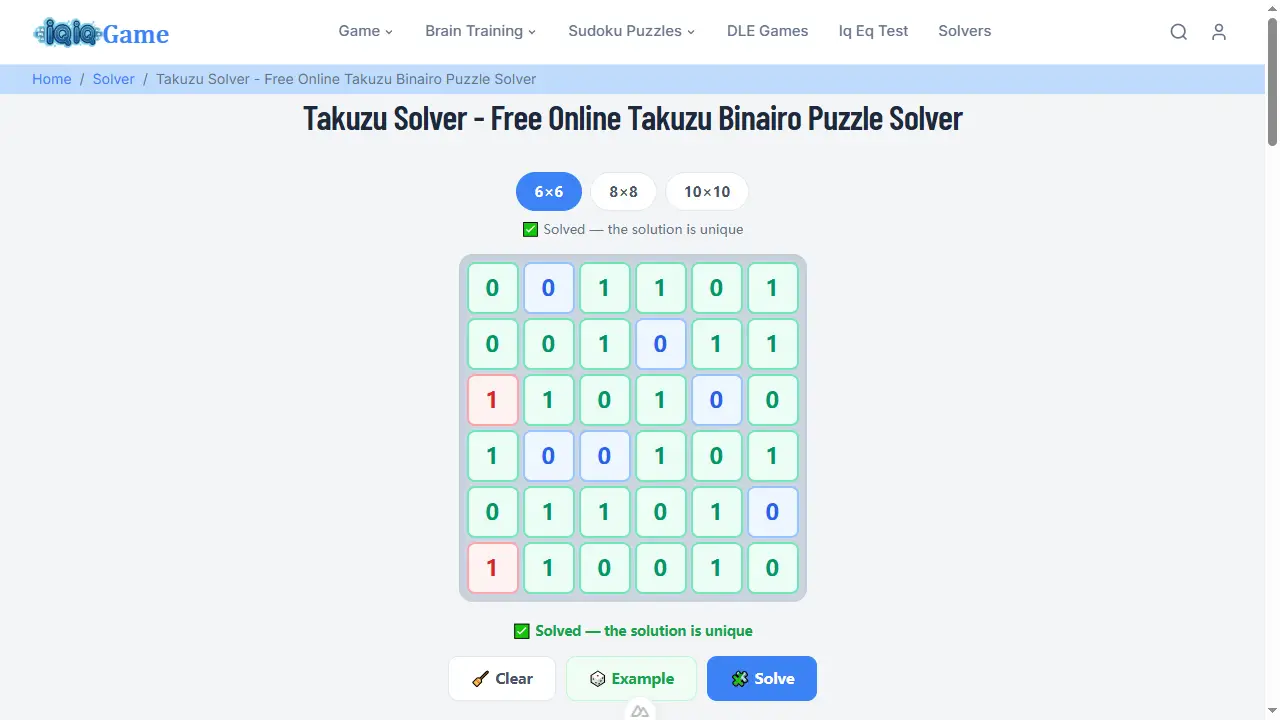
Beyond the completed grid, the solver verifies the three Takuzu rules exhaustively and reports whether the solution is unique. Here is a 6×6 example with only seven given digits - blue cells are the givens, green cells are the solution:
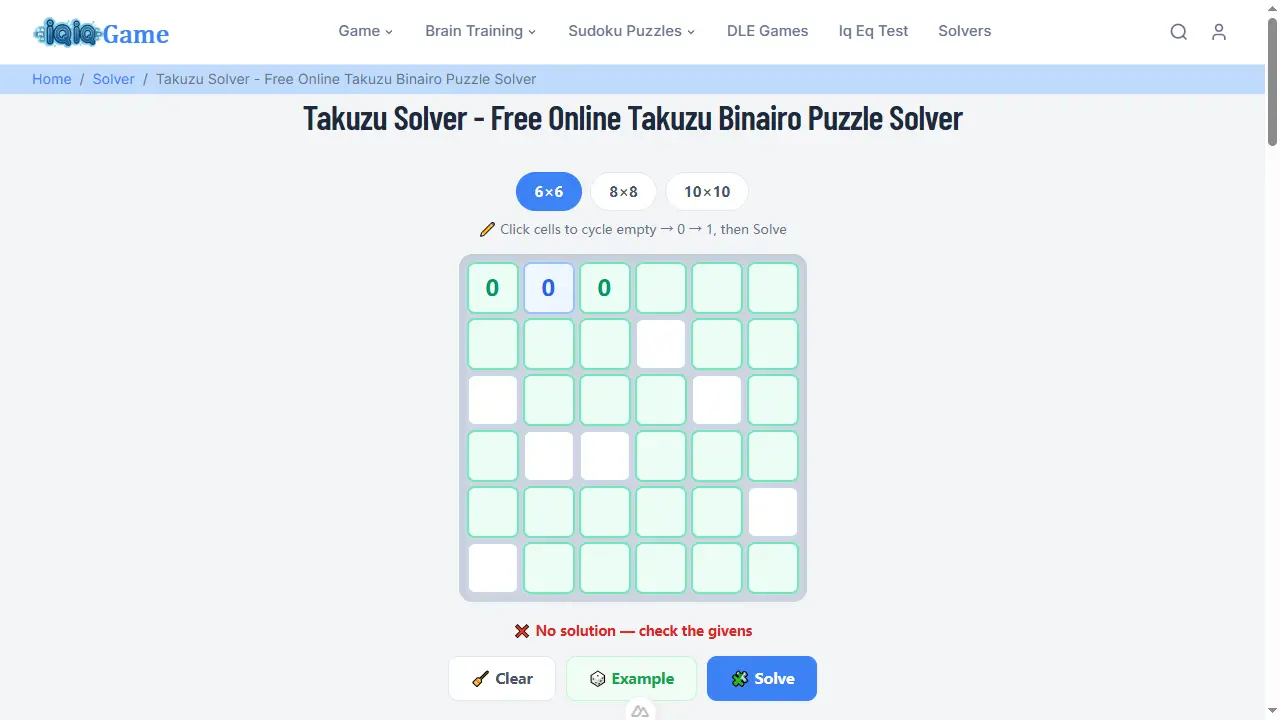
If the givens contradict the rules - three 0s in a row, or an unbalanceable count - the solver proves there is no solution:
How the Takuzu Solver Works
The engine is a backtracking search with three incremental constraint checks per candidate. Placing a digit is rejected immediately if its row or column would exceed the half-count, if it completes a three-in-a-row (checked on both sides of the cell), or if completing a row or column would duplicate an existing line signature. When the grid is full, every row and column signature is verified against the others one last time.
The search stops after finding two solutions, which is how the uniqueness verdict is produced. The Example generator works in reverse: it builds a random valid Takuzu grid with the same incremental constraints, then removes givens one at a time while the solution stays unique - the classic 6×6 example needs only seven givens to be fully determined.
Worked Example: Seven Digits Are Enough
The example 6×6 puzzle gives you just seven digits - a 1 at A1, a 0 at C1 and D1, a 1 at A2 and B2, a 1 at D4 and a 0 at F4. From those, the three rules cascade: row 1 and row 2 each need their remaining cells to balance; column D holds 1, 2... forcing patterns down the grid; and the moment two rows start looking alike, the no-duplicate rule tells you exactly which digit must differ. The unique solution is:
| 1 | 1 | 0 | 0 | 1 | 0 |
| 1 | 1 | 0 | 1 | 0 | 0 |
| 0 | 0 | 1 | 0 | 1 | 1 |
| 1 | 0 | 1 | 1 | 0 | 0 |
| 0 | 1 | 0 | 0 | 1 | 1 |
| 0 | 0 | 1 | 1 | 0 | 1 |
Read the givens in blue and the solved cells in green: seven digits, one unique grid, every rule satisfied.
Tips for Solving Takuzu
Apply the pair rule everywhere. Two equal digits adjacent means both their neighbours must be the opposite digit - the single most used technique.
Split pairs create gaps. A pattern like 0 _ 0 forces the middle to 1.
Count to the half. When a row already holds N/2 zeros, all remaining empty cells in that row must be 1 - fill them instantly.
Use the duplicate rule offensively. When two rows differ in only one cell, that cell is forced to be the opposite of the corresponding cell in the other row.
Watch the corners and edges. Edge cells have fewer neighbours, so triple checks there involve only one side.
Is Takuzu Good for Your Brain?
Takuzu is pure binary deduction: with only two symbols, every placement is a forced move or a contradiction, which trains crisp if-then reasoning. The balance rule adds constant counting discipline, and the no-duplicate rule rewards pattern comparison across the whole grid. Its minimalist look hides genuine depth - perfect as a daily two-minute logic warm-up that scales from 6×6 to demanding 10×10.
Frequently Asked Questions
What is Takuzu?
A binary logic puzzle: fill an even-sized grid with 0s and 1s so every row and column is balanced, contains no three consecutive identical digits, and no two rows or columns are identical. Also known as Binairo or Binario.
What size grids does Takuzu use?
Even sizes: 6×6, 8×8, 10×10 and up. The balance rule requires an even size. This solver supports 6×6, 8×8 and 10×10.
Can a Takuzu puzzle have multiple solutions?
Under-clued ones can. Well-made puzzles are unique, and this solver tells you which case you are in before you copy anything.
What do I do when a row has all its 0s?
Fill every remaining empty cell of that row with 1s - the balance rule guarantees it.
Is Takuzu the same as Binary Puzzles in newspapers?
Yes - Binairo, Binario, Takuzu and "binary puzzles" all refer to the same three-rule game.
Does the solver handle 8×8 and 10×10?
Yes - all three sizes solve instantly thanks to incremental constraint checking.
Is this Takuzu solver free?
Completely free with no sign-up. Solving runs entirely in your browser after the page loads, so it even works offline.
More Logic Puzzles to Explore
Enjoy minimalist logic? Try the Sudoku Solver, the inequality-based Futoshiki Solver, or play our free Sudoku game.