
Futoshiki Solver - Free Online Futoshiki Puzzle Solver
What Is Futoshiki?
Futoshiki is a Japanese logic puzzle whose name means "inequality" (futōshiki, 不等式). It is played on an N×N grid - classically 5×5, but anything from 4×4 to 9×9 works - and every row and every column must contain each number from 1 to N exactly once, just like a Latin square. The twist that gives the puzzle its name: some neighbouring cells are joined by inequality signs (< or >), and the numbers they touch must obey them.
Because of those signs, Futoshiki is also known as Inequality Sudoku - though unlike Sudoku there are no 3×3 boxes, which makes the grid logic cleaner: only rows, columns and the little wars between neighbours. Most published puzzles have exactly one solution, and some can be fiendishly sparse - a few lonely givens and a handful of signs carrying the whole proof. This Futoshiki solver finishes any grid you enter and even tells you whether the solution is unique.
Futoshiki Rules
Rows and columns are permutations. Each row contains every number from 1 to N exactly once, and so does each column.
Inequality signs bind. A sign between two neighbouring cells points at the smaller number: in 2 < 5 the 2 must be on the pointy side.
Vertical signs read the same way. A ∧ between two vertically adjacent cells means the top number is smaller; a ∨ means the bottom number is smaller.
Givens are fixed. Numbers printed in the grid at the start cannot change.
No box rule. Unlike Sudoku there are no sub-grid restrictions - only rows, columns and signs.
How to Use the Futoshiki Solver
Choose a grid size. Tap 4×4 up to 7×7 in the toolbar.
Enter the givens. Type the starting numbers into their cells (1 up to the grid size).
Set the inequality signs. Click a narrow slot between two cells to cycle it: horizontal slots go < → > → empty; vertical slots go ∧ (top smaller) → ∨ (bottom smaller) → empty.
Press Solve. The empty cells are filled in green, and the status line tells you whether the solution is unique.
Unique or not? If several solutions exist, one is shown and the solver says so - a well-made puzzle should have exactly one.
Reset or explore. Clear wipes the grid and the signs, and Example loads a random puzzle with a guaranteed unique solution.
What the Solver Tells You
When the puzzle is solvable, the empty cells are filled in and the status line reports whether the answer is unique. Below, a 4×4 puzzle with seven givens and ten signs solves to a single grid:
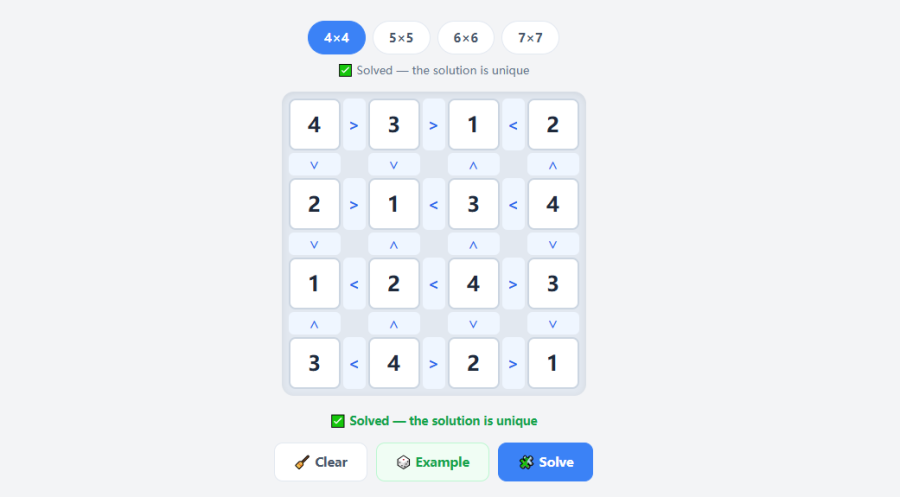
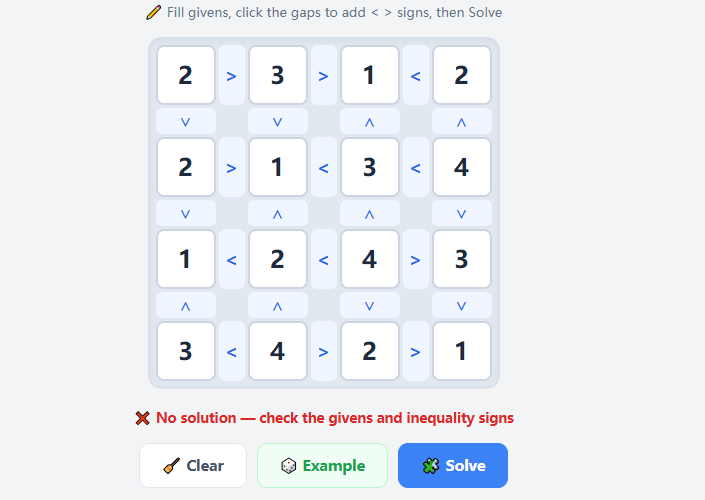
If the constraints contradict each other - a sign that cannot hold, two equal givens sharing a row - the solver reports that no solution exists. Spotting the impossible early is half the battle:
How the Futoshiki Solver Works
Behind the scenes the solver runs a constraint-guided backtracking search. It sweeps the grid cell by cell, tracking a bitmask of used numbers for every row and column, so a candidate that repeats a row-mate or column-mate is rejected instantly. Before any candidate is placed, the four neighbouring cells that already carry numbers are checked against their inequality signs - a number that would break even one sign never enters the grid. Wrong branches are unwound the moment they die.
The search keeps going until it has found two solutions or exhausted the grid: one solution means your puzzle is uniquely determined, two means it is ambiguous, and zero means the constraints contradict. The same machinery also powers the Example button: the generator first builds a random completed Latin square, then hides most of it, derives signs from the true solution, and quietly adds clues and signs back until the puzzle is guaranteed unique. Even a full 7×7 cycle takes about a millisecond in your browser.
Worked Example: A 4×4 Futoshiki
Here is a complete 4×4 puzzle. Filled bold numbers are the givens; green numbers are the solution the solver returns; the signs between cells are shown in blue:
| 1 | < | 4 | > | 2 | 3 | |
| ∨ | ∧ | |||||
| 2 | 3 | < | 4 | 1 | ||
| ∨ | ∨ | |||||
| 4 | 3 | 1 | 2 | |||
| ∨ | ||||||
| 3 | > | 2 | 4 | > | 1 |
The logic flows in one clean chain, no guessing required. Row 2 has three givens, so its missing cell must be 1. Column 2 now holds 4, 1 and 3, forcing its bottom cell to 2 - and the ∨ sign between rows 3 and 4 approves: 3 > 2. Row 4 keeps only 1 and 4 for its last two cells, and the sign 4 > 1 decides their order. Row 1 needs {1, 2} for its two empty cells, but its first column already contains 2 and 3 further down - so the 1 lands on the left, 2 on the right. Column 3 then holds 2, 3 and 4 with one gap left, so 1 drops in - right where its 3 > sign wants it. Finally row 3 needs {2, 4}: its first column still misses 4, which sends 2 to the last cell. Seven givens, ten signs, one unique grid.
Tips for Solving Futoshiki by Hand
Read signs as eliminations. A sign does more than compare two cells: a < b means a cannot be N and b cannot be 1, whatever else you know.
Follow the chains. Signs that continue across a row or column create ordering chains like a < b < c - the end of a long chain of < signs cannot hold a big number, and the start cannot hold a small one.
Anchor on givens. A given number next to a sign fixes its partner to a range instantly: 4 > neighbour pins that neighbour to 1, 2 or 3.
Count the leftovers. Like all Latin-square puzzles, a row with three numbers placed leaves exactly three candidates for the last cell - cross out the ones the signs forbid and the cell often solves itself.
Use columns as referees. When a row cell could be two values, check what its column already contains and what its vertical signs demand; the column usually breaks the tie.
Exploit uniqueness. If a well-made puzzle must have one solution, a candidate that would allow two valid completions of a region can often be ruled out - the solver's uniqueness check is built on exactly this idea.
Is Futoshiki Good for Your Brain?
Futoshiki is a compact course in constraint reasoning. Every sign is a relationship rather than a fact, so solving means juggling comparisons across two directions at once - the kind of relational thinking that underpins algebra. It sharpens elimination discipline (what a clue rules out, not just what it says), scanning accuracy across rows and columns, and ordering logic through the sign chains. The 4×4 grids make a gentle on-ramp for kids, while the 7×7 boards with sparse clues reward real patience.
Frequently Asked Questions
What is Futoshiki?
A Japanese grid logic puzzle in which every row and column contains 1 to N exactly once, and inequality signs between neighbouring cells must be respected. It is also sold as Inequality Sudoku.
What does the name Futoshiki mean?
It comes from the Japanese word futōshiki (不等式), meaning "inequality" - the < and > signs are the heart of the puzzle.
How is Futoshiki different from Sudoku?
Both fill grids so rows (and in Futoshiki, columns) are permutations, but Futoshiki has no 3×3 boxes and adds inequality signs between neighbours instead.
Which way do the signs point?
Toward the smaller number. In 2 < 5 the point faces the 2; a vertical ∧ means the top cell is smaller, and ∨ means the bottom cell is smaller.
Can a Futoshiki puzzle have multiple solutions?
Loosely constructed ones can. Well-made puzzles are designed to have exactly one, and this solver checks uniqueness automatically - if your grid has several answers, it tells you and shows one of them.
What grid sizes does the solver support?
4×4, 5×5, 6×6 and 7×7, which covers the range most newspapers and apps publish.
Can givens break the rules?
If two givens share a row or column, or a sign between givens is already false, the puzzle is unsolvable - the solver detects this immediately instead of searching forever.
Is this Futoshiki solver free?
Completely free with no sign-up. Solving runs entirely in your browser after the page loads, so it even works offline.
More Logic Puzzles to Explore
Enjoy Latin-square logic? Try our free Sudoku game, its dot-flavoured cousin kropki sudoku, or explore more tools like the 24 Game Solver and the Sumplete Solver.