

What Is Crack the Code?
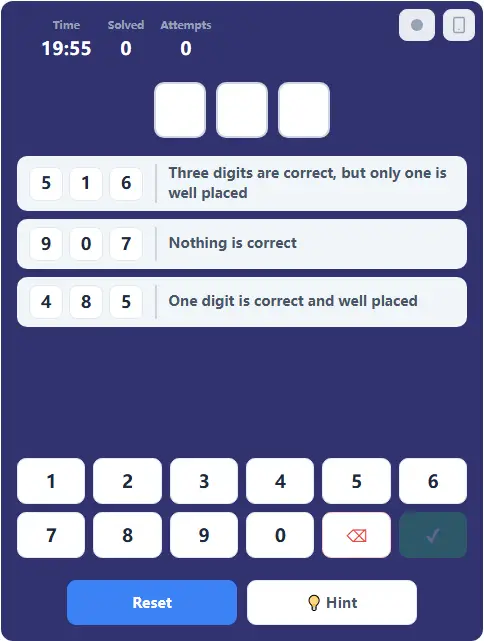
Crack the Code is the viral number logic puzzle you have seen all over short-video platforms. You are given a secret code — 3, 4, or 5 unique digits — and a fixed list of clues. Each clue shows a digit combination together with a statement about it, for example:
7 0 4 8 — Two digits are correct and well placed
4 3 5 9 — Two digits are correct, but only one is well placed
9 2 3 5 — Two digits are correct but wrongly placed
1 5 6 0 — Nothing is correct
Unlike guessing games, you get no new feedback — all the information is already on the screen. Your job is to combine the clues, eliminate impossible digits, pin down the correct ones, and work out their exact positions. Every puzzle is generated with a guaranteed unique solution.
How to Play
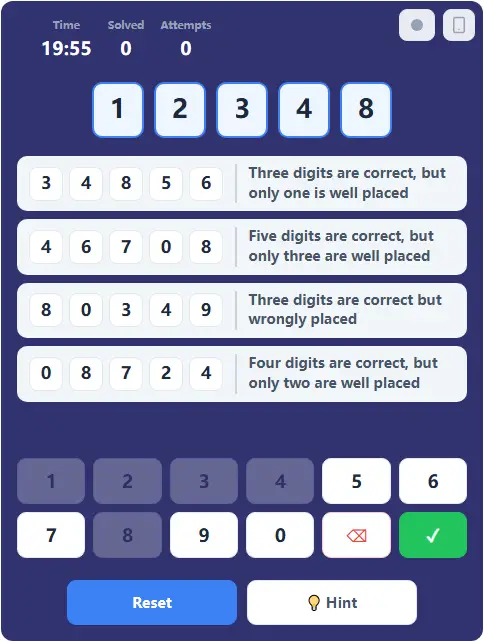
Choose a code length — 3, 4 or 5 digits (digits never repeat; the first digit is never zero).
Read all the clues carefully before typing anything.
Tap the keypad to fill the answer boxes with your deduced code.
Press the green ✓ button to submit. Wrong attempts are counted — try to solve it in one shot!
Stuck? Use Hint to reveal the code — after each use it goes on a 60-second cooldown (the button shows a toast if you try again too soon).
Reset starts the game over from the mode menu (with a confirmation dialog).
How to Solve: A Worked Example
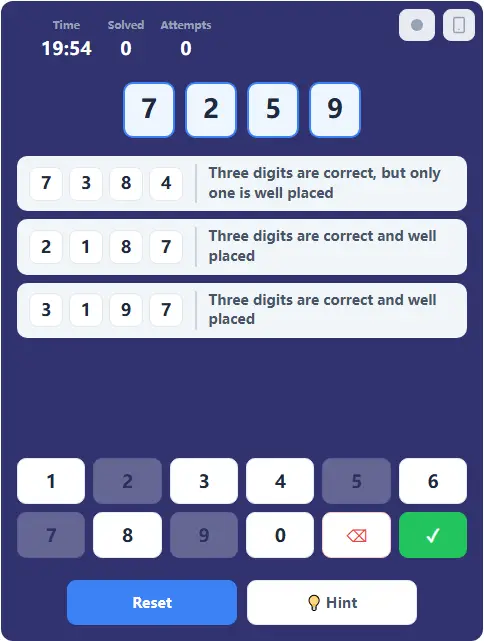
Suppose the clues for a 4-digit code are:
7 0 4 8 — Two digits are correct and well placed
4 3 5 9 — Two digits are correct, but only one is well placed
9 2 3 5 — Two digits are correct but wrongly placed
1 5 6 0 — Nothing is correct
Step 1: Eliminate
Clue 4 says nothing is correct, so 1, 5, 6, 0 are all out. This also cleans up the other clues: remove 0 from clue 1, and 5 from clues 2 and 3.
Step 2: Find the correct digits
Clue 3 now reads: two of 9, 2, 3 are in the code, both misplaced. Clue 2: two of 4, 3, 9 are in the code. Clue 1: two of 7, 4, 8 are in the code, both well placed. Testing the combinations shows the code must contain 7, 4 from clue 1 and 2, 3 from clue 3.
Step 3: Lock the positions
From clue 1, 7 stays in slot 1 and 4 stays in slot 3. From clue 3, digit 3 is NOT in slot 3 and digit 2 is NOT in slot 2, so 3 goes to slot 2 and 2 to slot 4. The code is 7 3 4 2.
Tips and Strategies
Start with "Nothing is correct" — it instantly removes up to 5 digits and simplifies every other clue.
Compare overlapping clues — digits appearing in several clues are the key; their combined statements often force a single conclusion.
Count carefully — if two clues share two digits but report different totals, the shared digits cannot both be right.
Use positions last — first settle WHICH digits are in the code, then use "well placed / wrongly placed" information to order them.
Why This Puzzle Is Great Brain Training
Crack the Code is a pure workout for deductive reasoning: hypothesis testing, constraint satisfaction, and elimination logic. It trains working memory (holding several clue statements at once) and systematic thinking — the same skills behind debugging code and solving logic grid puzzles. Best of all, a puzzle takes only a few minutes, making it a perfect daily brain teaser.
Game Modes: Normal vs Rank
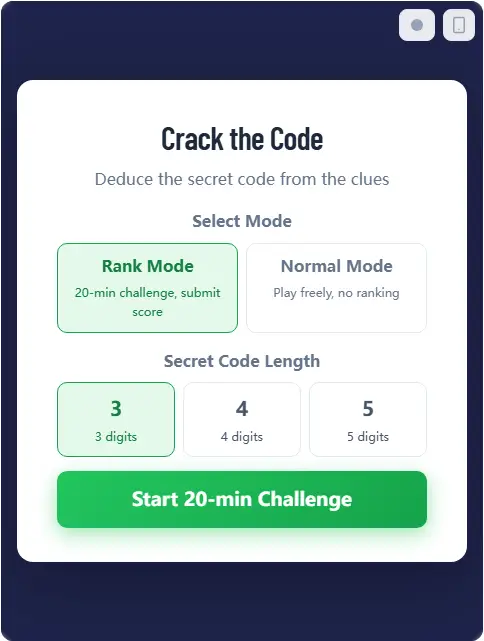
Normal Mode — practice freely with no timer and no leaderboard. Pick a code length (3, 4 or 5 digits) and solve as many puzzles as you like; nothing is submitted anywhere.
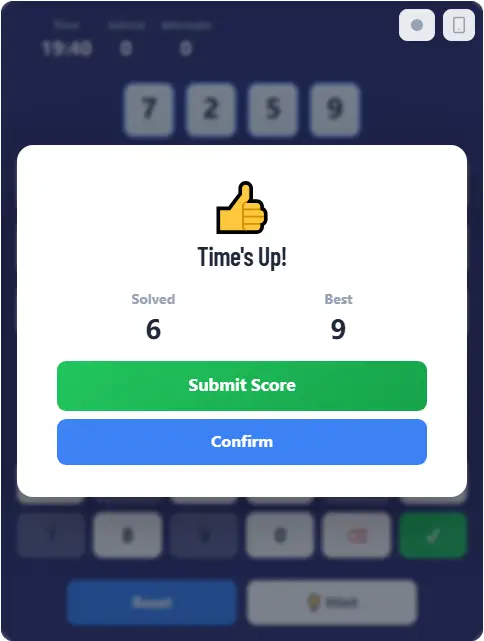
Rank Mode — the ranked challenge. Pick a code length, then you get a 20-minute countdown with random hard puzzles of that length. Every code you crack adds to your score; when the clock hits zero you can submit your result.
Scoring Rules
Rank Mode scoring: every code you crack within the 20-minute limit adds +1 to your score. Wrong guesses and revealed answers do not add points — only solved codes count.
Leaderboards are per code length. A 3-digit run competes on the 3-digit board, a 5-digit run on the 5-digit board — the three lengths (3 / 4 / 5 number) are separate ranked events with the same 20-minute format.
Submitting: when time runs out, press Submit Score on the results panel. You need to be logged in; if you are not, a login window appears first and your submission continues automatically after you sign in.
Personal best: your best score for each code length is saved, and the results panel flags a new record the moment you beat it.
Normal Mode scoring: none. Normal Mode is pure practice — no score, no countdown and nothing is sent to the leaderboard.
FAQs
Is every puzzle solvable by logic alone?
Yes. Every generated puzzle is brute-force verified to have exactly one code consistent with all clues, and redundant clues are removed so every clue matters.
Can digits repeat in the code?
No. All digits are unique and the first digit is never zero, which keeps the deduction clean.
What is the difference from Bulls and Cows (Mastermind)?
In Bulls and Cows you guess repeatedly and get feedback after each guess. In Crack the Code, all clues are fixed up front — you solve it in your head (or on paper) and submit once. Try both and see which style suits you!
Which difficulty should I start with?
Start with 3 digits to learn the clue patterns, move to 4 digits for the classic experience, and try 5 digits when you want a real challenge.