
Sequence Memory Game - Simon Says Brain Training Online
How to Play Sequence Memory
Sequence Memory is a classic Simon Says style brain training game that tests your ability to remember the temporal order of events — a core function of working memory.
Round flow
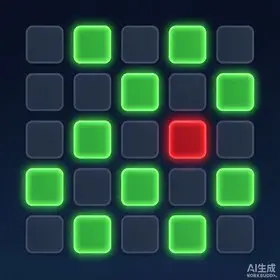
Choose a grid size: 3×3 (9 cells, default), 4×4 (16 cells) or 5×5 (25 cells).
Press START TEST. The first round shows 1 step: a single cell flashes white for about 0.5 seconds, accompanied by a musical tone.
After the playback finishes, click the cell that lit up.
If you are correct, the sequence grows by one step: now two cells flash one after another, each with their distinct tone. Click them back in the same order.
Each correct round adds one more step. One wrong click ends the run immediately.
Audio cues
Each step in the sequence plays a fixed musical note from a 12-tone scale (C5 to B6). Step 1 always sings C5, step 2 D5, step 7 B5, step 13 C5 again.
This means you can hear which step number you are on — if you are on round 16 and hear the note for D5, you know you are at step 2, 8, or 14, helping you stay oriented in long sequences.
Each cell flash lasts approximately 0.48 seconds with a 0.18-second gap between flashes, giving you time to register both the visual and auditory cues.
Grid sizes
3×3 (default) — 9 cells. Best entry point for new players.
4×4 — 16 cells. More spatial positions to distinguish.
5×5 — 25 cells. Maximum spatial memory challenge.
Why Train Sequence Memory?
Sequencing is fundamental to how the brain organizes events in time. Whether following a recipe, recalling a phone number, or learning a dance routine, your brain must hold temporal order information in working memory. Deliberate sequencing practice strengthens the neural pathways that support attention, language comprehension, and planning.
Tips to Improve
Pair sound with space. Each step position has a fixed pitch. Associate the tone with the cell position — the double cue (visual + auditory) gives you two chances to get it right.
Use the corners and edges. Corner cells are easier to identify. Mentally label them: top-left, bottom-right, etc.
Chunk the sequence. Group 3–4 steps into mini-patterns (e.g., "corner-jump-corner") instead of trying to memorize each step individually.
Start on 3×3. Build your sequencing ability on the smallest grid before increasing the cell count. The skill transfers upward.
FAQ
Why is there only one life?
Sequence memory is a strict test of working memory span. A single mistake means you lost track of the order. One-life scoring gives you a clean, honest measure of your true capacity.
What is a good score?
The average human score is 9 steps. Scores above 12 are strong, and above 15 is excellent. With daily practice, most people can push past the median within a week.
Does the game save my progress?
Your highest completed round is saved locally in your browser for each grid size.