
Killer Sudoku Solver - Free Online Killer Sudoku Puzzle Solver
What Is Killer Sudoku?
killer sudoku is Sudoku with teeth. The grid follows all the classic rules - every row, column and 3×3 box contains the digits 1 through 9 exactly once - but there are almost no starting numbers. Instead the grid is divided into cages: dotted groups of neighbouring cells, each stamped with a target sum that its digits must add up to. And one extra rule with real bite: digits never repeat inside a cage.
Because the sums replace most of the givens, Killer Sudoku plays like a hybrid of Sudoku and Kakuro, and it rewards a different kind of thinking: you reason about combinations (which sets of distinct digits add to 16?) and about the 45 rule (every row, column and box totals 45) long before you place actual digits. This Killer Sudoku solver takes your givens and cage layout, works through that arithmetic exhaustively, and returns the finished grid - plus a verdict on whether the solution is unique.
Killer Sudoku Rules
Classic Sudoku core. Every row, every column and every 3×3 box contains the digits 1-9 exactly once.
Cage sums. The digits inside each dotted cage add up exactly to the number printed in its corner.
No repeats in a cage. Even if a cage spans two rows or boxes, the same digit may not appear twice inside it.
Few givens. Most Killer Sudokus start with zero or very few filled cells - the cages carry the information.
How to Use the Killer Sudoku Solver
Enter the givens. Type any starting numbers into the grid.
Enter the cages. In the Cages box, write one cage per line using spreadsheet coordinates - columns A-I left to right, rows 1-9 top to bottom. A cage summing to 16 over A1, A2 and B1 is written as 16: A1 A2 B1.
Check the parse. The solver validates every line as you type: malformed lines, overlapping cages and disconnected cages are flagged immediately.
Press Solve. Empty cells fill in green and the status line reports whether the solution is unique.
Reset or explore. Clear wipes everything, and Example deals a randomly generated puzzle with a guaranteed unique solution.
What the Solver Tells You
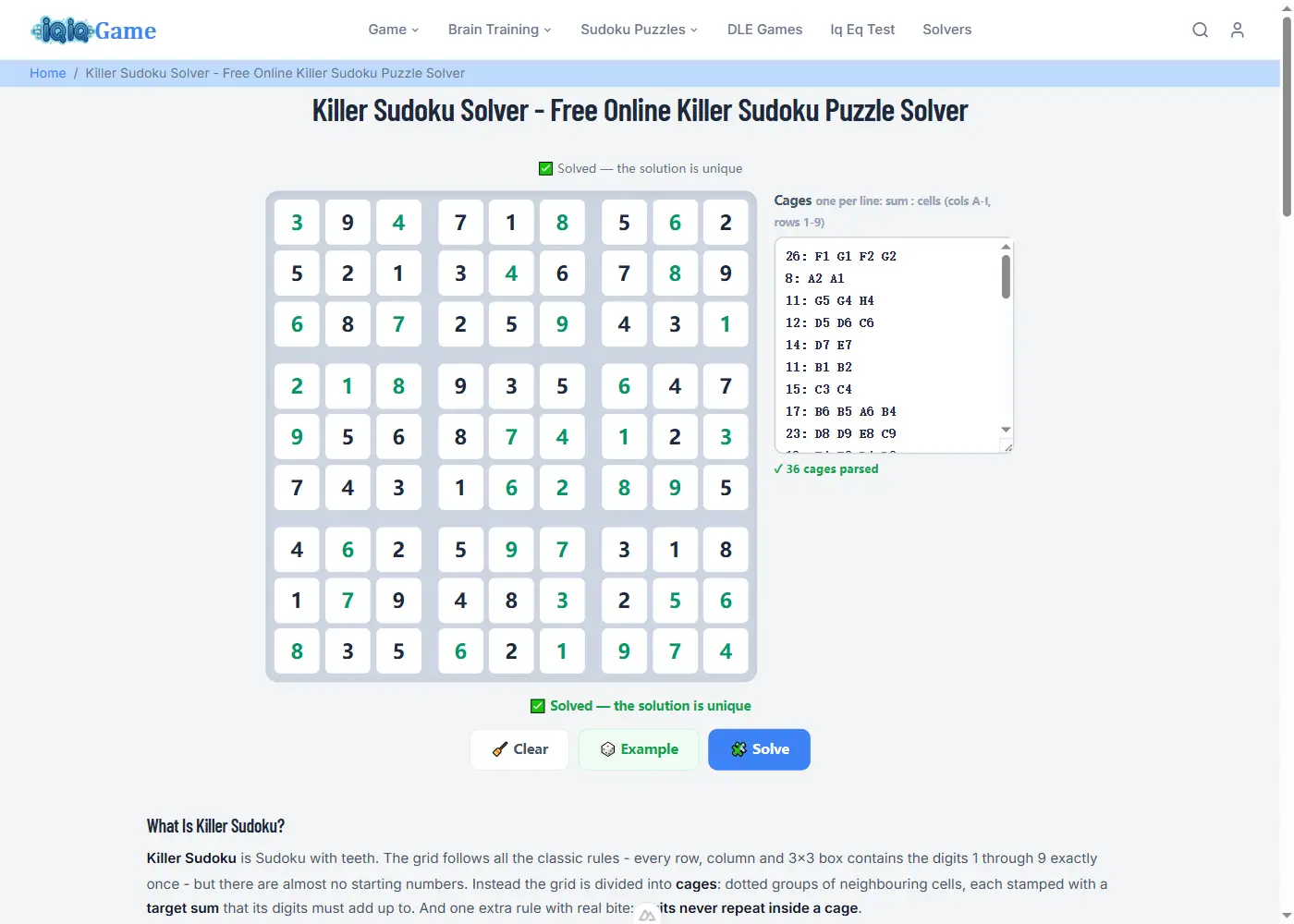
Beyond the completed grid, the solver distinguishes three verdicts. Unique - the gold standard; your cages and givens pin down exactly one grid. Multiple solutions - the constraints under-determine the puzzle; published Killers should never do this. No solution - the constraints contradict, often because a cage sum is impossible for its cell count or two givens collide. Here is a 24-clue, 36-cage puzzle solved from givens and cage text alone:
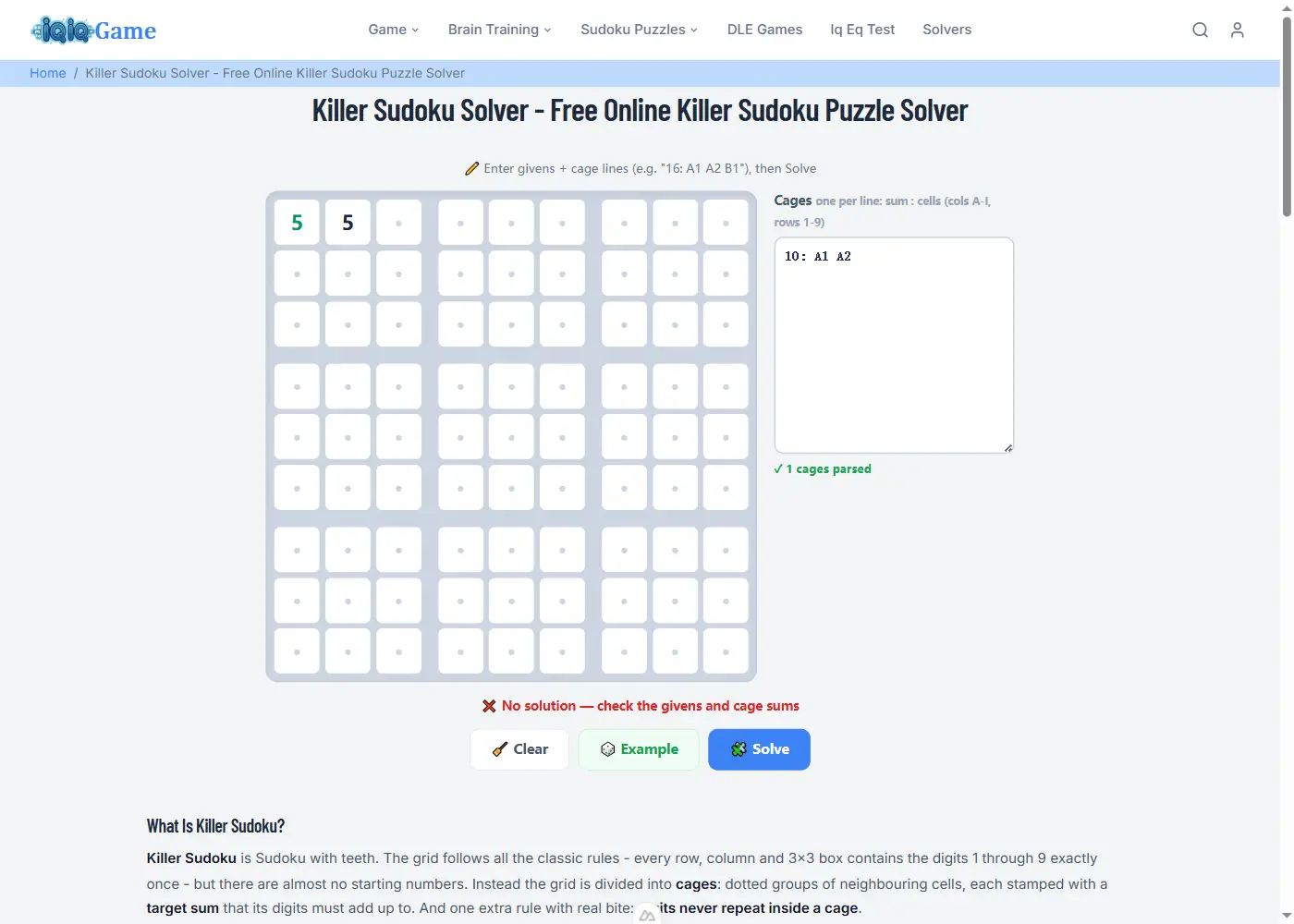
And when the constraints fight each other - two 5s given inside the same cage, which breaks the no-repeat rule - the solver proves there is no way forward:
How the Killer Sudoku Solver Works
The engine is a backtracking search in the same family as our classic Sudoku solver, upgraded with cage arithmetic. It keeps 9-bit masks for every row, column and box, plus three running totals per cage: the digits already used, their sum, and how many cells are still empty. A candidate digit must survive four filters at once - row, column, box and cage.
The cage filter is where Killer gets clever, and it prunes hard. A candidate is rejected if it is already used in the cage, if it would push the partial sum past the target, if the remaining cells could not possibly make up the difference (each empty cell adds at least 1 and at most 9), or if it is the last cell of the cage and the sum is not exact. Combined with the MRV heuristic - always branch on the cell with the fewest candidates - even cage-only puzzles with zero givens resolve in milliseconds, entirely inside your browser.
Worked Example: Reading a Cage Layout
Here is a 24-clue puzzle with 36 cages generated by the Example button (the screenshot below shows it solved live). Several cages are single-cell gifts - I1 = 1, A9 = 2, B8 = 5, E9 = 8, H4 = 8, I5 = 4, F2 = 7 - each one a free placement that immediately constrains its row, column, box and any multi-cell cage it joins.
The two-cell cages demonstrate combination thinking. Take 9: A1 A2: two distinct digits summing to 9 can only be {1,8}, {2,7}, {3,6} or {4,5} - four possibilities. But 17: C1 D1 has just one combination, {8,9}, because 17 is the largest 2-cell sum after 18 (which would force 9+9, banned by the no-repeat rule). Extreme sums are free information: 3 can only be 1+2, and 4 can only be 1+3.
Once enough cells settle, the 45 rule takes over: every row, column and box must total 45, so any cluster of cages that exactly tiles a unit has one sum 45 short or over - and the difference belongs to the cell or cells that stick out. That single technique, applied repeatedly, is how human solvers finish Killer grids without ever guessing.
Tips for Solving Killer Sudoku
Memorise the extreme cage combinations. 2-cell cages: 3=1+2, 4=1+3, 16=7+9, 17=8+9. 3-cell cages: 6=1+2+3, 7=1+2+4, 23=6+8+9, 24=7+8+9. At the extremes the combination is unique - free placements.
Use the 45 rule. Every row, column and box sums to 45. When a group of cages covers a unit plus one overhanging cell, that cell equals (cage sums) − 45.
Think in combinations, not values. Before asking "which digit goes here", ask "which digit sets can this cage hold" - the intersection across a cell's row, column, box and cage is where solutions appear.
Non-repeating is a weapon. A cage spanning a single row already obeys the row rule; a cage crossing two boxes restricts both. Every repeated-digit possibility you can kill prunes two units at once.
Harvest single-cell cages first. They are givens in disguise - place them and ripple the constraints outward.
Track partial sums. Strong players keep a running total for every cage and know instantly whether the remaining cells are arithmetically capable of closing the gap - exactly what the solver automates.
Is Killer Sudoku Good for Your Brain?
Killer Sudoku is the arithmetic heavyweight of the Sudoku family. It layers mental addition and subset thinking onto classic Sudoku deduction: every cage is a tiny combinatorics problem ("which distinct digits make 16?"), and the 45 rule trains you to see totals and gaps rather than individual cells. Players often find it sharper work than plain Sudoku precisely because arithmetic and elimination feed each other - and because the grid gives you almost nothing for free.
Frequently Asked Questions
How does this Killer Sudoku solver work?
It runs a backtracking search with row, column and box bitmasks plus live cage bookkeeping - used digits, partial sum and remaining cells - and prunes any candidate that breaks a cage constraint. It also keeps searching after the first answer to verify uniqueness.
How do I enter cages?
One cage per line in the Cages box: the sum, a colon, then the cells in spreadsheet coordinates. For example 16: A1 A2 B1 means three cells - A1, A2 and B1 - that must total 16. The parser checks every line and flags overlaps and disconnected cages.
Can digits repeat inside a cage?
No - that is the rule that gives Killer Sudoku its extra difficulty, even when the cage stretches across multiple rows or boxes.
Can a Killer Sudoku have multiple solutions?
A poorly constructed one can. Well-made puzzles have exactly one solution, and this solver tells you which case you are in before you start copying numbers.
What is the 45 rule in Killer Sudoku?
Every row, column and 3×3 box sums to 45 (1+2+...+9). When a set of cages covers a whole unit plus one extra cell, subtracting the cage sums from 45 reveals the overhanging cell's value.
Which cage sums have only one combination?
For 2-cell cages: 3 (1+2), 4 (1+3), 16 (7+9) and 17 (8+9). For 3-cell cages: 6 (1+2+3), 7 (1+2+4), 23 (6+8+9) and 24 (7+8+9). Extreme sums lock the digits completely.
Does the solver need any givens?
No - it can solve from cages alone. Givens simply speed the search up, and the solver handles any mix of the two.
Is this Killer Sudoku solver free?
Completely free with no sign-up. Solving runs entirely in your browser after the page loads, so it even works offline.
Play Killer Sudoku Online
Ready to test yourself? Play our free Killer Sudoku game, brush up with the classic Sudoku Solver, or explore more tools like the 24 Game Solver.