
Wordle Solver - Free Online Wordle Puzzle Solver
What Is a Wordle Solver?
A Wordle solver is the wingman for your daily five-letter puzzle. You feed it the guesses you have already made and the colours Wordle gave back - grey, yellow, green - and it answers the only question that matters: which words are still possible? This one is built on the official list of 2,315 answer words, so every candidate it shows you is a genuine Wordle answer, not dictionary filler.
But a list is not a strategy. After filtering, the solver ranks the survivors by information value - how much each candidate would teach you about letter positions and letter coverage - and hands you the best next guess. Whether you want the answer handed over or just a nudge away from a wasted turn, this tool does both.
How to Use This Wordle Solver
Type a guess. Enter any five-letter word you have already played.
Copy the colours. Click each square to cycle it - grey (not in the word), yellow (in the word, wrong spot), green (correct spot) - until the row matches Wordle's feedback.
Add more guesses with the ➕ button, one row per turn you have played, and paint them the same way.
Press Filter. The solver instantly shows how many official answers remain and ranks the best next guesses, with bars showing relative information value.
One candidate left? That is your answer - type it into Wordle and enjoy the green cascade.
Start over. Reset clears every row, and Demo loads a real two-guess example so you can see the engine work.
What the Solver Tells You
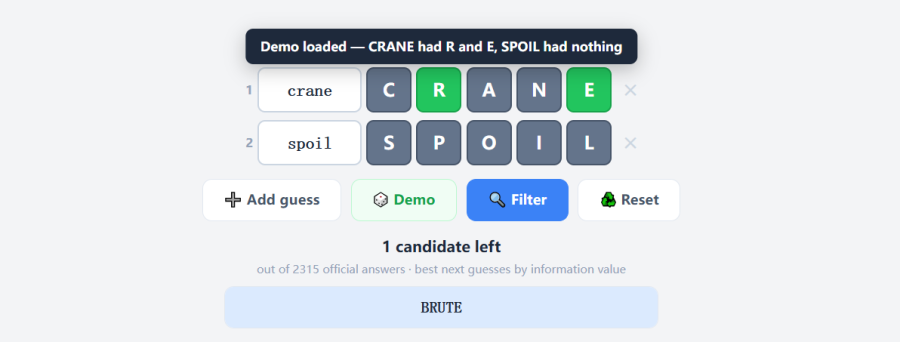
The candidate count is the heartbeat of the tool. Watch it collapse as rows are added: a fully grey CRANE eliminates most of the alphabet and leaves 263 official answers; add green R and E in the right slots and the pool shrinks to 26; a fully grey SPOIL after that leaves exactly one word:
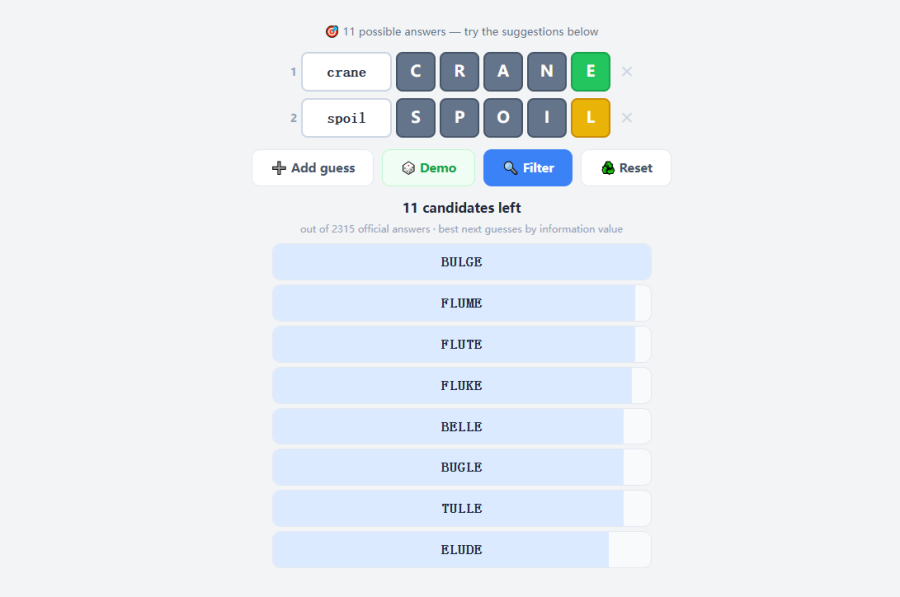
The suggestion list is ranked, not random - the top bar means the biggest expected information gain. When several answers remain, the best guess is usually a word that tests the most common unsettled letters rather than a blind coin flip:
How the Wordle Solver Works
Filtering is the easy half - with one subtlety that trips up even good solvers: duplicate letters. The engine implements Wordle's exact semantics. Green letters are pinned to their positions; yellow letters must exist somewhere else; and a grey letter means "no more copies than the greens and yellows already showed". Guess PUPPY with a green P and three grey or yellow squares, for example: a candidate like POUCH (one extra P beyond the green? none - valid) survives, while PULPS (two P's - one too many) is eliminated. Every candidate on the official list is checked against all of your rows with these rules.
Ranking is the strategic half. For every surviving word the solver counts position frequencies (how often each letter sits in each slot across the remaining pool) and letter coverage (how many candidates contain each letter anywhere). Words that hit popular letters in popular slots score highest - they maximise the expected number of tiles painted green or yellow on your next turn, which is exactly what a good Wordle guess should do.
Worked Example: CRANE → SPOIL → BRUTE
Guess CRANE. Wordle paints R and E green in their slots, everything else grey. Filtering the official list leaves 26 candidates shaped ?R??E.
Guess SPOIL. All five letters come back grey - painful looking, but five whole letters eliminated is a mountain of information. The pool collapses to one word.
The answer is BRUTE. Type it in and collect your greens.
Notice the lesson inside the example: SPOIL looked like a wasted turn because nothing turned green, but it tested five letters CRANE never touched - S, P, O, I, L - and that is precisely why it finished the puzzle. Good Wordle play is about information per turn, not greens per turn; the solver's suggestions are ranked by the same principle.
Tips for Winning Wordle
Open with a frequency-rich word. CRANE, SLATE, RAISE and AUDIO cover the most common letters and positions in the official answer list - the solver's ranking of the full pool puts them at the top too.
Run a two-word opener. If the opener left you cold, a second word that uses five brand-new common letters (MOUNT, SPLT-style pairs like CRANE + SPOIL) tests ten letters in two turns.
Respect the greys. The most common rookie mistake is reusing a letter that came back grey. Grey is permanent - the solver never breaks it.
Beware duplicate letters. Wordle loves words like GEEKY and PIZZA: one letter appearing twice. If a green or yellow letter could plausibly repeat, test the double before exotic consonants.
When 2-3 candidates remain, pick the one with the most common letters - and if you truly cannot decide, choose the guess that splits them rather than committing.
Hard mode players: the solver still helps - every suggestion it makes can be checked against your revealed greens before you type it.
Is Wordle Good for Your Brain?
Wordle is a daily dose of constraint satisfaction dressed as a word game. Each colour is evidence, each guess is an experiment, and the win condition rewards players who update beliefs without overcommitting - the same skill that powers debugging, diagnosis and science. It also builds letter-pattern vocabulary: regular players develop an instinct for which consonant clusters and vowel placements are common in English, which is why the five-minute daily ritual has stuck with millions of people for years.
Frequently Asked Questions
How does this Wordle solver work?
You enter the guesses you have played and colour each square to match Wordle's feedback. The solver filters the official 2,315-word answer list using Wordle's exact rules - including the tricky duplicate-letter logic - then ranks the survivors by how informative they are as next guesses.
Is using a Wordle solver cheating?
It is your breakfast - you decide. Most players use a solver as a rescue tool after guess four, as a learning aid to study which letters matter, or simply to keep a streak alive on a brutal puzzle.
Why does the solver use a 2,315-word list?
The original Wordle shipped with a curated list of 2,315 possible answers - common enough to be fair, curated enough to avoid obscurities. Guesses outside the list can still be played in Wordle, but an answer is never outside it, so filtering that list finds the solution.
What about repeated letters?
Fully handled. A grey letter does not always mean "absent" - it means "no more copies than the greens and yellows already showed". The solver implements exactly that rule, so duplicate-heavy words like GEEKY or PIZZA are filtered correctly.
What are the best starting words?
Measured against the official answer list, frequency-rich openers like CRANE, SLATE, RAISE, AUDIO and TRACE consistently reduce the pool the most. This solver's suggestion ranking reflects the same logic automatically.
Does it work for Quordle or other variants?
The filtering logic is identical - quordle is four Wordles with the same feedback rules - so you can reuse the colour rows per board. Dedicated variants live in our games section.
The solver says no candidates. What went wrong?
One of your colourings contradicts the others - usually a grey that should have been yellow, or a transposed green. Recheck the rows; the official answer list is never wrong.
Is this Wordle solver free?
Completely free with no sign-up. Filtering and ranking run entirely in your browser after the page loads, so it even works offline.
Play Wordle Online
Ready for the real thing? Play our free Wordle game, go four-at-once with quordle, try numbers with nerdle, or explore more tools like the 24 Game Solver.