
The Wordle answer for November 3, 2026 is POUCH. Before the reveal: the word starts with P and ends in H. Below is the complete 5-guess chain, how 2,315 candidates collapsed to one, and the grey-tile rule that made the filtering work.
The Wordle answer for November 3, 2026 is POUCH. It took five guesses, and the row that settled the puzzle was the third one — a row that produced four green tiles and still did not give up the word.
Below is the complete record for the wordle answer 3 nov 2026: every guess, what each tile actually ruled out, and how the field fell from 2,315 possible words to one. The board was played on our own free daily Wordle, so the tiles below are the tiles the game returned.
Today's Answer and the Final Board
The answer was POUCH, solved in 5 guesses out of the 6 the puzzle allows.
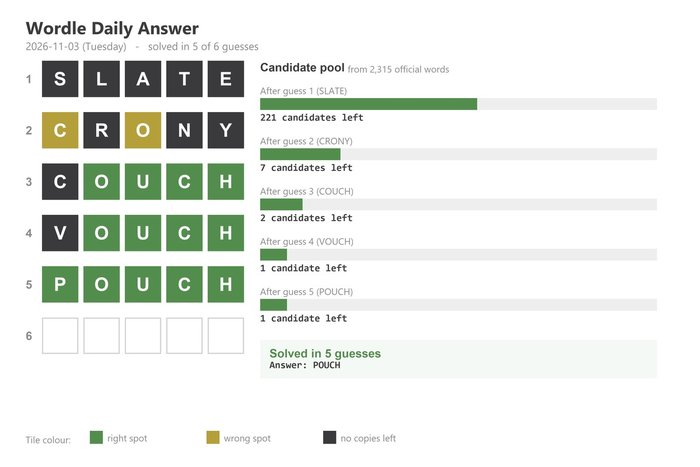
SLATE  ⬛⬛⬛⬛⬛
CRONY  🟨⬛🟨⬛⬛
COUCH  ⬛🟩🟩🟩🟩
VOUCH  ⬛🟩🟩🟩🟩
POUCH  🟩🟩🟩🟩🟩
POUCH is one of the 2,315 words in the official Wordle answer list, so the field we started from is the full 2,315 — no extra word bolted on for this one.
The shape of the board tells the story before any of the explanation does: one dead row, one row with a pair of yellows, then three rows all leaning on the same four green tiles.
The Full Guessing Chain, Step by Step
Five rows, none of them a guess in the casual sense. Each row was picked to divide what was left.
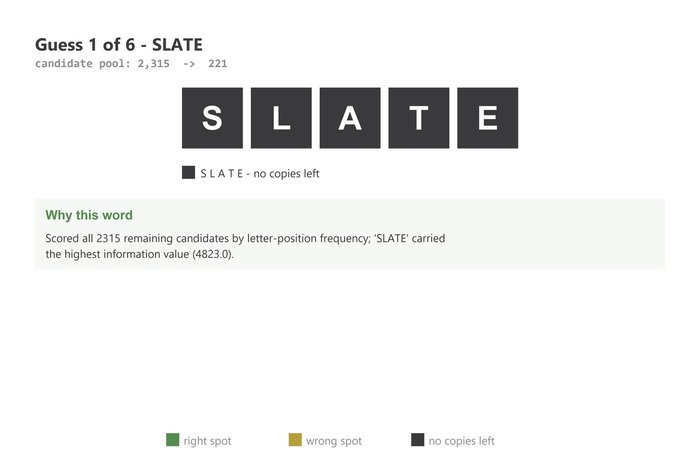
Guess 1: SLATE — 2,315 candidates down to 221
SLATE came back ⬛⬛⬛⬛⬛. All five letters dead in a single row: S, L, A, T and E each have no unclaimed copies left in the answer.
That looks like the worst possible opening. It is close to the best. Five of the most common letters in English left the board at once, and the field fell from 2,315 to 221 — roughly one word in ten survives without any of those five letters. A row that costs one turn and removes most of the dictionary is a good row.
The mistake players make here is treating an all-grey row as wasted and reaching for something exotic on row two. The information is already in hand. An exotic word spends a turn to learn less than the dead row did.
Guess 2: CRONY — 221 down to 7
With S, L, A, T and E gone, the job was to test fresh letters and start pinning them into slots. CRONY produced 🟨⬛🟨⬛⬛:
- C yellow at position 1. C is in the word, but not in the first slot.
- O yellow at position 3. O is in the word, but not in the third slot.
- R, N and Y grey. All three spent.
A yellow tile carries two facts, not one: the letter exists, and one specific position is wrong. After this row the answer had to hold both a C and an O, neither in the slot just tested, and only 7 candidates were still standing.
Guess 3: COUCH — 7 down to 2
COUCH is the row worth studying. It came back ⬛🟩🟩🟩🟩 — four green, one grey.
- C at position 1 grey. Row two had already said C is not in the first slot, so this confirms rather than surprises.
- O, U, C and H green at positions 2, 3, 4 and 5. The answer ends in OUCH.
The word was now known except for its first letter. And that grey tile at position 1 is the day's clearest demonstration of how the marking works: COUCH contains two Cs. The one at position 4 matched the answer and turned green, which spent the answer's single C. The one at position 1 had no C left to claim, so it went grey. Same letter, same row, two colours — because the tiles count copies, they do not look up letters.
Seven candidates in, two out. With _OUCH fixed, only two words were still alive.
Guess 4: VOUCH — 2 down to 1
VOUCH returned ⬛🟩🟩🟩🟩: the four known letters held, V was spent.
Two candidates remained, and this row tested one of them. When the field is down to two, either word is a free shot — if VOUCH had been the answer the puzzle ends, and if it was not, exactly one word is left. The row cost a turn and bought certainty.
Guess 5: POUCH — confirmation
One candidate standing, so the last row is paperwork. POUCH came back all green and the puzzle closed in five.
Note what the chain never did: it never tested the first letter on its own. Rows one to four pinned four positions and spent nine letters getting there, and the fifth letter fell out of the arithmetic.
How the Candidate Pool Collapsed
| Guess | Word | Candidates left |
|---|---|---|
| start | — | 2,315 |
| 1 | SLATE | 221 |
| 2 | CRONY | 7 |
| 3 | COUCH | 2 |
| 4 | VOUCH | 1 |
| 5 | POUCH | 1 |
Three things stand out.
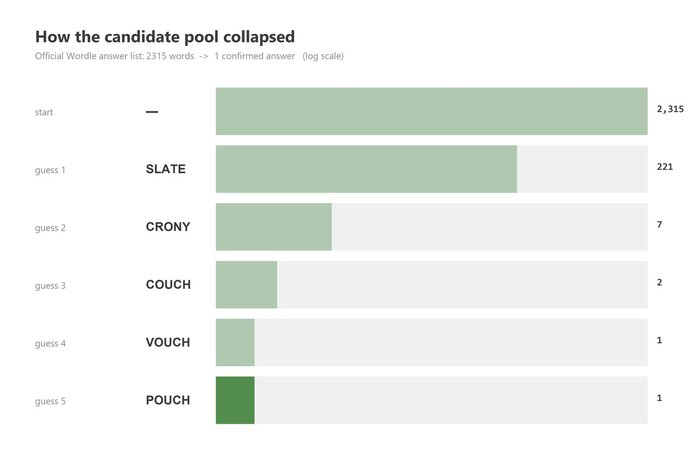
First, the biggest proportional cut came from the yellows, not the greens. Row one removed far more words in absolute terms — 2,315 down to 221 — but row two cut 221 to 7, roughly thirty times over. A green tile confirms one position. A yellow tile confirms a letter and denies a position, and on a small pool that denial is worth more.
Second, nothing stalled. Every row more than halved what remained: about ten times, then about thirty, then about three, then two, then flat.
Third, the flat tail is not waste. Once one candidate remains, 1 to 1 means the word is known and the last row only proves it. The funnel has already done its job; the closing row is a receipt.
The Rule That Makes Wordle Filtering Work
Most Wordle arguments start from one wrong reading of grey. A grey tile does not mean the letter is missing. It means the answer has no unclaimed copies of that letter left.
Today's third row is the cleanest version of that sentence. COUCH holds two Cs and the answer holds one. One C landed on position 4 and turned green; the other came back grey. Anyone who reads grey as a verdict on the letter would conclude that the answer holds no C at all, and then be baffled by POUCH.
The bookkeeping runs in two passes, and it is worth doing explicitly:
- Mark every position that matches the answer as green, and take those letters out of the answer's inventory.
- For every position still unmarked, mark yellow if the guess letter still has inventory left, otherwise grey.
Read each tile as a statement about counts and the board becomes arithmetic. That is the whole filtering engine; the rest is choosing which word to spend.
On choosing: score every surviving candidate by how often its letters sit in each position across the field, weight the positional part heavily, and add a small bonus for distinct-letter coverage. Position beats presence. It is why SLATE is a strong opener even on a day it returns nothing — five different letters in five different slots, none repeated, so the row can discriminate in five places at once.
The published work on the game points the same way. A University of Aberdeen research group showed that a strong fixed opener plus disciplined follow-up finds the target in three to four moves; a Binghamton University team formalises the same intuition with information entropy; a University of Basel bachelor's thesis puts entropy-driven play at an average of 3.43 guesses. None of it depends on intuition about words. All of it depends on counting tiles.
What You Can Take Away
An all-grey row is information, not bad luck. Five dead letters is a five-way exclusion, and exclusions are what shrink the field. Today's opener removed most of the dictionary in one turn. Treat that row as a result, not a setback.
Yellows are worth double. A yellow tells you the letter is present and that one slot is wrong. Today's two yellows took 221 candidates down to 7 — the sharpest cut of the whole chain, from the row with no greens at all.
With two candidates left, the probe is free. When only two words fit the clues, either one is a safe submission: right, and you are done; wrong, and the other is certain. Spend the row without agonising over which of the two is more likely.
If you want to play the same board or see how it compares with earlier days, the Wordle game page and the daily answer archive both run free, with no sign-up.