
The Wordle answer for October 24, 2026 is HOLEY. If you only want a wordle hint 24 oct 2026 before the reveal: the word starts with H and ends in Y. Below is the complete 5-guess chain, how 2,316 candidates collapsed to one, and the grey-tile rule that made the filtering work.
The Wordle answer for October 24, 2026 is HOLEY. Five guesses, no wasted rows, and one genuinely instructive moment in the middle where a grey tile told us more than any green one could.
This is a walkthrough of the whole chain: what each guess tested, what the colours actually ruled out, and how the field went from 2,316 possible words to a single confirmed answer. Everything below was played out on our own free daily Wordle, so the board in the screenshots is the board you would see if you opened it yourself.
If you came here for a Wordle hint 24 oct 2026 and nothing else, take this one line: the answer starts with H, ends in Y, holds exactly one E, and the middle letter is not O. That is enough to narrow the field hard without giving the word away. What follows is the reasoning — the five rows that got us there, and why the second row was the one that decided the puzzle.
Today's Answer and the Final Board
The answer was HOLEY, solved in 5 guesses out of the 6 the puzzle allows.
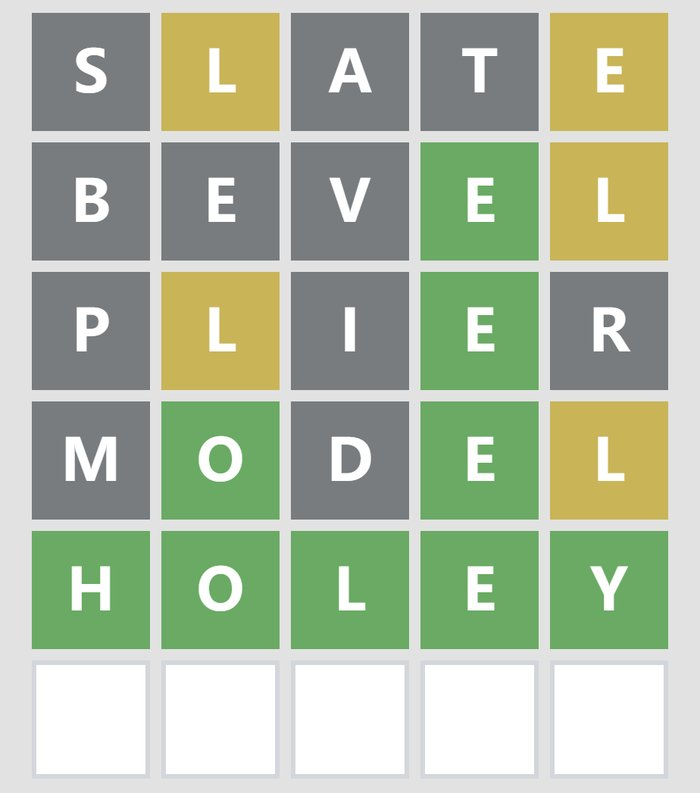
SLATE  ⬛🟨⬛⬛🟨
BEVEL  ⬛⬛⬛🟩🟨
PLIER  ⬛🟨⬛🟩⬛
MODEL  ⬛🟩⬛🟩🟨
HOLEY  🟩🟩🟩🟩🟩
One word of housekeeping on the numbers: the candidate pool we track is 2,316 words. That is the widely used 2,315-word answer list plus today's word, because HOLEY postdates that snapshot. Treat 2,316 as the starting field for this puzzle, not 2,315.
The Full Guessing Chain, Step by Step
Guess 1: SLATE — 2,316 candidates down to 114
SLATE is a common opener for a reason: five of the most frequent letters in the language, all distinct, no repeats. Today it paid off immediately.
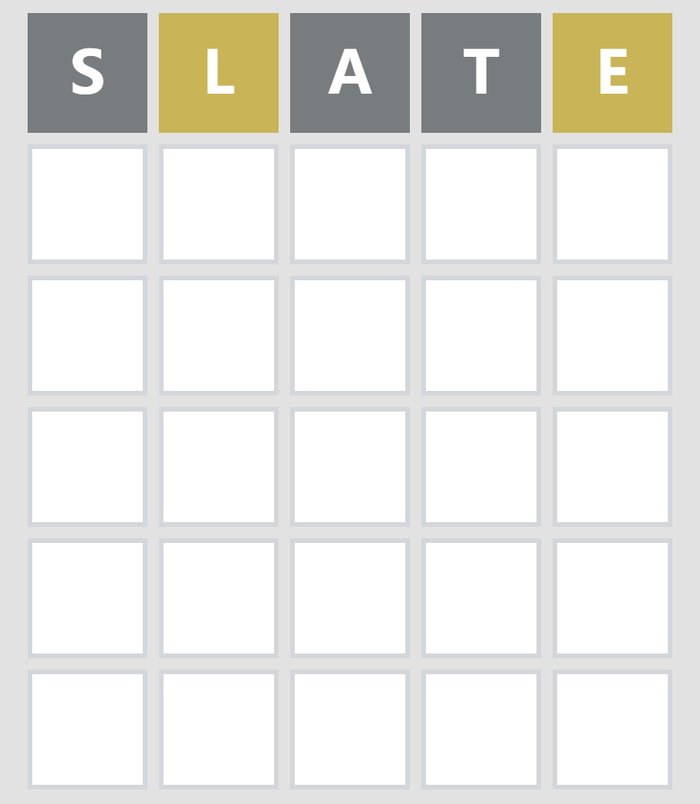
- S, A, T came back grey. Those three letters have no copies left in the answer.
- L came back yellow, meaning L is in the word but not in position 2.
- E came back yellow, meaning E is in the word but not in position 5.
That is a lot of information from one row. Three letters eliminated outright, two letters confirmed present with one position each excluded, and 2,316 candidates collapsed to 114 — a 95% cut in a single guess.
The tempting mistake here is to read the grey S, A and T as "the answer is unusual". It is not. The answer simply does not contain those letters, and there are plenty of common five-letter words built from the remaining alphabet.
Guess 2: BEVEL — 114 candidates down to 24
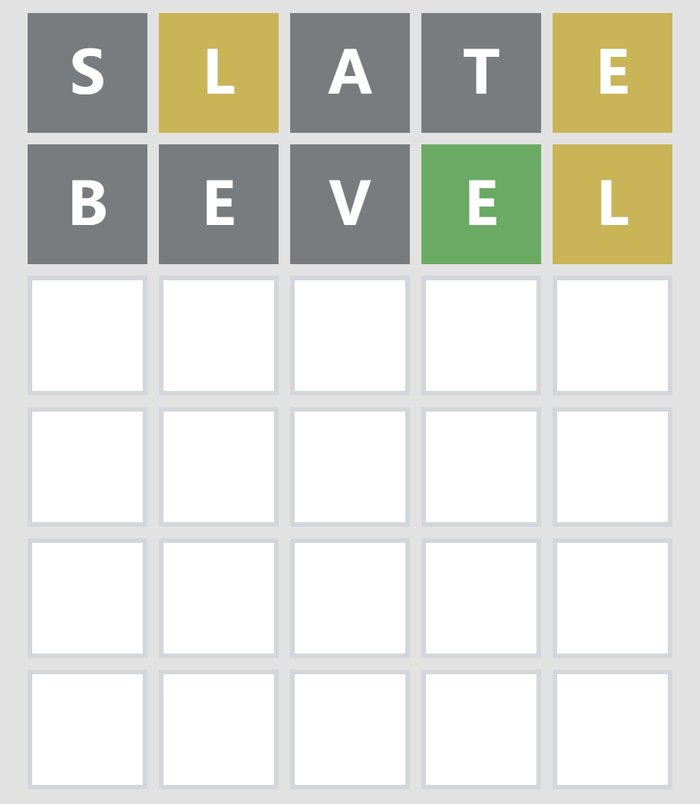
With L and E confirmed present, the next job was to place them and to test a fresh set of consonants. BEVEL did both, and produced the most interesting row of the day.
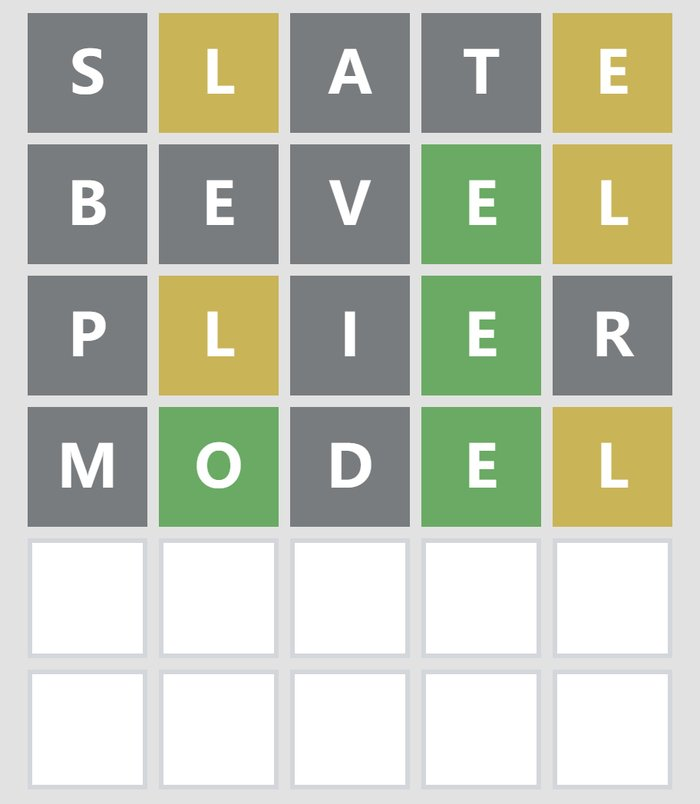
- B and V came back grey. Both eliminated.
- The second E, in position 2, came back grey. This is the key tile.
- The E in position 4 came back green. Position 4 is E.
- L in position 5 came back yellow. So L is not in position 5 either.
Read those two E tiles together. The answer contains a single E, that E sits in position 4, and the E we placed in position 2 has no remaining copy to claim. A grey E right next to a green E is not a contradiction — it is the two-pass marking rule doing exactly what it is supposed to do, and it silently rules out every candidate with a double E. That is why the pool fell from 114 to 24 in one row.
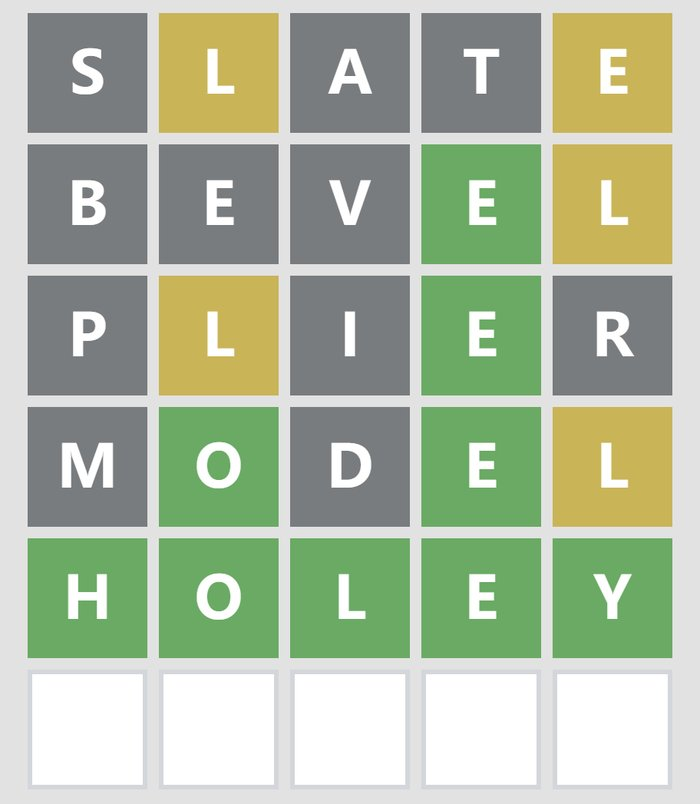
At this point the board says: position 4 is E, L is in the word but not in position 5, and there is exactly one E in the answer.
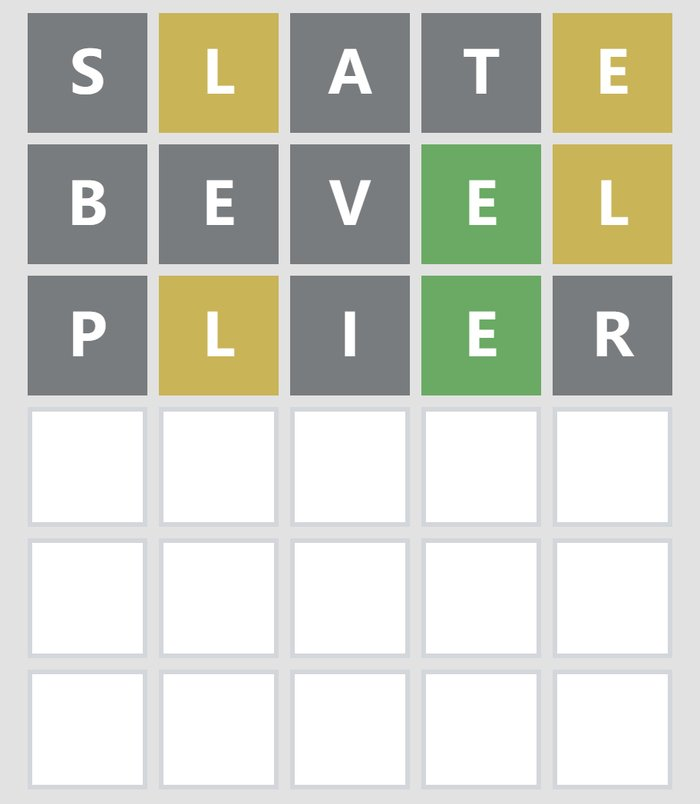
Guess 3: PLIER — 24 candidates down to 7
PLIER was chosen to test three untried consonants (P, I, R) while re-checking L in a different slot.
- P, I and R all came back grey. Eliminated.
- E in position 4 confirmed green again.
- L in position 2 came back yellow. So L is not in position 2.
Two yellow tiles for L across three guesses now say: L is not in position 2 and not in position 5. Since position 4 is E, L has to live in position 1 or position 3. Seven candidates remain.
Guess 4: MODEL — 7 candidates down to 1
This row did the structural work.
- M and D grey, eliminated.
- O in position 2 green. Position 2 is O.
- E in position 4 green, confirming the anchor.
- L in position 5 yellow — consistent with everything before, still not position 5.
Now combine the constraints. Position 2 is O, so L cannot be there. Position 5 is ruled out. Position 4 is E. That leaves L in position 1 or position 3, with a single candidate left in the pool.
Guess 5: HOLEY — confirmation
With one candidate standing, the row is not really a guess. HOLEY came back all green in five tiles, and the puzzle was done in five.
Note what the answer looks like next to the clues: H (untested until the end), O (pinned on guess 4), L (the letter every middle guess kept rotating), E (pinned on guess 2), Y (also untested). The last row is a confirmation, not a deduction — and that is exactly what a healthy candidate pool is supposed to produce.
How the Candidate Pool Collapsed
The numbers, in order:
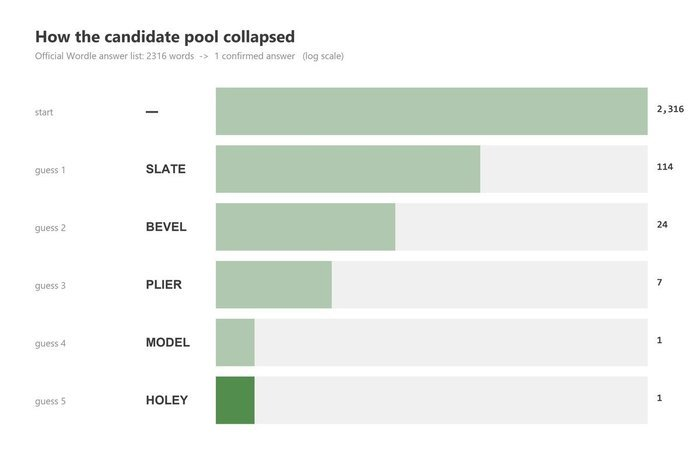
| Guess | Word | Candidates left |
|---|---|---|
| start | — | 2,316 |
| 1 | SLATE | 114 |
| 2 | BEVEL | 24 |
| 3 | PLIER | 7 |
| 4 | MODEL | 1 |
| 5 | HOLEY | 1 |
Two things stand out.
First, the biggest cut happened on the very first guess, and it had nothing to do with luck. SLATE eliminated three letters and placed two more into the "present but wrong slot" bucket. Both kinds of clue are filtering operations, and the second kind is the one players tend to under-use.
Second, the pool never stalled. Each guess more than halved the field: 20x, then 5x, then 3.4x, then 7x. A guess that narrows the field by less than half is a guess that spent a row on confirmation rather than information — useful when you are close, expensive when you are not.
The flattening at the end is not inefficiency. Once one candidate remains, "1 to 1" is the correct outcome: the answer is known, and the final row just proves it.
The Rule That Makes Wordle Filtering Work
Most of the confusion around Wordle comes from one misreading of grey tiles. A grey tile does not mean "this letter is not in the answer". It means "the answer uses no more copies of this letter than the green and yellow tiles have already claimed".
Today's second guess is the clean demonstration. BEVEL contains two Es. One of them landed on the answer's single E and turned green. The other came back grey — not because E is absent, but because the answer's supply of E was already spent by the green tile. A player who treats grey as "E is gone" reaches the same conclusion here by luck, but that shorthand breaks on words with repeated letters, and it breaks silently.
The correct bookkeeping, the same one used by the official scoring rules, runs in two passes:
- Mark every position that matches exactly as green, and remove those letters from the answer's remaining inventory.
- For every remaining position, mark yellow if the guess letter still has inventory left in the answer; otherwise grey.
Read as a counting rule rather than a presence rule, every yellow and grey tile becomes a statement about quantity. That is the entire filtering engine — the rest is choosing which word to spend next.
On choosing: a useful heuristic scores each candidate by letter-position frequency across the field (weighted heavily) plus distinct-letter coverage (weighted lightly). Position beats presence. That is why SLATE was a strong opener and why BEVEL — a word nobody would guess as an answer — was a strong second guess. Probe words are not supposed to look like answers.
This is also where the academic work lands. Professor Nir Oren, Director of Research at the University of Aberdeen's School of Natural and Computing Sciences, , showing that a strong opener plus disciplined follow-up locates the target in three to four moves. A research team at Binghamton University formalises the same intuition with entropy, in a peer-reviewed information-theory treatment. And Floyd Peiszan's bachelor's thesis at the University of Basel, , puts entropy-based play at an average of 3.43 guesses — within about 1% of optimal.
What You Can Take Away
Three habits from today's chain transfer to any Wordle day.
Treat grey as a count, not an absence. The moment a green tile claims a letter, every other copy of that letter in the same guess is grey by construction. Understanding that stops the "why is this E grey when E is right there" confusion, and it prevents you from ruling out words that legitimately repeat a letter.
Play probe words that do not look like answers. BEVEL is not a plausible answer to anything. It was still the best second guess on the board, because it tested V, re-tested L in a new slot, and forced the E-count question. Early guesses are for information, not for glory.
Watch the position exclusions, not just the letter exclusions. L was present from guess 1. It took four rows to force its position, because each row eliminated one slot. Tracking "L not position 2, not position 5" is what made the final answer fall out; tracking only "L is in the word" would have left several candidates alive.
If you want to try the same discipline on today's puzzle, the daily answer archive and the Wordle game page both run the same board shown above, with no sign-up and unlimited replays.