
The Wordle answer for October 28, 2026 is GRIST. If you only want a wordle hint 28 oct 2026 before the reveal: the word starts with G and ends in T. Below is the complete 4-guess chain, how 2,316 candidates collapsed to one, and the grey-tile rule that made the filtering work.
The Wordle answer for October 28, 2026 is GRIST. Four guesses, puzzle No. 1957, and the board never looked lost for a single row.
The opening was neither a disaster nor a jackpot. SLATE came back with two yellow tiles and three grey ones — S and T are in the word but sitting in the wrong slots, while L, A and E are finished. That mixed result is the most useful thing a first row can hand you, and it is why the field fell from 2,316 words to 25 in a single move.
If you only want a wordle hint 28 oct 2026 before the reveal: five letters, one syllable, starts with G, ends with T, and it names the substance of a thing — the part worth keeping. The rest of this page is the reasoning, in order.
Everything below was played on the free daily Wordle on this site, so the board in the screenshots is the board you get if you open the same puzzle yourself.
Today's Answer and the Final Board
The answer was GRIST, solved in 4 guesses out of the 6 the puzzle allows.
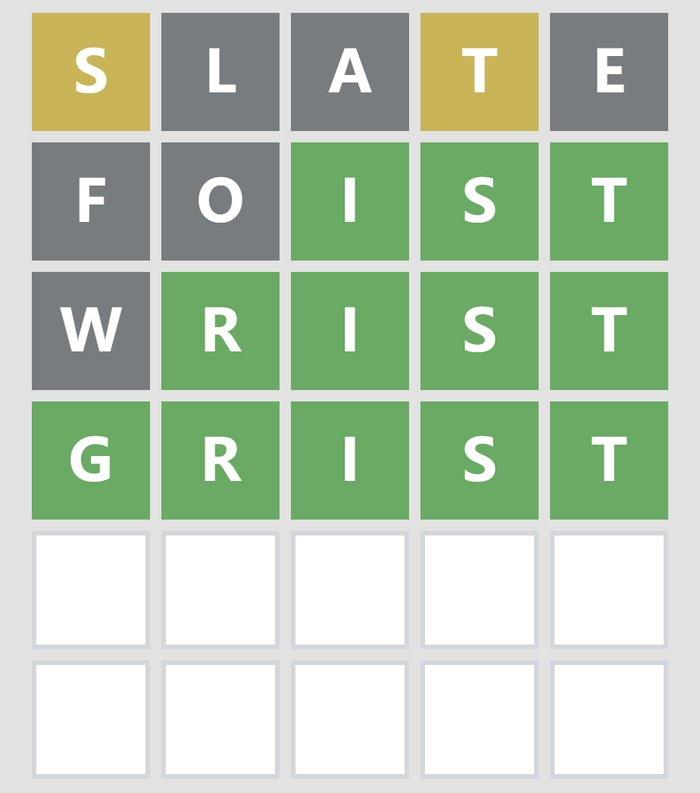
SLATE  🟨⬛⬛🟨⬛
FOIST  ⬛⬛🟩🟩🟩
WRIST  ⬛🟩🟩🟩🟩
GRIST  🟩🟩🟩🟩🟩
One note on the starting number. The field is tracked against the 2,315-word Wordle answer-list snapshot from 2022. GRIST is not in that snapshot — today's word postdates it — so the snapshot plus today's word gives a starting field of 2,316. That is where the funnel begins.
The Full Guessing Chain, Step by Step
Guess 1: SLATE — 2,316 candidates down to 25
SLATE is the fixed opener here: five distinct letters, each among the most frequent in English, no repeats to complicate the read. Across the full 2,316-word field it carried the highest information value of any word, which is what a first guess is for.
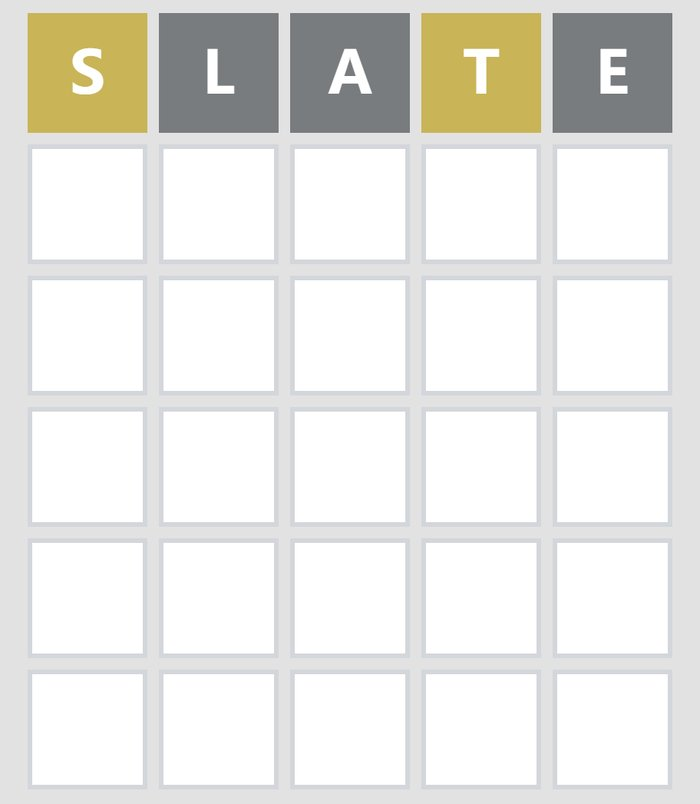
- S in slot 1 came back yellow. S is in the answer, not in the first slot.
- T in slot 4 came back yellow. T is in the answer, not in the fourth slot.
- L, A and E came back grey. Each of those letters has no copies left in the answer.
Because SLATE contains no repeated letters, each grey tile settles its letter's entire supply on its own — three unconditional deletions, no counting subtlety to untangle. The two yellows each did two things at once: claimed one copy of a letter and banned one slot for it.
2,316 candidates collapsed to 25. Those 25 were not a random sample either: every one of them contains both S and T, and nineteen of them end in -ST. A word list had turned into a family with a shared skeleton.
Guess 2: FOIST — 25 candidates down to 3
With L, A and E gone, the second row had real work to do: place the two confirmed letters into slots the yellows had not banned, and open up fresh consonants at the same time. FOIST ranked first among the 25 on position frequency. It puts I, S and T into slots 3, 4 and 5 — the three slots the yellows left open for S and T — while spending its first two slots on F and O, letters untouched so far.
- F in slot 1 came back grey. No copies left.
- O in slot 2 came back grey. No copies left.
- I in slot 3, S in slot 4, T in slot 5 all came back green.
Three greens in a row is the strongest signal the game gives. The answer now had to end in I-S-T, and the field of 25 fell to 3:
TWIST, WRIST, GRIST
Look at what is left to decide. All three share slots 3-5. Slot 1 holds T, W or G. Slot 2 holds W or R. The whole puzzle had been reduced to two slots and three possible combinations.
There is a satisfying detail in how the yellows paid off. Row 1 banned S from slot 1 and T from slot 4. Row 2 put S in slot 4 and T in slot 5 — both landed one slot to the right of where they had been rejected, which is exactly the outcome a yellow tile is quietly pointing at.
Guess 3: WRIST — 3 candidates down to 1
WRIST was the top-ranked of the three on position frequency, but the ranking is not why it was the right row. Look at where the three words disagree: slot 1 and slot 2. Now look at WRIST — its W sits in slot 1 and its R sits in slot 2. One word, testing both discriminating slots at once.
- W in slot 1 came back grey. The answer holds no W — which removes TWIST (W in slot 2) and removes WRIST itself (W in slot 1).
- R in slot 2 came back green. Slot 2 is R, which confirms GRIST and, independently, also kills TWIST, since TWIST has W there.
- I, S and T stayed green.
Two separate lines of reasoning arrived at the same single survivor. GRIST was the only word left.
This is the part of a Wordle chain that gets undersold: the third row was not a guess among three, it was a probe built to split three. Any of the three would have been a legal guess. Only one of them resolves the field whichever way the colours fall.
Guess 4: GRIST — 1 candidate down to 1
One candidate remained, so the fourth row only had to be typed. Worth saying plainly instead of dressing it up: the puzzle was solved by the third row. The fourth was bookkeeping.
How the Candidate Pool Collapsed
The numbers, in order:
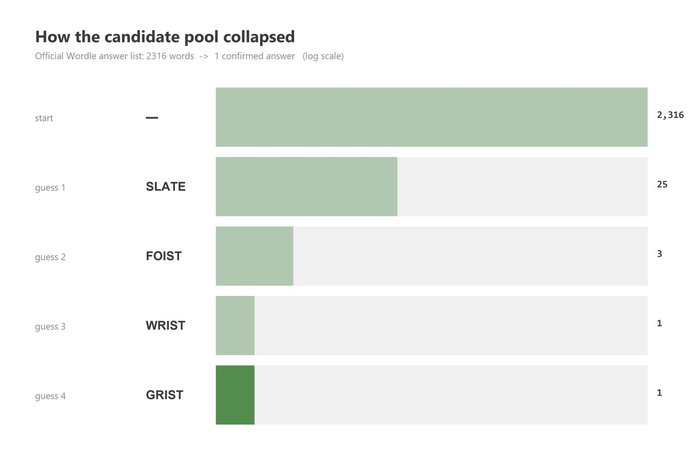
| Guess | Word | Candidates left |
|---|---|---|
| start | — | 2,316 |
| 1 | SLATE | 25 |
| 2 | FOIST | 3 |
| 3 | WRIST | 1 |
| 4 | GRIST | 1 |
Three things stand out.
First, the opener carried almost the whole load. 2,316 down to 25 in one row, and it came from a row that looked half-failed. Two yellows feel like a partial result; in practice two yellows plus three greys is the tightest constraint a five-letter opener can produce, because the greys delete letters outright while the yellows convert into slot bans.
Second, FOIST was the row that turned letters into positions. Greens are worth more than yellows for a structural reason: a yellow narrows a letter to four slots, a green closes a slot permanently. Three greens in slots 3-5 took 25 words to 3, and did it while also eliminating two fresh letters.
Third, the last real decision was a three-way split, and no probe row was wasted on it. On harder days the solver deliberately spends a row on a word that cannot be the answer, purely to divide the remaining field. Today it never had to, because the top-ranked candidate and the best available probe happened to be the same word.
The Rule That Makes Wordle Filtering Work
Most confusion about Wordle traces back to treating the three tile colours as three shades of one statement. They are not. Each colour makes a different kind of claim.
- Green says: right letter, right slot — and one copy of that letter is now accounted for.
- Yellow says: one copy of that letter is accounted for, and this slot is excluded for it.
- Grey says: the answer's supply of that letter is exhausted.
The grey is the one people get wrong. It is a statement about quantity, not a verdict on the letter. That distinction only bites when a guess has repeated letters, but it decides the puzzle when it does: a grey tile can mean "no copy left once the claimed ones are counted", which is far narrower than a blanket exclusion.
Today offers a cleaner example than repeats do. SLATE's S came back yellow in slot 1. Two rows later the same S came back green in slot 4. Nothing about the word changed in between — the yellow had said one S exists and slot 1 is not it, and slot 4 was always allowed.
The bookkeeping that follows is the same two-pass marking the official rules use:
- Mark every position that matches exactly as green, and subtract those letters from the answer's remaining inventory.
- For every remaining position, mark yellow if the guess letter still has inventory left in the answer; otherwise grey.
Read as counts rather than presence, every tile becomes something a filter can consume. The filter then does the boring part: keep a candidate only if replaying the guess against it reproduces the exact same pattern of greens, yellows and greys. Not "does it contain S" but "would S have scored exactly this way against this word" — the second question has a single correct answer, and the first one quietly loses words it should have kept.
For choosing what to spend next, the heuristic is simple and it holds up: score each candidate by how often its letters appear in each position across the surviving field, weighted heavily, plus distinct-letter coverage, weighted lightly. Position beats presence. That is the whole reason three greens outperform five yellows — they do not just tell you which letters are available, they tell you where those letters are allowed to be.
What You Can Take Away
A mixed opening row is the best case, not a compromise. Three greys delete three letters outright; two yellows hand you two letters and two banned slots. That combination is a tighter constraint than five greys, because it starts placing letters instead of only removing them.
When the shortlist is tiny, stop guessing and start splitting. Three words that share three slots are one decision with three branches. Find the slots where they differ, then pick the word that tests a letter in each of those slots. WRIST's W and R sat exactly on the two disagreements, which is why one row finished the job.
Positions collapse fields; letters only narrow them. 25 words to 3 came from three greens, not from knowing more letters. Given the choice between a row that touches many letters and a row that locks two more slots, take the slots.
Keep counting, not collecting. A single yellow tile is a floor on how many copies the answer holds, never a ceiling. The moment it is treated as a ceiling, the words that are actually still alive start getting deleted.
If you want to run the same discipline on today's puzzle, the Wordle game page serves the board shown above, and the daily answer archive has the full chain for every previous day — no sign-up, unlimited replays.