
The Wordle answer for October 27, 2026 is BINGO. If you only want a wordle hint 27 oct 2026 before the reveal: the word starts with B and ends in O. Below is the complete 3-guess chain, how 2,315 candidates collapsed to one, and the grey-tile rule that made the filtering work.
The Wordle answer for October 27, 2026 is BINGO. Three guesses — and the first one came back completely grey.
That is usually read as bad luck. It isn't. SLATE wiped out five of the most common letters in the language in a single row, and the field fell from 2,315 words to 221 before the second guess was even chosen. Two rows later there were six candidates left, and the third row closed it.
This is the whole chain: what each guess tested, what the colours actually ruled out, and how the field went from 2,315 possible words down to one. It was played out on our own free daily Wordle, so the board in the screenshot is the board you would see if you opened it yourself.
If you came here for a Wordle hint 27 oct 2026 and nothing else: the word starts with B, ends with O, and its two confirmed letters — N and O — sit one slot away from where a bad second guess placed them. That narrows it hard without naming it. What follows is the reasoning.
Today's Answer and the Final Board
The answer was BINGO, solved in 3 guesses out of the 6 the puzzle allows.
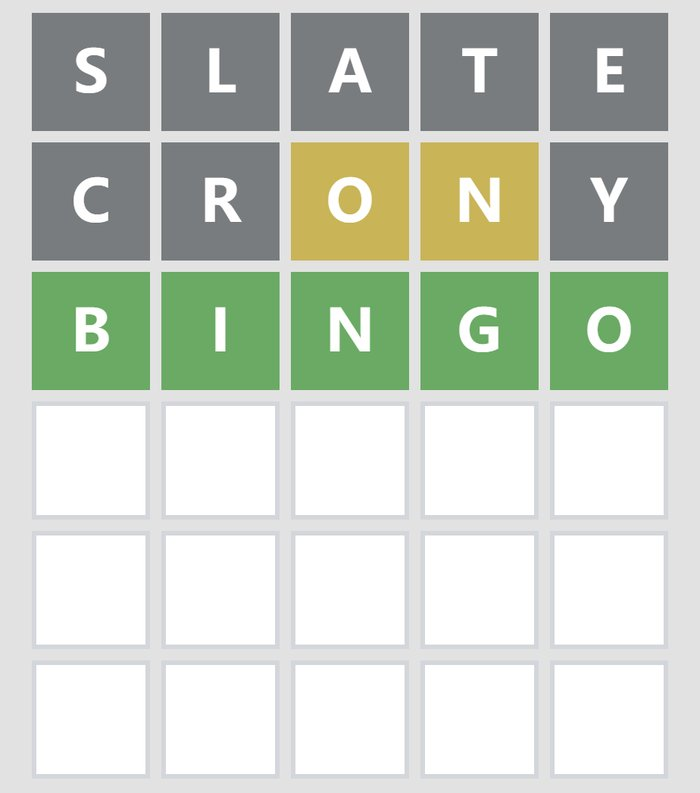
SLATE  ⬛⬛⬛⬛⬛
CRONY  ⬛⬛🟨🟨⬛
BINGO  🟩🟩🟩🟩🟩
One note on the numbers: the candidate pool tracked here is the official 2,315-word Wordle answer list snapshot. BINGO is part of that list, so there is no adjustment today — 2,315 is the starting field exactly as it stands.
The Full Guessing Chain, Step by Step
Guess 1: SLATE — 2,315 candidates down to 221
SLATE is the fixed opener of this solver: five distinct letters, each one among the most frequent in the language, no repeats to muddy the read. Today it produced the cleanest possible result.
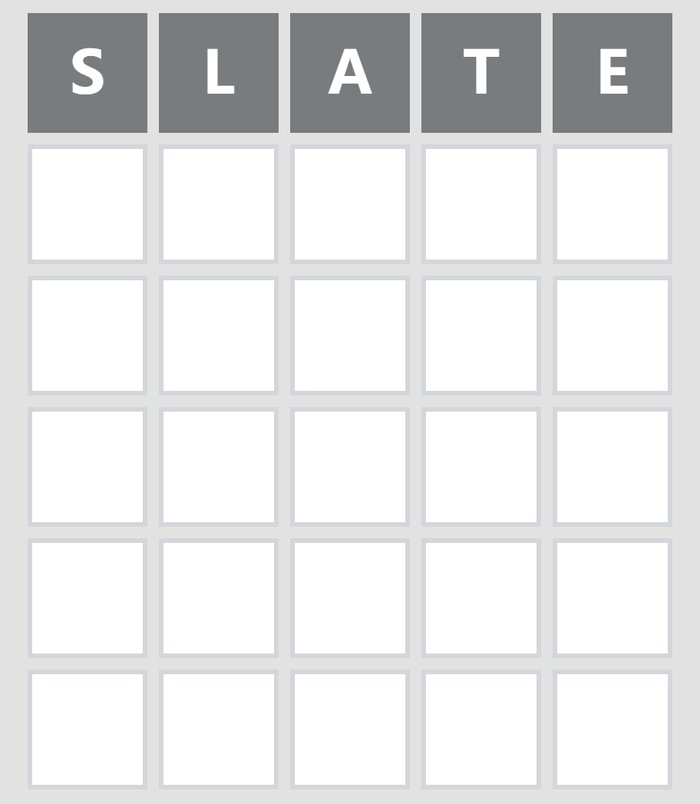
- S, L, A, T and E all came back grey.
Because no letter appears twice in SLATE, each grey tile settles that letter's entire supply on its own. Five greys means five letters with nothing left in the answer's inventory — and five of the twelve most-used letters in English are gone after one row.
2,315 candidates collapsed to 221. Roughly nine in ten words were eliminated by the opening guess alone.
Guess 2: CRONY — 221 candidates down to 6
With all five openers dead, the second guess had to do something different: probe a fresh set of consonants and, critically, test the vowels that survived. A, E were gone. I, O and U were untested. CRONY carried O and the consonant pair C-R, plus N and Y.
- C, R and Y came back grey. Eliminated outright.
- O in position 3 came back yellow. O is in the word, but not in the third slot.
- N in position 4 came back yellow. N is in the word, but not in the fourth slot.
Two rows, eight letters erased: S, L, A, T, E, C, R, Y. Two letters confirmed, both with a position exclusion attached. That is a lot of structure for 221 words to survive, and only six did:
BINGO, BONGO, DINGO, INBOX, ONION, UNION
Look at what those six have in common, because it is not a coincidence. Every one of them contains an N in slot 2 or slot 3, and an O in slot 4 or slot 5 — precisely the placements CRONY left legal. Three of them end in the same three-letter run, N-G-O. Two of them end in N-I-O-N. Only INBOX stands apart.
That is the shape of a puzzle that has been squeezed correctly: the shortlist stopped looking like a word list and started looking like a family.
Guess 3: BINGO — 6 candidates down to 1
BINGO ranked first among the six on position frequency, at 37.5 against 34.5 for DINGO and 33.0 for BONGO. It also happens to be a well-designed probe for this particular shortlist: it differs from BONGO only in slot 2 and from DINGO only in slot 1, so even a miss would have split the field immediately rather than leaving six words standing.
- B, I, N, G and O — all five green.
The two yellow tiles paid off exactly where the exclusions said they could. O had been ruled out of slot 3; it sat in slot 5. N had been ruled out of slot 4; it sat in slot 3, one slot to the left of its rejected home. Solved in 3.
Worth being honest about the last row: this was a hit on a six-word shortlist, not a deduction down to one word. Six candidates with four rows still available is a position where guessing one of them is correct play — the elimination work was already finished, and the final row only had to land.
How the Candidate Pool Collapsed
The numbers, in order:
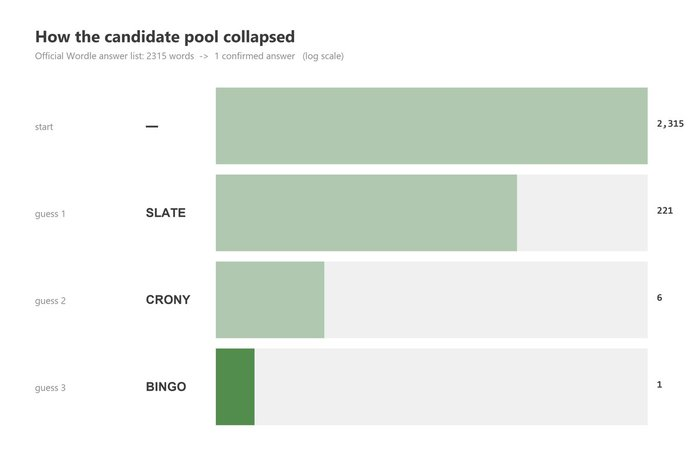
| Guess | Word | Candidates left |
|---|---|---|
| start | — | 2,315 |
| 1 | SLATE | 221 |
| 2 | CRONY | 6 |
| 3 | BINGO | 1 |
Three things stand out.
First, the all-grey opener did almost all of the work. 2,315 down to 221 is roughly nine in ten words gone in a single row, and it came from a guess that looked like it had failed. A grey row from a five-distinct-letter opener is the cleanest information event available on the opening — every tile is an unconditional deletion, with no counting ambiguity to resolve.
Second, CRONY was the precision row. Grey consonants thin a field; yellow vowels reshape it. O excluded from slot 3 and N excluded from slot 4 forced every survivor into a narrow band of skeletons, and the pool went from 221 to 6 in one move.
Third, no probe row was needed. On all three rows the highest-information word was also a live candidate, which is the best case a solver can be in. On harder days the solver deliberately spends a row on a word that cannot be the answer, purely to split the remaining field. Today's chain never had to — the shortlist was small enough that a winning guess and an informative guess were the same word.
The Rule That Makes Wordle Filtering Work
Most Wordle confusion traces back to one misreading of the colour tiles. A grey tile does not report "this letter is not in the answer". It reports that the answer's remaining supply of that letter is zero. A yellow tile does not report "this letter appears once". It reports that the tile has claimed one copy, in a slot now excluded.
The difference matters most when a guess has repeated letters, but today it shows up in a subtler place — the second row's single yellow N.
CRONY contains one N, and it came back yellow. It is tempting to conclude that the answer holds exactly one N. It does not follow. One yellow tile can only claim one copy, so a single yellow N is a floor, never a ceiling. ONION and UNION both carry two N's, and both were perfectly legal survivors of the CRONY row. A player who reads a yellow as a cap would have deleted two of the six real candidates and never known it.
The correct bookkeeping, the same one the official scoring rules use, runs in two passes:
- Mark every position that matches exactly as green, and subtract those letters from the answer's remaining inventory.
- For every remaining position, mark yellow if the guess letter still has inventory left in the answer; otherwise grey.
Read as a counting rule rather than a presence rule, every yellow and grey tile becomes a statement about quantity — and quantity is what the candidate filter can actually consume. The rest is choosing which word to spend next. There a simple heuristic carries a long way: score each candidate by letter-position frequency across the surviving field, weighted heavily, plus distinct-letter coverage, weighted lightly. Position beats presence, which is why BINGO edged out DINGO and BONGO on a shortlist where all three letters were already known to be legal.
What You Can Take Away
Three habits from today's chain transfer to any Wordle day.
An all-grey opener is a gift, not a disaster. Five greys from a word with no repeated letters deletes five letters completely and unambiguously. Treat the row as five eliminations rather than a failed guess, and the pool numbers stop feeling like bad luck.
When the shortlist gets small, read its shape. Six words that all share an N in slot 2 or 3 and an O in slot 4 or 5 are not six independent guesses — they are one family with a handful of variants. Spotting the shared skeleton is what turns a coin flip into a decision.
Yellow is a floor, not a ceiling. One yellow N says the answer holds at least one N. It says nothing about a second. Don't let a single yellow tile talk you out of double-letter words before the greens have had their say.
If you want to run the same discipline on today's puzzle, the Wordle game page serves the same board shown above, and the daily answer archive has the full chain for every previous day — no sign-up, unlimited replays.