
The Wordle answer for October 25, 2026 is DRESS. If you only want a wordle hint 25 oct 2026 before the reveal: the word starts with D and ends in S. Below is the complete 4-guess chain, how 2,315 candidates collapsed to one, and the grey-tile rule that made the filtering work.
The Wordle answer for October 25, 2026 is DRESS. Four guesses, a first row that did most of the heavy lifting, and a final one-letter decision between two words that differed only at the front.
This is a walkthrough of the whole chain: what each guess tested, what the colours actually ruled out, and how the field went from 2,315 possible words down to a single confirmed answer. Everything below was played out on our own free daily Wordle, so the board in the screenshots is the board you would see if you opened it yourself.
If you came here for a Wordle hint 25 oct 2026 and nothing else, take this one line: the answer starts with D, holds exactly one E, and ends in a doubled S. That alone collapses the field to a handful of words without giving the whole thing away. What follows is the reasoning — the four rows that got there, and why the third row decided the puzzle.
Today's Answer and the Final Board
The answer was DRESS, solved in 4 guesses out of the 6 the puzzle allows.
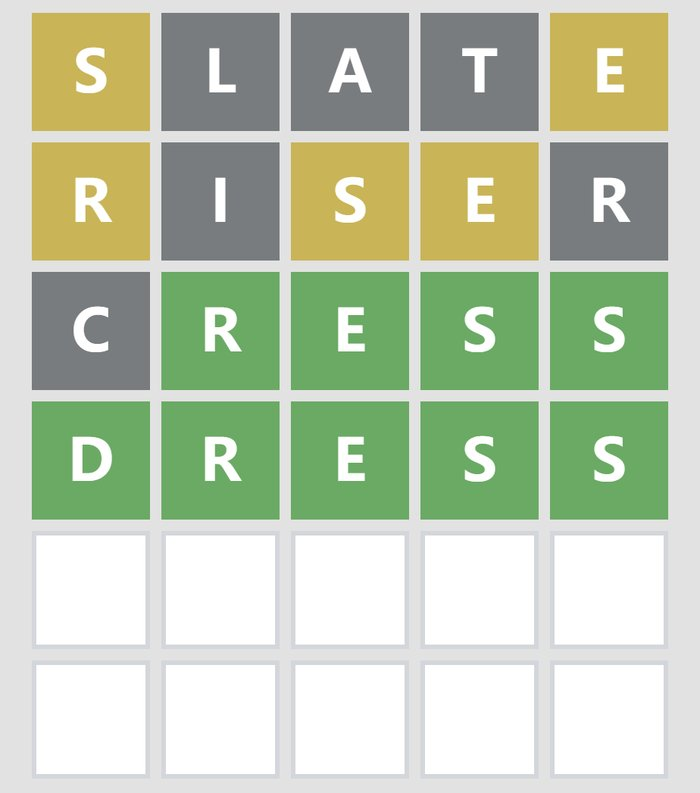
SLATE  🟨⬛⬛⬛🟨
RISER  🟨⬛🟨🟨⬛
CRESS  ⬛🟩🟩🟩🟩
DRESS  🟩🟩🟩🟩🟩
One note on the numbers: the candidate pool we track is the official 2,315-word answer list snapshot. DRESS is part of that list, so today there is no adjustment — 2,315 is the starting field, exactly as it stands.
The Full Guessing Chain, Step by Step
Guess 1: SLATE — 2,315 candidates down to 19
SLATE is the fixed opener of this solver: five distinct letters, all among the most common in the language. Today it earned its keep immediately.
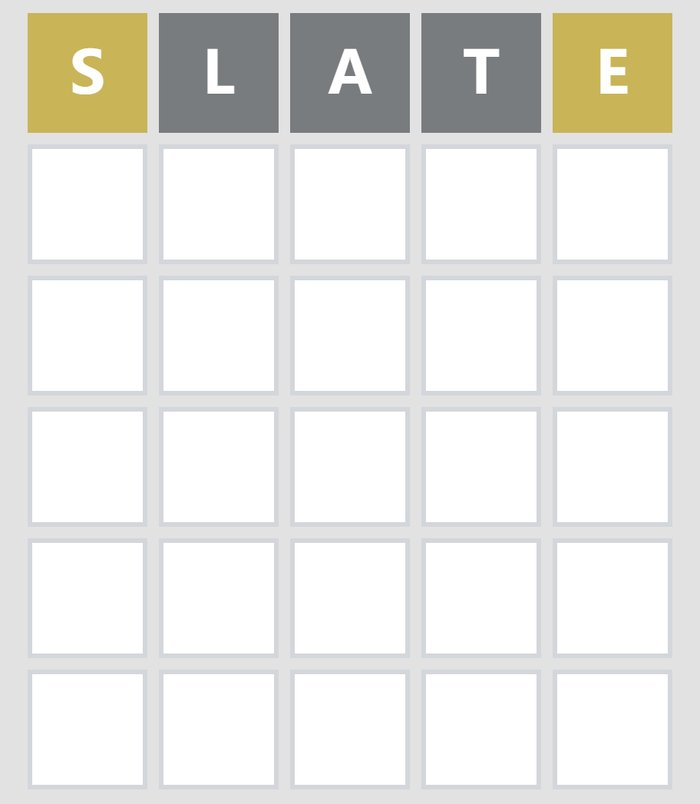
- S came back yellow. S is in the word, but not in position 1.
- E came back yellow. E is in the word, but not in position 5.
- L, A and T came back grey. The answer holds no copies of any of them.
Two letters confirmed present with one wrong slot each, three letters eliminated outright — and 2,315 candidates collapsed to 19. When a first guess leaves fewer than twenty survivors, the rest of the puzzle is mostly bookkeeping.
Guess 2: RISER — 19 candidates down to 5
With S and E confirmed but unplaced, the second guess needed to probe new positions and test fresh consonants. RISER did both — and it was itself one of the 19 survivors, which made it a natural high-information pick.
- R in position 1 came back yellow. R is in the word, but not in position 1.
- I came back grey. Eliminated.
- S in position 3 came back yellow. S is in the word, but not in position 3 either.
- E in position 4 came back yellow. E is not in position 4 — and it already missed position 5 on the opening row, so E has now been cornered into the first three slots.
- The second R, in position 5, came back grey. This is the tile worth studying. R is not absent from the answer — the yellow R in position 1 proves it is there. The second R is grey because the answer contains only one R, and that copy was already claimed by the yellow tile. That is the counting rule at work, and it silently rules out every candidate with a double R.
Five candidates survived the row: CRESS, DRESS, FRESH, PRESS and VERSO.
Guess 3: CRESS — 5 candidates down to 2
CRESS tested the C while re-casting the R-E-S-S skeleton into slots 2 through 5. The answer:
- C came back grey. No copies of C.
- R in position 2, E in position 3, S in position 4, S in position 5 — all four came back green.
Four green tiles in a row say the word ends in -RESS with nothing else to learn about its back half. Every survivor must now look like _RESS, and among the five candidates only two fit: DRESS and PRESS.
Guess 4: DRESS — the one-letter decision
Two candidates, one distinguishing letter at the front. DRESS went in and came back all green in five tiles. Solved in 4.
It is worth noticing what the final board looks like against the clues: D was never tested until the last row, R landed on its first try in position 2, E took three rows to place, and the double S sat in plain sight from the moment CRESS went green. The last row was a confirmation, not a deduction — exactly what a well-managed candidate pool is supposed to produce.
How the Candidate Pool Collapsed
The numbers, in order:
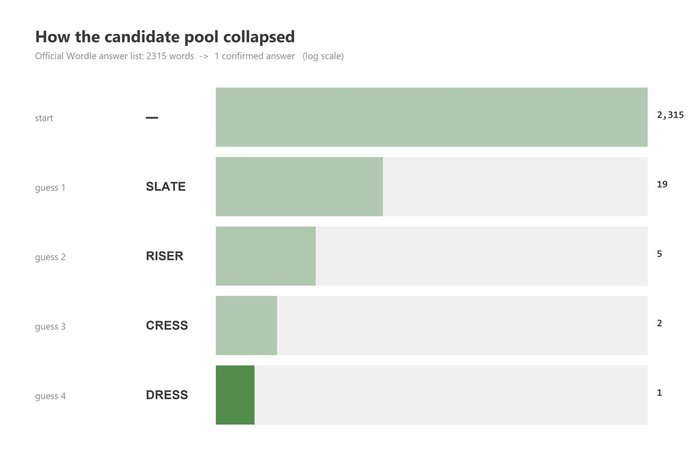
| Guess | Word | Candidates left |
|---|---|---|
| start | — | 2,315 |
| 1 | SLATE | 19 |
| 2 | RISER | 5 |
| 3 | CRESS | 2 |
| 4 | DRESS | 1 |
Three things stand out.
First, the opener did the heavy lifting. 2,315 down to 19 in a single row is the kind of cut that makes the rest of the puzzle tractable — and it came from elimination plus placement, not luck.
Second, every later step at least halved the field: 19 to 5, 5 to 2, 2 to the answer. Nothing stalled.
Third, all four guesses were live candidates. No probe words were needed today — when the highest-information word is also a plausible answer, the choice is easy. On other days the solver deliberately spends a row on a word that cannot be the answer, purely to split the field; today's chain never had to.
The Rule That Makes Wordle Filtering Work
Most Wordle confusion traces back to one misreading of grey tiles. A grey tile does not mean "this letter is not in the answer". It means "the answer contains no more copies of this letter than the green and yellow tiles have already claimed".
Today's second guess is the clean demonstration. RISER holds two Rs. The first came back yellow, proving R is in the word. The second came back grey — not because R vanished, but because the answer's single R was already accounted for. A player who reads grey as "R is gone" would start excluding words like DRESS itself, and dig a hole no logic can climb out of. Read as a count instead, the grey tile is simply bookkeeping: one R in the answer, one claim already filed, zero remaining.
The correct bookkeeping, the same one the official scoring rules use, runs in two passes:
- Mark every position that matches exactly as green, and subtract those letters from the answer's remaining inventory.
- For every remaining position, mark yellow if the guess letter still has inventory left in the answer; otherwise grey.
Read as a counting rule rather than a presence rule, every yellow and grey tile becomes a statement about quantity. That is the entire filtering engine. The rest is choosing which word to spend next — and there a simple heuristic carries a long way: score each candidate by letter-position frequency across the surviving field, weighted heavily, plus distinct-letter coverage, weighted lightly. Position beats presence, which is why RISER — with its R, S and E all placed in fresh, untested slots — outscored everything else in the 19-candidate field.
What You Can Take Away
Three habits from today's chain transfer to any Wordle day.
Treat grey as a count, not an absence. The moment a yellow tile claims a letter, every additional copy of that letter in the same guess is grey by construction. RISER's two Rs showed it in one row.
Track position exclusions across rows, not just letter presences. E was present from guess 1 but needed three rows to place: not position 5, not position 4, therefore position 3 — and CRESS confirmed it. "Where a letter cannot be" is information too, and it compounds.
Endgame is about separating near-twins. DRESS and PRESS differed by one tile. A single row on any _RESS-shaped word with a fresh first letter would have split them; CRESS happened to be that word and also a live candidate. When two candidates remain, spend the row that distinguishes them instead of guessing on instinct.
If you want to try the same discipline on today's puzzle, the daily answer archive and the Wordle game page both run the same board shown above, with no sign-up and unlimited replays.