
The Wordle answer for October 29, 2026 is MOTOR. If you only want a wordle hint 29 oct 2026 before the reveal: the word starts with M and ends in R. Below is the complete 3-guess chain, how 2,315 candidates collapsed to one, and the grey-tile rule that made the filtering work.
The Wordle answer for October 29, 2026 is MOTOR. Puzzle No. 1958, solved in three guesses, and the third row never had to sweat.
It was a quiet, efficient solve — one yellow on the opening row, one green and one yellow on the second, and then five green tiles. What makes it worth walking through is how little it took: the opener produced a single yellow tile, and that was still enough to cut the field from 2,315 words to 86.
If you only want a wordle hint 29 oct 2026 before the reveal: five letters, starts with M, ends with R, carries a repeated vowel in the middle, and it names the part that makes things turn — in a car, a fan, a toy. Everything below is the reasoning, in order.
Every row you see here was played on the free daily Wordle on this site, so the screenshots show the same board you get when you open today's puzzle yourself.
Today's Answer and the Final Board
The answer was MOTOR, solved in 3 guesses out of the 6 the puzzle allows.
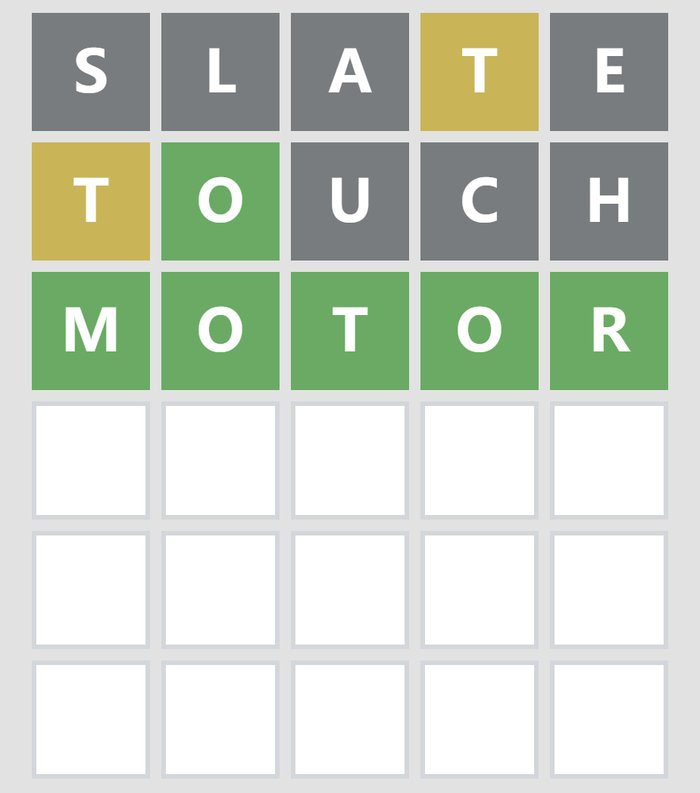
SLATE  ⬛⬛⬛🟨⬛
TOUCH  🟨🟩⬛⬛⬛
MOTOR  🟩🟩🟩🟩🟩
MOTOR is one of the 2,315 words in the official Wordle answer list, so today's field starts at the full 2,315 — no adjustments needed for postdating the snapshot.
The Full Guessing Chain, Step by Step
Guess 1: SLATE — 2,315 candidates down to 86
SLATE is the fixed opener here: five distinct letters, heavy on common consonants and vowels. Against MOTOR it came back almost empty — four grey tiles and one yellow.
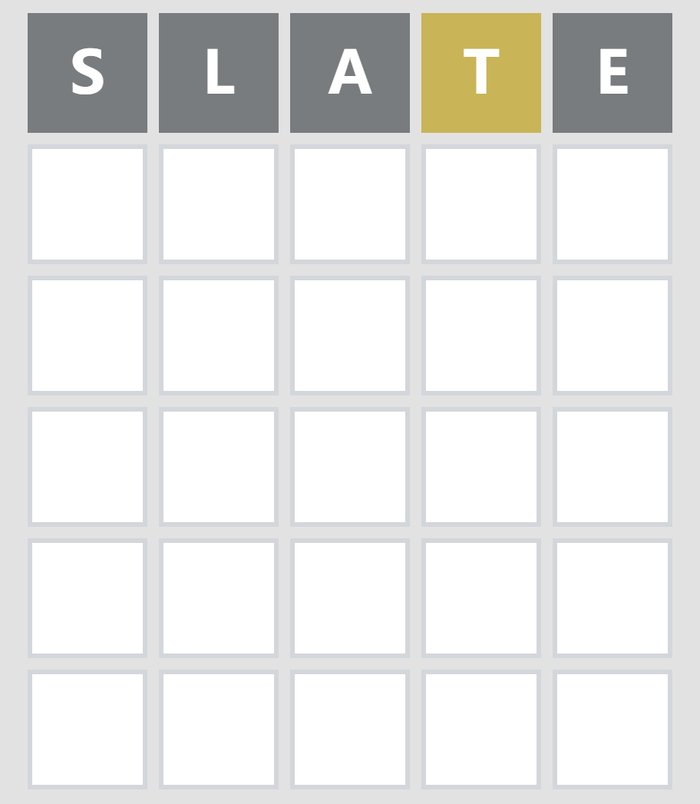
- T in slot 4 came back yellow. T is in the answer, but not in the fourth slot.
- S, L, A and E came back grey. Each of those letters has no copies left in the answer.
Four greys feel like a failed row, and one yellow feels like a consolation prize. The field said otherwise: 2,315 candidates collapsed to 86, a cut of over 96%. Every single survivor contains a T. One confirmed letter, tested and banned in one slot at a time, did nearly all of that work — the greys only had to delete four letters outright because T's yellow tile was already steering the field into a narrow channel.
The shape of the 86 mattered too. T was the only confirmed letter, but it was everywhere: all 86 survivors contain it, and 44 of them also contain an O. Slot 2, in particular, was an O hotspot — 22 of the 86 put O there. That distribution is what the next row would exploit.
Guess 2: TOUCH — 86 candidates down to 7
With T confirmed present but unplaced, the second row had one obvious job: give T a fresh slot to be tested in, and spend the remaining tiles on letters the opener never touched. TOUCH ranked first among the 86 on position frequency. It re-tests T in slot 1 — a slot the yellow had not banned — and puts O into slot 2, the hottest position in the surviving field. U, C and H are three letters the opener never touched, spent on the last three tiles.
- T in slot 1 came back yellow again. T is in the answer, and now slot 1 is banned for it too.
- O in slot 2 came back green. Slot 2 is O, permanently.
- U, C and H came back grey. No copies of any of them.
Two yellows in two rows, both on the same letter. T had now been rejected from slot 4 and slot 1, which left exactly three slots where it could live: 2, 3 and 5 — except slot 2 was just taken by O, so T lived in slot 3 or slot 5. The field of 86 fell to 7:
joint, motif, motor, point, robot, rotor, vomit
Every one of the seven fits the same description: O locked in slot 2, T hiding in slot 3 or slot 5, and none of S, L, A, E, U, C, H anywhere. Six of the seven are common enough that most players have typed them; the list is short because the constraints are tight, not because the words are obscure.
Guess 3: MOTOR — 7 candidates down to 1
MOTOR was the top-ranked of the seven on position frequency — 44.0 against 43.0 for robot and 42.5 for joint, point and rotor. A tight race, but the ranking had a structural reason to favour MOTOR: it satisfies every known constraint in the most economical way, and it carries a second O in slot 4 that nothing had ruled out.
- M in slot 1, O in slot 2, T in slot 3, O in slot 4, R in slot 5 — all green.
No drama. The solver's top pick and the answer happened to be the same word, so the third row was a formality: 7 candidates down to 1, and the puzzle closed on row three.
Worth noting what the second O did. Nothing in the first two rows had said anything about a double O — the yellow O in row 2 only ever claimed one copy. MOTOR turned out to hold two, and the second one had been sitting in the field, untested and unbothered, the whole time.
How the Candidate Pool Collapsed
The numbers, in order:
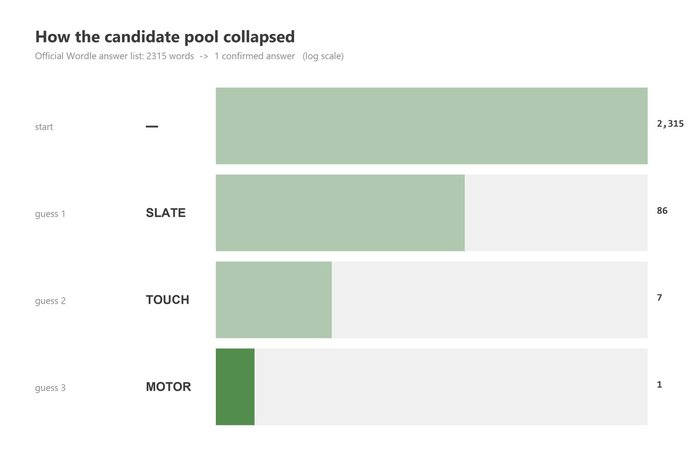
| Guess | Word | Candidates left |
|---|---|---|
| start | — | 2,315 |
| 1 | SLATE | 86 |
| 2 | TOUCH | 7 |
| 3 | MOTOR | 1 |
Three things stand out.
First, the opener did the heavy lifting while looking half-dead. Four greys and a single yellow is the picture of a wasted row in most players' intuition. In numbers it cut the field by more than 96%, because four letter deletions compound and the yellow T organised what remained.
Second, TOUCH was the row that converted presence into position. SLATE proved T exists; TOUCH found O's exact address and shrank T's possible homes from four slots to two. 86 to 7 is the kind of drop that only happens when a row locks a slot and deletes three letters in the same move.
Third, the endgame needed no tricks. On harder days the solver deliberately spends a row on a probe word that cannot be the answer, purely to split a stubborn shortlist. Today the shortlist was already small enough that the best candidate and the best next move were the same word — MOTOR closed the puzzle and the list at once.
The Rule That Makes Wordle Filtering Work
Most confusion about Wordle traces back to treating the three tile colours as three shades of one statement. They are not. Each colour makes a different kind of claim.
- Green says: right letter, right slot — and one copy of that letter is now accounted for.
- Yellow says: one copy of that letter is accounted for, and this slot is excluded for it.
- Grey says: the answer's supply of that letter is exhausted.
The grey is the one people get wrong. It is a statement about quantity, not a verdict on the letter. SLATE's four greys did not say "S, L, A and E are banned from the alphabet" — they said the answer holds zero copies of each once nothing had claimed them. Because SLATE has no repeated letters, each grey settled its letter's entire supply on its own: four clean deletions, no counting subtlety.
Yellow works the opposite way: it is a floor, never a ceiling. Today's board says this twice. T came back yellow in slot 4, then yellow again in slot 1 — each tile only banned one more slot, and only the second guess's green could finally place it. And the yellow O in row 2 claimed one copy of O, while MOTOR actually holds two. A player who read "one yellow O" as "exactly one O" would have survived today by luck, not by logic — the rule that keeps such words alive is that a yellow never caps the count.
The bookkeeping behind the filter is the same two-pass marking the official rules use:
- Mark every position that matches exactly as green, and subtract those letters from the answer's remaining inventory.
- For every remaining position, mark yellow if the guess letter still has inventory left in the answer; otherwise grey.
Read as counts rather than presence, every tile becomes something a filter can consume. The filter then keeps a candidate only if replaying the guess against it reproduces the exact same pattern of greens, yellows and greys — "would this word have scored exactly this way" rather than "does it contain the right letters". The second question has one correct answer; the first quietly deletes words it should have kept.
For choosing what to spend next, the heuristic is simple and it held up again today: score each surviving candidate by how often its letters appear in each position across the field, weighted heavily, plus distinct-letter coverage, weighted lightly. Position beats presence — which is why O in slot 2, a green, was worth more than the second yellow T it sat next to.
What You Can Take Away
A single yellow is not a weak opening. Four greys plus one yellow cut 2,315 words to 86. Letter deletions compound fast; the yellow organises what survives. Judge your opener by the field it leaves, not by the colour count.
Re-test a yellow in a fresh slot immediately. T was yellow in slot 4, so the very next row tested it in slot 1. Two rejections later, only slots 3 and 5 remained — that is how a "maybe" letter becomes an address.
When the shortlist is small, let the ranking work. Seven candidates is small enough to eyeball but tight enough that position frequency is the honest tiebreaker. MOTOR led robot by half a point, and the structural read — every constraint satisfied, second O unexcluded — agreed with the number.
Treat every yellow as a floor. One yellow O never means one O. Words with doubled letters live and die by the counting rule, and the filter that respects counts keeps them alive.
If you want to run the same discipline on today's puzzle, the Wordle game page serves the board shown above, and the daily answer archive has the full chain for every previous day — no sign-up, unlimited replays.