
The Wordle answer for October 30, 2026 is SLIDE. If you only want a wordle hint 30 oct 2026 before the reveal: the word starts with S and ends in E. Below is the complete 3-guess chain, how 2,315 candidates collapsed to one, and the grey-tile rule that made the filtering work.
The Wordle answer for October 30, 2026 is SLIDE. Puzzle No. 1959, solved in three guesses, and the opening row did almost all of the talking: three green tiles on the very first line.
If you arrived looking for a wordle hint 30 oct 2026 before the reveal: five letters, starts with S, ends with E, no repeated letters, and it names the smooth motion of something gliding from one place to another — a puck across ice, a photo across a table, a puzzle piece into place. Everything below is the full reasoning, in order.
Every row you see here was played on the free daily Wordle on this site, so the screenshots show the same board you get when you open today's puzzle yourself.
Today's Answer and the Final Board
The answer was SLIDE, solved in 3 guesses out of the 6 the puzzle allows.
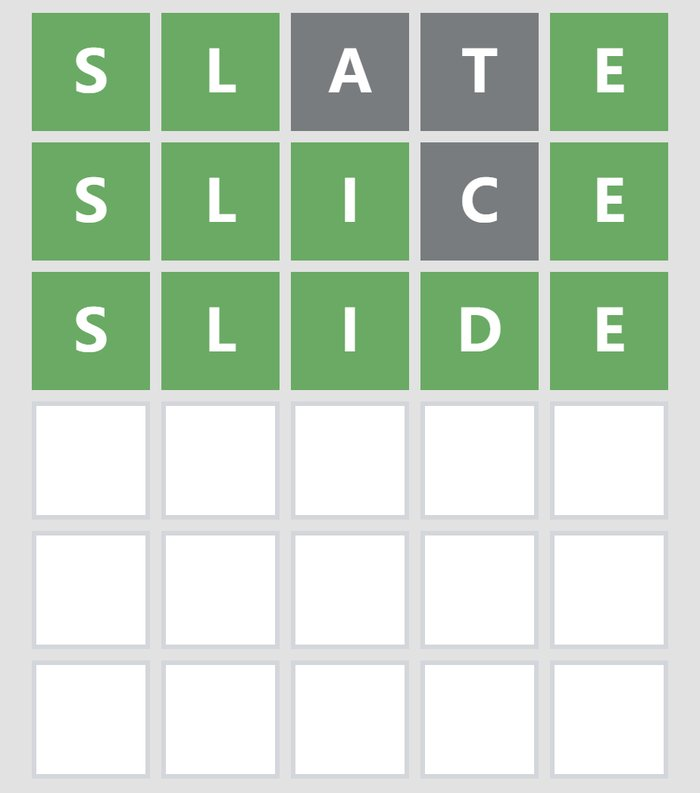
SLATE  🟩🟩⬛⬛🟩
SLICE  🟩🟩🟩⬛🟩
SLIDE  🟩🟩🟩🟩🟩
SLIDE is one of the 2,315 words in the official Wordle answer list, so today's field starts at the full 2,315 — no adjustments needed for postdating the snapshot.
The Full Guessing Chain, Step by Step
Guess 1: SLATE — 2,315 candidates down to 4
SLATE is the fixed opener here: five distinct letters, heavy on common consonants and vowels. Against SLIDE it came back with three greens — which is the kind of row that feels like a victory and isn't one yet.
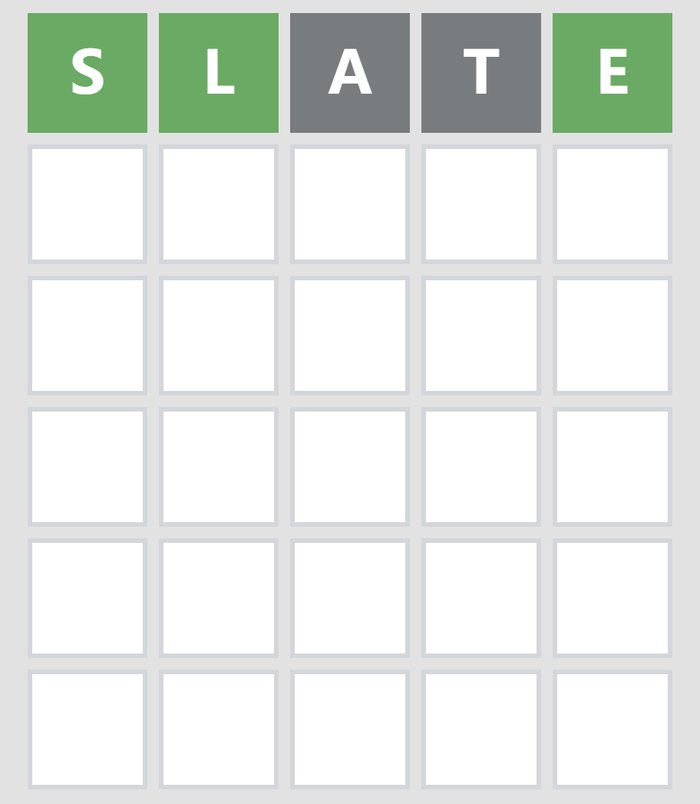
- S in slot 1, L in slot 2 and E in slot 5 came back green. Three slots were locked on the opening move.
- A in slot 3 and T in slot 4 came back grey. The answer holds zero copies of either letter.
Three greens on row one cut the field from 2,315 all the way to 4. That is a bigger first-row collapse than most boards ever see. But look at what the four survivors actually were — the solver replayed every filter and found exactly four words that could still score this way:
slice, slide, slime, slope
All four share the same S-L skeleton, and three of the four are twins: slice, slide and slime are identical everywhere except slot 4. The greens had locked three slots; they had not told us which member of the family we were looking at. A board can be almost full of green and still be asking a question.
Guess 2: SLICE — 4 candidates down to 2
With slots 1, 2 and 5 settled, the second row had one job: attack the two slots where the survivors disagreed. SLICE ranked at the top of the remaining field on position frequency — tied with slide and slime themselves, in fact, because all three spend their letters on the same contested slots. It keeps the confirmed S, L and E in place and tests two fresh letters, I and C, in exactly the positions where the four survivors part ways.
- I in slot 3 came back green. Slot 3 is I — which quietly eliminates slope, the one survivor that wanted an O there.
- C in slot 4 came back grey. The answer holds zero copies of C — which eliminates slice itself, the word the row just played.
- S, L and E stayed green in their slots, as expected.
Two letters tested, two survivors dismissed, and the field fell from 4 to 2: slide and slime. Notice the mechanics of that row. SLICE could not be the answer and the board said so with one grey tile — a guess does not need to be a candidate to be a good guess. It needed to split the family, and it did: I versus O resolved in one green, C versus D or M resolved in one grey.
Guess 3: SLIDE — 2 candidates down to 1
What remained was the narrowest possible endgame: two words, identical in four slots, separated by a single letter in slot 4. D or M.
The solver ranked slide and slime level at the top of the two-word field — position frequency could not separate them, because the words differ in exactly one position and nothing in the first two rows had testified about D or M. So the third row was a straight bet: play one of the twins, and if the tile comes back grey, play the other with two rows to spare. The tiebreak went to slide, and the board answered immediately:
- S, L, I, D, E — all five green.
No probe needed, no fourth row. The 50/50 landed on the answer, and the puzzle closed on row three. On a different day the same structure could just as easily have gone four rows — the discipline that matters is that a level pairing gets played, not agonized over.
How the Candidate Pool Collapsed
The numbers, in order:
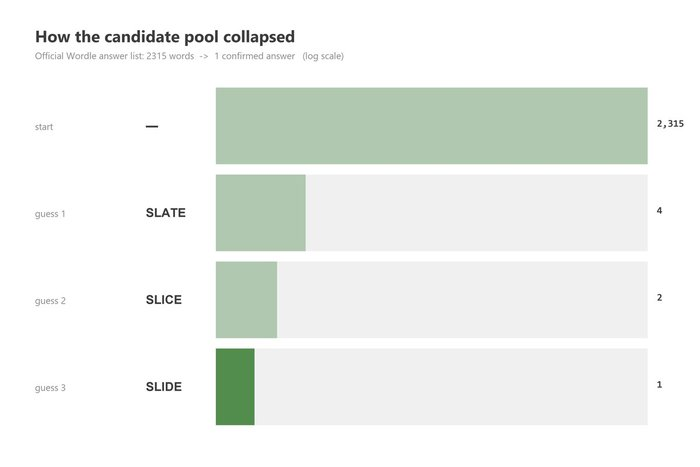
| Guess | Word | Candidates left |
|---|---|---|
| start | — | 2,315 |
| 1 | SLATE | 4 |
| 2 | SLICE | 2 |
| 3 | SLIDE | 1 |
Three things stand out.
First, the opener's collapse was enormous but incomplete. Three greens plus two clean deletions cut 2,315 words to 4 — a destruction of more than 99% of the field in one row. And yet the puzzle was nowhere near over, because the four survivors were a family. Collapse by count and collapse toward the answer are different things; SLATE delivered the first and only started the second.
Second, the second row was the one that did the discriminating. All the uncertainty lived in slots 3 and 4, so SLICE spent both of its unconfirmed tiles there — one green (I, locking the slot) and one grey (C, killing a sibling). Four to two in a single move, with the guess itself among the casualties.
Third, the endgame was honest about being a coin flip. When two candidates differ by one letter and no evidence favors either, the ranking calls it level, and the right move is to commit. Had slide come back with a grey D, the field would have had exactly one survivor — slime — and two spare rows to confirm it. That is what a clean pair looks like: either way you play, the puzzle ends by row four.
The Rule That Makes Wordle Filtering Work
Most confusion about Wordle traces back to treating the three tile colours as three shades of one statement. They are not. Each colour makes a different kind of claim.
- Green says: right letter, right slot — and one copy of that letter is now accounted for.
- Yellow says: one copy of that letter is accounted for, and this slot is excluded for it.
- Grey says: the answer's supply of that letter is exhausted.
The grey is the one people get wrong. It is a statement about quantity, not a verdict on the letter. Today's A and T tiles did not say "A and T are banned from the alphabet" — they said the answer holds zero copies of each, once nothing had claimed them. Because SLATE has no repeated letters, each grey settled its letter's entire supply on its own: two clean deletions, no counting subtlety.
Today's board also shows what green does not do. Three greens on the opening row locked three slots, and the field still held four words — because green constrains positions, it does not finish words. The four survivors agreed with the board everywhere SLATE had testified; they disagreed with each other in the slots SLATE had left grey. Discrimination moved to exactly those slots, and that is where the next row spent its letters.
The bookkeeping behind the filter is the same two-pass marking the official rules use:
- Mark every position that matches exactly as green, and subtract those letters from the answer's remaining inventory.
- For every remaining position, mark yellow if the guess letter still has inventory left in the answer; otherwise grey.
Read as counts rather than presence, every tile becomes something a filter can consume. The filter then keeps a candidate only if replaying the guess against it reproduces the exact same pattern of greens, yellows and greys — "would this word have scored exactly this way" rather than "does it contain the right letters". The second question is looser, and the loose version quietly keeps words it should have deleted.
For choosing what to spend next, the heuristic is simple and it held up again today: score each surviving candidate by how often its letters appear in each position across the field, weighted heavily, plus distinct-letter coverage, weighted lightly. When the field is a family of near-twins, that scoring is why SLICE — the guess that attacks both contested slots at once — outranked playing a survivor and hoping.
What You Can Take Away
Three greens are not a finish line. SLATE locked three slots and still left a four-word family. Greens fix positions; they do not identify the word. Read the grey slots after the green ones — that is where the answer still hides.
Send your next guess to the contested slots. Every disagreement among the survivors lived in slots 3 and 4, so the second row tested I and C there and resolved two questions in one move. A guess is judged by what it splits, not by whether it can be the answer — SLICE got a grey on itself and was still the right play.
When the pair is level, commit. Slide and slime differed by one letter and nothing favoured either. The ranking called it even, the solver played one, and two spare rows stood by for the other. A 50/50 endgame played decisively costs at most one extra row.
If you want to run the same discipline on today's puzzle, the Wordle game page serves the board shown above, and the daily answer archive has the full chain for every previous day — no sign-up, unlimited replays.