
The Wordle answer for October 31, 2026 is YAHOO. If you only want a wordle hint 31 oct 2026 before the reveal: the word starts with Y and ends in O. Below is the complete 4-guess chain, how 2,316 candidates collapsed to one, and the grey-tile rule that made the filtering work.
The Wordle answer for October 31, 2026 is YAHOO. Puzzle No. 1960, solved in four guesses, and the game stayed quiet almost the whole way: one yellow on the opening row, two greens on the second, and a decision that only became obvious in hindsight.
If you arrived looking for a wordle hint 31 oct 2026 before the reveal: five letters, starts with Y, ends with O, contains a doubled letter — the same vowel twice, back to back at the end. It is an exclamation of wild joy, it is the name Jonathan Swift gave his brutish creatures in Gulliver's Travels, and for three decades it has also been the name of a very familiar internet company. Everything below is the full reasoning, in order.
Every row you see here was played on the free daily Wordle on this site, so the screenshots show the same board you get when you open today's puzzle yourself.
Today's Answer and the Final Board
The answer was YAHOO, solved in 4 guesses out of the 6 the puzzle allows.
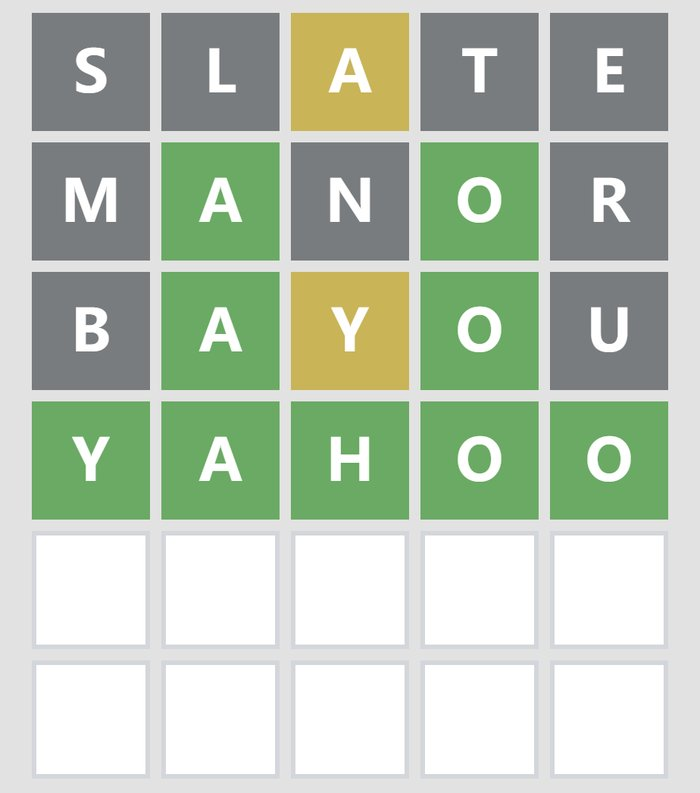
SLATE  ⬛⬛🟨⬛⬛
MANOR  ⬛🟩⬛🟩⬛
BAYOU  ⬛🟩🟨🟩⬛
YAHOO  🟩🟩🟩🟩🟩
YAHOO does not appear in the official 2,315-word answer list snapshot from 2022 — like a growing number of recent answers, it postdates that list. So today's solver field starts at 2,315 plus the day's word: 2,316 candidates. That number matters for everything that follows.
The Full Guessing Chain, Step by Step
Guess 1: SLATE — 2,316 candidates down to 137
SLATE is the fixed opener here: five distinct letters, heavy on common consonants and vowels. Against YAHOO it came back nearly silent — four greys and a single yellow.
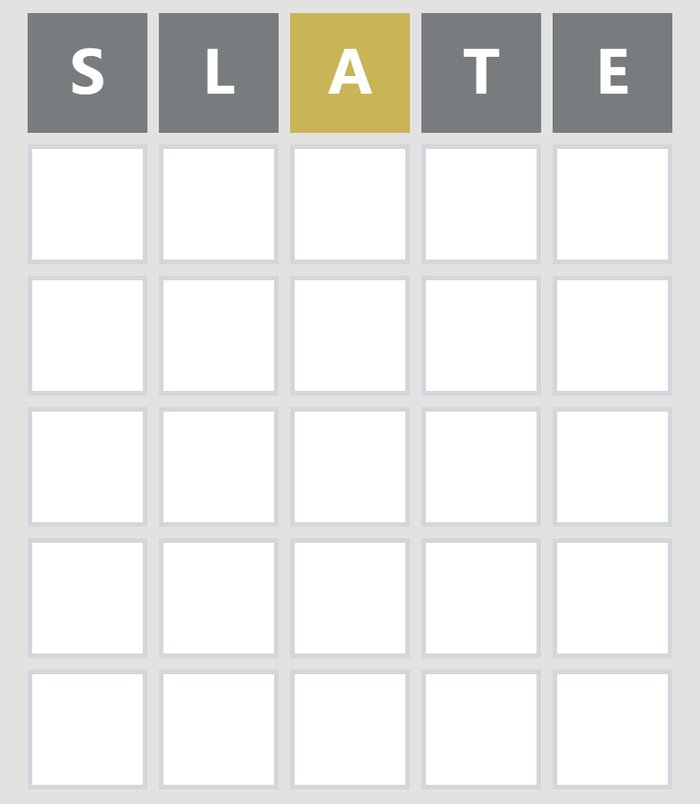
- A in slot 3 came back yellow. The answer holds at least one A, but not in that position.
- S, L and T in the other consonant slots came back grey. The answer holds zero copies of each.
- E in slot 5 came back grey as well.
One yellow tile and four grey ones cut the field from 2,316 to 137 — roughly 94% of the dictionary gone in a row that never turned a single tile green. That is the quiet power of the grey: each one is a clean, total deletion of a letter. It is also the first hint of a subtlety this puzzle rewards: the yellow promised an A existed somewhere, and said nothing about how many.
Guess 2: MANOR — 137 candidates down to 3
The solver ranked every survivor by position frequency, and MANOR came out on top of the 137-word field. It is a natural follow-up after a yellow A: it puts A in a new slot (slot 2), spends none of the dead letters, and probes three fresh common consonants plus an O.
- A in slot 2 came back green — the yellow from row one found its home.
- O in slot 4 came back green.
- M, N and R came back grey — three more letters deleted outright.
Two greens, three greys, and the field collapsed from 137 to exactly 3. The solver replayed the filters and found the survivors: yahoo, bayou, havoc. All three share the same _A_O_ skeleton, but havoc is the outsider in what it lacks — no Y anywhere, and only one O.
Notice what the two greens did not say. The green O in slot 4 accounted for one copy of O. It said nothing about a second. On a board where the answer turns out to end in a doubled O, that silence in slot 5 lasted all game.
Guess 3: BAYOU — 3 candidates down to 1
Three words left, and here is the twist: ranked by position frequency across the surviving field, YAHOO itself scored last. The top of the ranking was a tie between bayou and havoc — both still plausible answers, both packed with letters that would testify about the other two. The solver played BAYOU: a survivor by eligibility, but a probe by intent.
- B in slot 1 came back grey. The answer holds zero copies of B — which eliminates bayou itself.
- A in slot 2 stayed green.
- Y in slot 3 came back yellow. The answer contains a Y — just not there.
- O in slot 4 stayed green.
- U in slot 5 came back grey. Zero copies of U.
That single yellow Y was the whole game. Havoc contains no Y at all, so it died on that tile. Bayou's only Y sits in slot 3 — exactly the position the yellow just forbade — so it died too, on top of its two fresh greys. Three candidates in, three verdicts delivered, and one word survived: YAHOO, the only candidate whose Y lives in slot 1.
Guess 4: YAHOO — the last candidate standing
With one candidate left, row four was a formality — and YAHOO repaid the two rows of probing with five straight greens. Only now did the board confirm what rows one through three had never testified about: the second O, sitting in slot 5. The green in row two had claimed one O; the answer turned out to carry two. Green claims a copy. It has never claimed all of them.
How the Candidate Pool Collapsed
The numbers, in order:
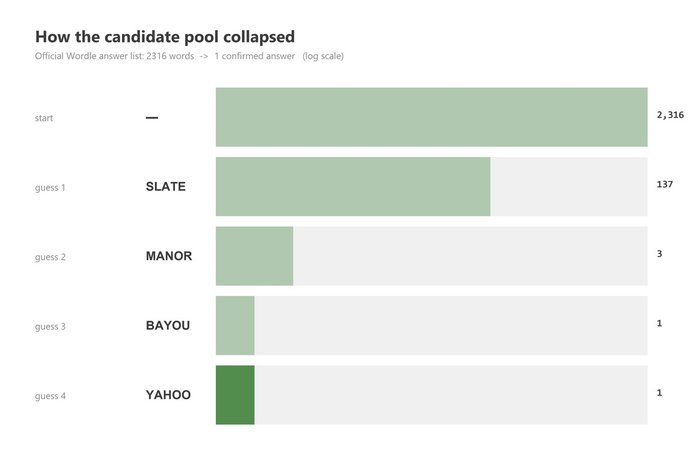
| Guess | Word | Candidates left |
|---|---|---|
| start | — | 2,316 |
| 1 | SLATE | 137 |
| 2 | MANOR | 3 |
| 3 | BAYOU | 1 |
| 4 | YAHOO | 1 |
Three things stand out.
First, the opener's collapse came without a single green. Four greys delete four letters entirely, and one yellow plus the counting filter does the rest — more than 94% of the field gone before the board showed any colour a beginner would celebrate. Rows that look empty are frequently the ones doing the heavy lifting.
Second, the second row was the discriminator. MANOR put its two greens exactly where they counted and deleted three letters outright; 137 became 3. And the shape of those 3 mattered: three words in the same _A_O_ frame, separated only by the letters they carried elsewhere. When the field shrinks that fast, the remaining question is almost always a letter-count question — who has the Y, who has the second O.
Third, the endgame was settled by a tile that never turned green. The yellow Y in row three did not lock a slot; it split a three-way field by combining two claims — the letter exists, and not here. Only YAHOO could satisfy both. The final row then confirmed the one thing no earlier tile had ever addressed: the doubled O.
The Rule That Makes Wordle Filtering Work
Most confusion about Wordle traces back to treating the three tile colours as three shades of one statement. They are not. Each colour makes a different kind of claim.
- Green says: right letter, right slot — and one copy of that letter is now accounted for.
- Yellow says: one copy of that letter is accounted for, and this slot is excluded for it.
- Grey says: the answer's supply of that letter is exhausted.
Today's board is a clinic on the second clause of each rule. The grey is about quantity, not existence: S, L, T, E, then M, N, R, then B and U — nine letters whose supply the answer holds zero of, in a word that still had room for a doubled vowel. Nobody who read those greys as "the letter is gone for good" would be badly misled today, but the reason the greys are correct is counting, not absence.
The yellow is where today's puzzle earns its keep. A yellow tile carries two claims, and both bind: the letter exists somewhere in the answer, and this particular slot is closed to it. The Y in row three was fatal to havoc on the first claim and fatal to bayou on the second — one tile, two different executions. And the same logic explains why the green O never ruled out a second O: one green accounts for one copy. YAHOO's slot-5 O stayed unverified until the word was already won.
The bookkeeping behind the filter is the same two-pass marking the official rules use:
- Mark every position that matches exactly as green, and subtract those letters from the answer's remaining inventory.
- For every remaining position, mark yellow if the guess letter still has inventory left in the answer; otherwise grey.
Read as counts rather than presence, every tile becomes something a filter can consume. The filter then keeps a candidate only if replaying the guess against it reproduces the exact same pattern of greens, yellows and greys — "would this word have scored exactly this way" rather than "does it contain the right letters". The second question is looser, and the loose version quietly keeps words it should have deleted.
For choosing what to spend next, the heuristic is simple and it held up again today: score each surviving candidate by how often its letters appear in each position across the field, weighted heavily, plus distinct-letter coverage, weighted lightly. With three candidates left and the actual answer ranked last, that scoring pushed the solver toward the tied top pair — and bayou, playable as an answer or as a probe, was the choice that could not lose information.
What You Can Take Away
A colourless row is not a wasted row. SLATE scored one yellow and four greys and still erased more than 94% of the field. Greys are total deletions; count them as progress even when the board looks empty.
When the answer ranks last, play the probe. With three candidates left, YAHOO sat at the bottom of the ranking while bayou and havoc tied at the top. BAYOU resolved all three in one row — eliminating itself twice over and its rival with a single yellow. If a top-ranked candidate can testify about the whole field, its eligibility as the answer is a bonus, not the point.
Use both halves of a yellow. Yellow means the letter is in the word and not in that slot. The first half killed havoc; the second half killed bayou. Readers who only track "which letters exist" lose half the signal the board is giving them — and on days like today, half the signal is the whole game.
If you want to run the same discipline on today's puzzle, the Wordle game page serves the board shown above, and the daily answer archive has the full chain for every previous day — no sign-up, unlimited replays.