Learn to build a memory palace in 5 steps, backed by Neuron and Science Advances studies, plus a worked example, common mistakes, and a 4-week plan.
Around the fifth century BCE, a Greek poet named Simonides stepped out of a collapsing banquet hall. When the rubble was cleared, the dead could only be identified by where they had been sitting. Simonides had matched every guest to his seat without trying, and that grim realization became the method of loci, better known today as the memory palace. It is still the technique world memory champions use to memorize decks of cards in minutes.
Here's what makes this worth your evening: it isn't a party trick reserved for the gifted. In a 2017 study published in Neuron, ordinary people with no prior training learned the method of loci over six weeks and went from recalling about 26 of 72 words to recalling about 62. Brain scans showed their memory networks reorganizing toward the patterns of elite memory athletes, and the gains were still measurable four months later.
You can build your first palace in about ten minutes tonight. This article walks you through exactly how, what the research actually says, and the five mistakes that make most people quit too early.
What Is a Memory Palace? (And Why Your Brain Loves Places)
A memory palace is a place you know well, usually your home, that you turn into a mental storage system. You pick a fixed route through it, choose specific stopping points along that route (each one is called a locus, plural loci), and "place" a vivid mental image representing each thing you want to remember at every stop. To recall the information, you mentally walk the route and collect the images in order.
The method works because it hijacks machinery your brain already runs at full power. Human spatial memory is ancient and absurdly good. You can walk into a friend's apartment once and still describe the furniture a month later, yet you can't hold onto a ten-item shopping list for twenty minutes. Neuroimaging backs this up: a 2025 systematic review and meta-analysis in the British Journal of Psychology found that the method of loci consistently activates the hippocampus, parahippocampus, and retrosplenial cortex, the core network for spatial navigation and memory, and that training with it produces measurable structural and functional brain changes.
The trick isn't memorizing harder. It's translating abstract, forgettable information into the format your brain never forgets: space, place, and image.
The Science: What Studies Actually Show
Because the memory palace has been around for 2,500 years, it has accumulated a lot of folklore. Here's what controlled research supports.
The headline study. Dresler and colleagues (2017, Neuron) compared 23 of the world's top-50 memory athletes with untrained volunteers. At baseline, the athletes remembered nearly 71 of 72 words after 20 minutes; the novices managed about 40. The researchers then split the novices into three groups: one trained in the method of loci for six weeks, one trained on a working-memory task, and one got no training. Only the loci group improved dramatically, from roughly 26/72 to 62/72 words, and their resting-brain connectivity shifted toward the athletes' pattern. Four months later, without further practice, the advantage held.
Durability and efficiency. Wagner and colleagues (2021, Science Advances) extended this: six weeks of mnemonic training produced memories that were more durable over time, alongside decreased brain activation during encoding. That decrease matters. It suggests the technique makes memory formation more efficient, not more effortful. The brain stores more while doing less.
The honest numbers. The 2025 meta-analysis by Ondřej pooled studies in adults and found a large effect of the method of loci on immediate serial recall compared with rehearsal: Cohen's d = 0.88. That's a big effect in psychology terms. The same paper notes that the quality of the underlying evidence is rated low to very low, mostly due to small samples and bias risks. The track record is strong, but the field agrees better trials would help.
One caveat. The gains are largely skill-specific. You get dramatically better at memorizing the kind of material you train with: lists, sequences, speeches, vocabulary. Memory athletes themselves report they still lose their car keys like everyone else. There's no solid evidence the palace raises general intelligence. It's a learnable tool, not a brain upgrade.

How to Build Your First Memory Palace in 5 Steps
Ready to build one? All you need is a place you know and ten minutes. We'll use a running example, memorizing a ten-item shopping list, so you can follow along and test yourself at the end.
Step 1: Pick a place you know cold
Your current home is the best choice, and the reason is simple: the route must be automatic. If you have to think about where the kitchen is, the location is too unfamiliar. Your childhood bedroom, your daily commute, or your school route also work. Avoid imaginary locations for now, because novelty undermines the spatial-memory advantage you're trying to exploit.
Step 2: Define a fixed route with 5–10 distinct loci
Walk through your home in your mind and pick a sequence of specific stopping points, always in the same direction. Front door, hallway, living room couch, TV, kitchen counter, fridge, sink, dining table, bathroom door, bed.
The key word is distinct. "The living room" is not a locus. "The left arm of the green couch" is. Each stop should be a named object, ideally with a surface where something could sit or hang. Vague loci are the number-one reason palaces fail.
Step 3: Convert each item into a vivid, absurd image
This is where beginners fail. You cannot place the abstract word "butter" on your couch and expect it to stick. You have to encode it: take each item and turn it into an image that is oversized, moving, loud, funny, or gross. The weirder the better, because the brain ignores the ordinary and holds onto the surprising.
Make the image interact with the locus, too. A banana lying politely on the counter is forgettable. A banana swordfighting the toaster is not.
Step 4: Walk the route and place each image, then walk it backwards
Mentally walk your route in order. At each locus, "place" the image and pause for three to five seconds. See it, hear it, add a smell if you can. Multi-sensory images create more retrieval cues.
After placing all ten, walk the route in reverse. This is your quality check: any locus that comes up blank means the image wasn't vivid enough. Make it weirder and try again.
Step 5: Retrieve at expanding intervals
Don't re-study the list. Test it. Walk the route mentally one hour later, again the next morning, again a week later. Effortful retrieval, even partial, strengthens the memory far more than review. If an item won't come, pause for thirty seconds and try to reconstruct it from the neighboring loci before giving up.
This spacing-and-testing combination is the same principle behind flashcard scheduling. The palace handles encoding; retrieval practice handles durability.
A Worked Example: Your First 10-Locus Palace
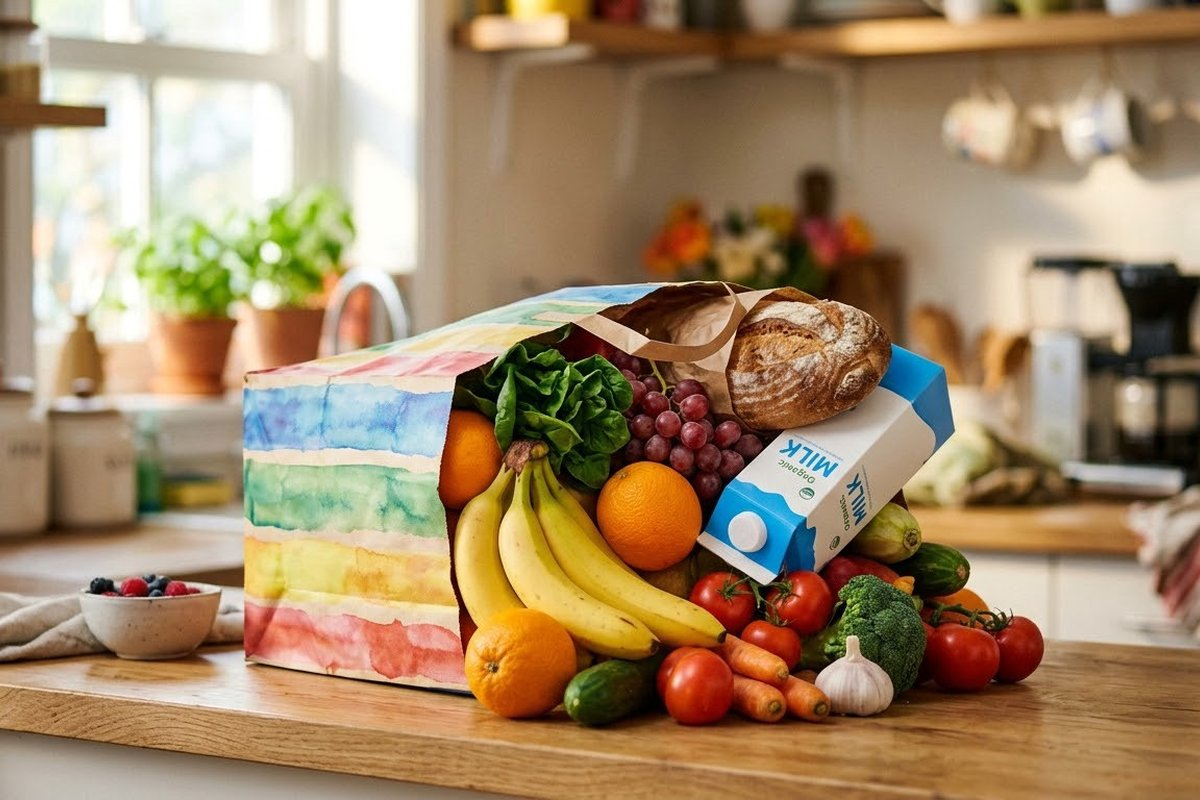
Here's the shopping list, fully encoded: eggs, milk, bananas, coffee, butter, bread, apples, cheese, orange juice, and toilet paper.
- Front door: A giant milk carton is ringing your doorbell, milk sloshing through the mail slot.
- Hallway: An egg the size of a bowling ball is rolling down the hallway, cracking slightly with every bounce.
- Couch (left arm): A banana is strumming the couch arm like a guitar, humming badly.
- TV: The screen shows a coffee cup the size of a hot tub, overflowing and flooding the living room.
- Kitchen counter: A stick of butter is sunbathing on the counter, slowly melting into a golden puddle.
- Fridge: Loaves of bread have packed the shelves shoulder to shoulder, like a crowded subway car.
- Sink: Apples are cascading out of the faucet instead of water, thunking into the basin.
- Dining table: A wheel of cheese sits at the head of the table wearing a party hat, clearly the guest of honor.
- Bathroom door: A carton of orange juice is taped to the door with a sticky note that says "DRINK ME."
- Bed: A roll of toilet paper is tucked under the covers, snoring.
Read through that once, then walk the route from memory: forward, then backward. If you got even eight out of ten, you've just seen why this technique has survived since antiquity. And notice the sensory details: the thunk of apples, the smell of coffee, the heat of melting butter. Those aren't decoration; they're extra retrieval paths.
5 Mistakes That Kill a Memory Palace (And the Fixes)
After you've tried this once, these are the failure modes you'll meet. All are fixable.
- Vague loci. "The corner of the kitchen" gives your image nowhere to sit. Fix: use named objects with surfaces, like the kettle, the doormat, or the second stair.
- Boring images. Polite, realistic images fade within hours. Fix: crank up size, motion, sound, and absurdity until the image feels slightly ridiculous.
- Building too big too fast. A 50-locus palace on day one collapses. Fix: start with 10 loci, and reuse the same palace for new lists. A single well-built palace can serve thousands of lists over years; just let old images fade before replacing them.
- Never testing retrieval. Placing images feels like learning, but it isn't. Fix: schedule the backward walk and the expanding-interval reviews from Step 5. Retrieval is where memory is actually built.
- Expecting it to fix everything. The palace is superb for ordered, discrete information: lists, speeches, vocabulary, anatomy, historical timelines. It's weak for conceptual understanding. Fix: match the tool to the task, and combine it with spaced repetition for long-term retention.
Memory Palaces and Brain Training: How to Make It a Habit
Like any skill, the memory palace compounds with repetition. A realistic four-week progression:
- Week 1: Build one 10-locus palace in your home. Memorize two lists with it (a shopping list, then tomorrow's to-do list). Review each at expanding intervals.
- Week 2: Build a second palace on your commute. Use it for something you actually care about: a speech, a presentation, vocabulary from a language you're learning.
- Week 3: Reuse both palaces with new material. Practice walking them faster; champions "read" their palaces at a glance.
- Week 4: Test the durability of your week-1 material. Anything that survived a month without review is essentially permanent.
Palace-building also pairs naturally with quick daily training in the browser. Sequence and memory-matching games sharpen the raw encoding speed, meaning how fast you form and hold vivid images, while the palace gives that skill a structure to live in. If you want a five-minute warm-up before a palace session, try a round of memory matching games or the memory match challenge; both train the same visual-spatial circuitry the method of loci depends on.

Finally, combine the palace with spaced repetition for the long game. The palace does the initial encoding; scheduled reviews at widening intervals keep the images alive. That one-two punch of ancient encoding and modern scheduling is the most reliable memory combination research has found.
Frequently Asked Questions
Does the memory palace really work? Yes, and it's one of the best-evidenced mnemonic techniques in cognitive psychology. Controlled studies show large recall improvements (d = 0.88 versus rote rehearsal), and six weeks of training moved novices from 26/72 to 62/72 words recalled, with gains persisting four months later.
How long does it take to learn? Basic competence takes one or two hours, and your first working palace can be built tonight in about ten minutes. Fluency (multiple palaces, fast encoding, reusable image alphabets) develops over weeks of regular practice.
Can it raise my IQ? No. Evidence shows the technique dramatically improves recall of trained material, but there's no solid evidence it raises general intelligence or fixes memory across the board. It's a tool, not an upgrade.
What should I memorize first? Something small and personally useful: a shopping list, tomorrow's to-do list, or the first ten lines of a speech. Early wins with real material keep the habit alive.
References
- Dresler, M., et al. (2017). "Mnemonic Training Reshapes Brain Networks to Support Superior Memory." Neuron. Coverage and summary: Stanford Medicine.
- Wagner, I. C., et al. (2021). "Durable memories and efficient neural coding through mnemonic training using the method of loci." Science Advances, 7(10). Full text.
- Ondřej, J. (2025). "The method of loci in the context of psychological research: A systematic review and meta-analysis." British Journal of Psychology, 116(4), 930–986. Full text.