
The Wordle answer for November 1, 2026 is VIPER. If you only want a wordle hint 1 nov 2026 before the reveal: the word starts with V and ends in R. Below is the complete 4-guess chain, how 2,315 candidates collapsed to one, and the grey-tile rule that made the filtering work.
The Wordle answer for November 1, 2026 is VIPER. Puzzle No. 1961, solved in four guesses, and the solve had a clean arc to it: one lonely yellow on the opening row, three greens on the second, and a final coin flip that the ranking called correctly.
If you arrived looking for a wordle hint 1 nov 2026 before the reveal: five letters, starts with V, ends with R, and it is a venomous snake — the kind that gives its name to both a family of real serpents and a fair share of movie villains. One more nudge for the cautious: of the five letters the opener tested, exactly one survives into the answer.
Every row you see here was played on the free daily Wordle on this site, so the screenshots show the same board you get when you open today's puzzle yourself.
Today's Answer and the Final Board
The answer was VIPER, solved in 4 guesses out of the 6 the puzzle allows.
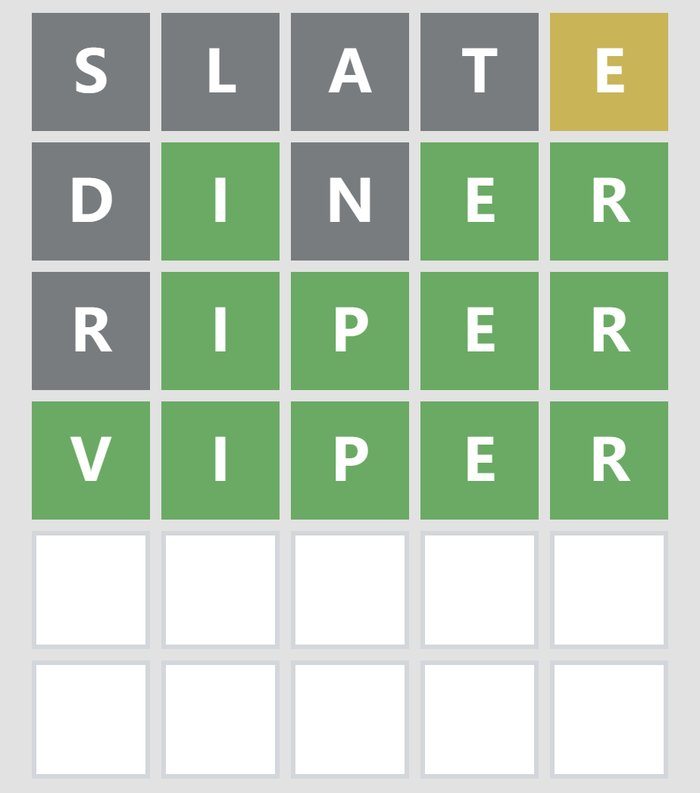
SLATE  ⬛⬛⬛⬛🟨
DINER  ⬛🟩⬛🟩🟩
RIPER  ⬛🟩🟩🟩🟩
VIPER  🟩🟩🟩🟩🟩
VIPER sits inside the official 2,315-word answer list snapshot from 2022, so today's solver field starts at exactly 2,315 candidates — no additions, no asterisks. That number matters for everything that follows.
The Full Guessing Chain, Step by Step
Guess 1: SLATE — 2,315 candidates down to 165
SLATE is the fixed opener here: five distinct letters, heavy on common consonants and vowels. Against VIPER it came back almost silent — four greys and a single yellow.
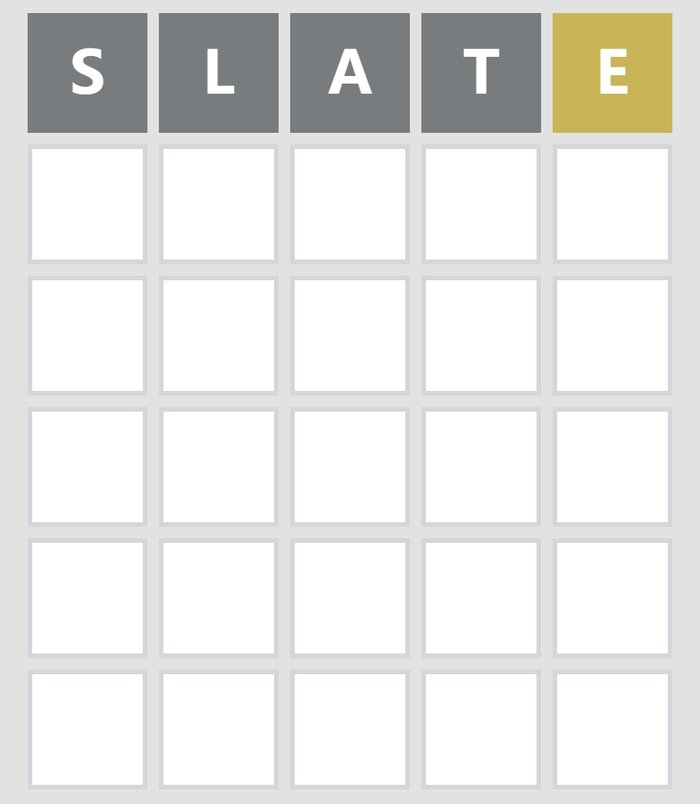
- E in slot 5 came back yellow. The answer holds at least one E, but not in the last position.
- S, L, A and T came back grey. The answer holds zero copies of each.
One yellow and four greys cut the field from 2,315 to 165. No green, no celebration tile — and still all but 165 words of the dictionary were gone. That is the quiet power of the grey: each one is a clean, total deletion of a letter. It also planted the seed of today's whole solve: an E exists, and its address is not slot 5.
Guess 2: DINER — 165 candidates down to 7
The solver ranked every survivor by position frequency, and DINER came out on top of the 165-word field. It is a natural follow-up after a yellow E: it moves E to a new slot, keeps R for fresh testimony, and spends none of the four dead letters.
- I in slot 2 came back green.
- E in slot 4 came back green — the yellow from row one found its home, two slots to the left of where it was rejected.
- R in slot 5 came back green.
- D and N came back grey.
Three greens, two greys, and the field collapsed from 165 to exactly 7. The solver replayed the filters and found the survivors: fiber, fixer, giver, piper, riper, river, viper. Look at them side by side — every single one fits the same _I_ER skeleton. I locked in slot 2, E in slot 4, R in slot 5, and the entire remaining question of the game compressed into just two open slots: first letter and third letter.
Guess 3: RIPER — 7 candidates down to 2
Seven candidates, and here is what made row three interesting: RIPER is itself one of the seven. Ranked across the surviving field it scored first — but barely, with viper breathing down its neck in second. The solver played it anyway: a survivor by eligibility, and a probe by design, because its letters would testify about every rival at once.
- The first R came back grey. The answer's supply of R is already claimed by the green R in slot 5 — there is no second R up front.
- I, P, E and R stayed green. Most importantly, P in slot 3 turned green.
That green P was the executioner. Fiber (B), fixer (X), giver (V) and river (V) all carry the wrong third letter and died on that one tile. The grey first R then closed the case on riper itself — the probe eliminated its own candidacy while solving the field. Two words survived: piper and viper, identical from the second letter onward, separated only by the very first tile of the board.
Guess 4: VIPER — the ranking's coin flip lands
Two candidates left, differing in exactly one position. The solver's ranking put VIPER first — by the thinnest of margins — and played it. Five straight greens came back, and Puzzle No. 1961 was solved. With a 50/50 endgame there is no cleverness left to deploy, only a choice; the same positional-frequency scoring that picked every earlier row picked the right one here.
How the Candidate Pool Collapsed
The numbers, in order:
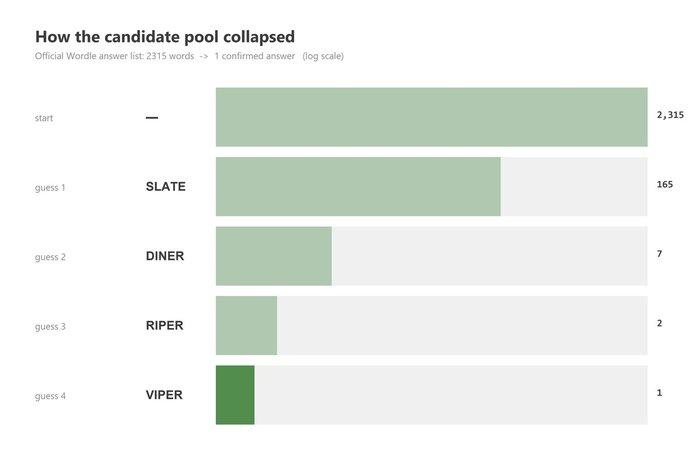
| Guess | Word | Candidates left |
|---|---|---|
| start | — | 2,315 |
| 1 | SLATE | 165 |
| 2 | DINER | 7 |
| 3 | RIPER | 2 |
| 4 | VIPER | 1 |
Three things stand out.
First, the opener did its damage in silence. Four greys delete four letters outright, and the lone yellow narrows E's address — all but 165 of 2,315 candidates gone before a single tile turned green. Rows that look empty are frequently the ones doing the heavy lifting.
Second, the second row set the skeleton. DINER's three greens did more than shrink the field — they shaped it. Once every survivor had to fit _I_ER, the game stopped being about twenty-six letters and became a two-slot puzzle: which letter opens the word, which letter sits in the middle.
Third, the endgame was settled by information the board had been holding all along. The grey first R in row three did not reveal anything new about the answer — it confirmed a count the green R in slot 5 had already implied. That is the texture of a good endgame: the last question answered is often one whose evidence was already on the board.
The Rule That Makes Wordle Filtering Work
Most confusion about Wordle traces back to treating the three tile colours as three shades of one statement. They are not. Each colour makes a different kind of claim.
- Green says: right letter, right slot — and one copy of that letter is now accounted for.
- Yellow says: one copy of that letter is accounted for, and this slot is excluded for it.
- Grey says: the answer's supply of that letter is exhausted.
Today's board is a clinic on the grey — because the grey and the green were talking about the same letter. The R in slot 5 came back green in row two: one copy of R, accounted for, address known. Two rows later, the first R of RIPER came back grey. Nobody should read that grey as "there is no R in the answer" — there obviously is. The grey said the remaining supply is zero: the answer holds exactly one R, and it is already on display in the last slot. Grey is about quantity, not existence.
The yellow earned its keep early. A yellow tile carries two claims, and both bind: the letter exists somewhere in the answer, and this particular slot is closed to it. The E rejected in slot 5 was the only letter the opener salvaged, and it was yellow — not green — that carried it forward to its green home in slot 4.
The bookkeeping behind the filter is the same two-pass marking the official rules use:
- Mark every position that matches exactly as green, and subtract those letters from the answer's remaining inventory.
- For every remaining position, mark yellow if the guess letter still has inventory left in the answer; otherwise grey.
Read as counts rather than presence, every tile becomes something a filter can consume. The filter then keeps a candidate only if replaying the guess against it reproduces the exact same pattern of greens, yellows and greys — "would this word have scored exactly this way" rather than "does it contain the right letters". The second question is looser, and the loose version quietly keeps words it should have deleted.
For choosing what to spend next, the heuristic is simple and it held up again today: score each surviving candidate by how often its letters appear in each position across the field, weighted heavily, plus distinct-letter coverage, weighted lightly. It put riper at the top of seven, then viper at the top of two — and both calls were correct.
What You Can Take Away
A probe can eliminate itself — and that is fine. RIPER was a genuine candidate when it was played, and its own grey first R deleted it from contention one row before the end. What a probe owes you is testimony, not survival. If the field shrinks from 7 to 2 and your guess is no longer on the list, the row still did its job.
Skeleton thinking beats letter hunting. After row two, the useful question was never "what letters are in the answer" but "what frame must the answer fit". Seven survivors in one _I_ER frame meant every future guess only needed to speak about two slots. When your board shows three or more greens, stop hunting letters and start filling frames.
Trust the ranking when it is close — there is nothing better to trust. Piper versus viper was a first-letter coin flip, and VIPER edged the ranking by a whisker. A 50/50 endgame is not a failure of method; it is the method telling you the board is exhausted. Any decent wordle helper or wordle guesser will hit the same wall on the same day — what separates disciplined play from guessing is everything that happened before row four.
If you want to run the same discipline on today's puzzle, the Wordle game page serves the board shown above, and the daily answer archive has the full chain for every previous day — no sign-up, unlimited replays.