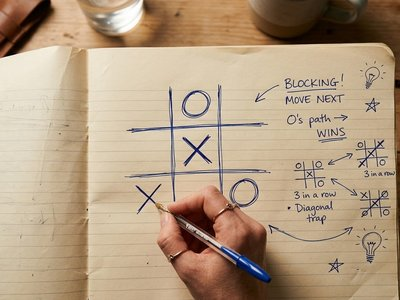
The complete tic tac toe strategy tree: corner-first traps, forced-win lines, forks, the 7-move priority checklist, and the game-theory math that proves you never lose.
Tic tac toe looks like a coin flip. Two players, nine squares, whoever gets three in a row wins. Yet this tiny game has a property that most people never suspect: it is completely solved. Mathematicians have enumerated every possible game — all 255,168 of them — and the verdict is airtight. If both players make the best move every turn, the game always ends in a draw. Every win, without exception, comes from a mistake by the loser.
That is not bad news. It is the whole point. Once you know where the mistakes happen and how to punish them, you will never lose another game, and you will win almost every match against someone who has not read this guide. Here is the complete strategy tree, verified move by move against a perfect-play simulation of the game.
Why Tic Tac Toe Is a "Solved" Game (And What That Means for You)
In game theory, a game is solved when we know its outcome from every position under perfect play. Tic tac toe is strongly solved: with a board this small — only 5,478 reachable positions, and just 765 once you ignore rotations and reflections — computers can check the entire game tree instantly.
The full count of possible games breaks down like this:
- 131,184 games end in a win for X (the first player) — 51.4%
- 77,904 games end in a win for O — 30.5%
- 46,080 games end in a draw — 18.1%
Under random play, first player wins more than half the time. Under perfect play, none of those 209,088 wins ever happen — the game is a draw all the way down. The gap between those two numbers is exactly the size of your opportunity. Every forced win in the list above requires someone to play a wrong square somewhere, and casual players play wrong squares constantly.
There is even an elegant proof that the second player can never force a win, called the strategy-stealing argument. Suppose O had a winning strategy. X could then play an arbitrary first move — a move that can only help X, never hurt — and afterwards pretend to be the second player, following O's "winning" strategy. Contradiction: two winners cannot exist. So the second player's best hope is a draw, and the first player's job is to make the draw hard to find.
Tic tac toe also has a place in computing history: OXO, built on the EDSAC computer at Cambridge in 1952, is widely cited as one of the earliest computer games ever made — and it played a perfect game.

The Best First Move: Corner vs Center (The Real Answer)
Ask around and you will get confident, contradictory answers. Some guides swear by the corner. Others insist the center is objectively best. Both camps are half right, and the confusion comes from measuring different things.
The honest way to compare squares is by counting how many winning lines pass through them:
| Square type | Winning lines | Squares on board |
|---|---|---|
| Center | 4 (row, column, 2 diagonals) | 1 |
| Corner | 3 (row, column, 1 diagonal) | 4 |
| Edge | 2 (row, column only) | 4 |
By raw line count, the center is the strongest square. But raw strength is not what wins casual games — opponent errors are. This is where the corner pulls ahead, and we verified the following with a full minimax simulation of the game tree:
- Open in a corner. The opponent's only non-losing reply is the center. If they answer anywhere else — another corner, any edge — you have a forced win. That is 7 out of 8 replies losing on move one.
- Open in the center. The opponent's only safe replies are the four corners. If they take any edge, you have a forced win. But corners are the square most players instinctively reach for, so you will punish fewer mistakes.
One more correction to popular advice: some guides claim that after a corner opening, the opponent can safely answer with the opposite corner. Our simulation says otherwise — X takes a corner, O takes any corner, and X wins by force every time. Only the center survives. That single clarification wins games against people who read the other guides.
Verdict: open in a corner. Against a perfect opponent both openings draw, but the corner opening converts the most opponent mistakes into wins.

Playing First: The Forced-Win Decision Tree
Say you took the top-left corner. Your opponent's reply decides everything, and each branch has a known answer.
Branch 1: They take an edge (the most common mistake)
Three different replies win by force here — the center, the edge opposite their piece, or the far corner on your side of the board (if they took the top edge, play the bottom-left corner). The corner is the cleanest to remember. Say you took the top-left, they took the top edge, and you play the bottom-left. You now threaten the left column, they must block it, and your next move builds an unstoppable fork. Whatever they do from here, the simulation shows the win arrives by force.
Branch 2: They take another corner
Counterintuitive but true: this also loses for them. Take one of the two remaining corners. Suppose you own the top-left, they grabbed the bottom-right, and you now take the top-right. You threaten the top row; they must block it. You then take the bottom-left, threatening the left column; they must block that too — and your third corner completes the far diagonal through the center. Two forced blocks, then a quiet diagonal win. The same shape works against an adjacent-corner reply.
Branch 3: They take the center (the correct move)
The game is now a theoretical draw if they keep playing perfectly. Play the opposite corner anyway. It sets up the X–center–X diagonal tension, and it gives them the most chances to go wrong later: if they answer with a corner instead of an edge, you can still force the win. Otherwise keep blocking and accept the draw — against correct defense, that is the ceiling.
What a fork actually is
A fork is any move that creates two winning threats at once. Picture two of your pieces in a row with an empty third square, and two more of your pieces in another row sharing a different empty square. Your opponent blocks one, you complete the other. Forks are the only mechanism that turns "no mistakes yet" into a loss, so every branch of the tree above is really just a different route to the same fork.
Playing Second: How to Never Lose
Going second is a defensive job. Your ceiling is a draw against a perfect player — but a draw is a win compared to losing, and sloppy first players hand you chances anyway.
- They open in a corner: take the center. Immediately. This is not a suggestion — it is the only move that avoids all their fork setups. Every other reply loses by force.
- They open in the center: take any corner. This neutralizes the four-line threat, and the game should draw.
- They open on an edge: take the center. You are now fully comfortable, and if they drift at any point, you have real winning chances — the edge is the weakest opening on the board for exactly the reason the table above shows.
One defensive skill matters more than any other: stopping forks with a counter-threat. When you spot your opponent building two lines toward a fork, do not just block one of the lines — that often accelerates their plan. Instead, play a move that creates your own two-in-a-row. Now they must respond to you, and their fork dissolves. Use this only after checking the first two items of the checklist below, or you will block while bleeding.
The 7-Item Move Priority Checklist (Your Unbeatable Algorithm)
Here is the entire strategy compressed into one list. On every single turn, run down it and take the first action that applies:
- Win: if you have two in a row with an empty third square, play it. Check this before anything else — people miss immediate wins embarrassingly often.
- Block: if your opponent has two in a row with an empty third, cover it.
- Fork: if a move creates two winning threats at once, play it.
- Block a fork: if your opponent threatens a fork next turn, either occupy the fork square or — better — make a counter-threat that forces them to defend.
- Prevent setups: deny them the opposite-corner and center-adjacent structures that feed forks.
- Take the center if it is still empty; otherwise take a corner.
- Take an edge only when nothing better exists.
Run this list faithfully and you literally cannot lose — on a 3x3 board, the list is perfect play. This is what game-theory programs compute with the minimax algorithm: assume your opponent answers every move with their best reply, and pick the move whose worst-case outcome is best. On nine squares you can do it in your head.
A quick worked example, straight from the verified tree. You are X: top-left corner. O takes the top edge — branch 1, the losing reply. You play the bottom-left corner, threatening the left column. O blocks on the left side. You now play the bottom-right corner: it threatens the bottom row through the bottom edge and the long diagonal through the center at the same time. That is a fork. O blocks one, you complete the other. Five of your marks, game over — and O was lost from their very first move.

Common Tic Tac Toe Mistakes That Cost You Wins
- Opening on an edge. It participates in only two lines and gives the opponent the most comfortable replies. Every losing casual game starts with lazy openings like this one.
- Answering a corner opening with anything but the center. As shown above, seven of eight replies lose by force. If you remember one defensive fact from this article, make it this one.
- Blocking one prong of an active fork. Once two real threats exist, it is already too late. Block forks before they mature — at step 4 of the checklist, not step 2.
- Chasing your own plan while ignoring theirs. Most losses are not strategic failures; they are missed blocks. Run the checklist top-down every turn and this disappears.
- Treating a draw as failure. Between two competent players, a draw is the correct result. If you lost, something in the tree went unanswered — find which branch and patch it.
Practice the Tree Against an Unbeatable Opponent
Reading the tree is one thing; owning it is another. The fastest way to lock it in is to play against an opponent that never blunders, watch where your plan dies, and trace the mistake back to a branch above. You can play tic tac toe free on iQiQGame against a perfect-play AI — start by drilling the two defensive facts (corner opening → reply center; center opening → reply corner) until they are reflexes.

The same habit this game trains — checking threats before chasing plans — carries directly into other logic puzzles. If you enjoy the decision-tree style of thinking, try How to Solve Lights Out Every Time or How to Play the 24 Game next. Tic tac toe is the smallest complete strategy anyone can learn; master it, and the bigger trees feel familiar.