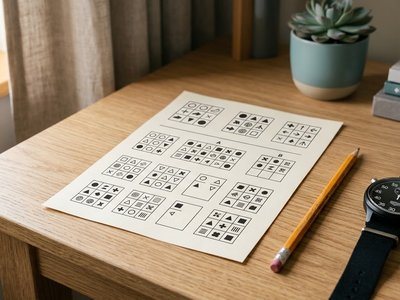
The 8 IQ test question types, from matrix reasoning to digit span — with worked examples, a 4-step solving framework, and what research says about practice.
Most people walk into their first iq test the same way they walk into an escape room: confident, curious, and completely unprepared for how the puzzles actually work. Then the clock starts, question three turns out to be a rotating-shape grid, question four is a number sequence, and half the time limit gets burned just figuring out what kind of question this even is.
That confusion is avoidable. IQ tests look unpredictable from the outside, but the question types are remarkably consistent across major test batteries. Learn to recognize the eight formats below and you stop wasting minutes on orientation — you spend your time actually reasoning, which is the only thing the test is scoring.
What an IQ Test Actually Measures
Before the question types, one piece of context that changes how you practice.
Modern intelligence tests are built on two ideas. The first is the split between fluid intelligence — reasoning through novel problems with no borrowed knowledge — and crystallized intelligence, the accumulated knowledge and vocabulary you carry around. Psychologist Raymond Cattell formalized this distinction in 1963, and it maps neatly onto what tests actually ask: a matrix puzzle is fluid; a vocabulary item is crystallized.
The second idea is scoring. Almost every mainstream test reports a score where 100 is the mean and 15 points is one standard deviation, following a normal distribution. Roughly 68% of people score between 85 and 115. That number describes how your raw performance compares to a norm group — nothing more. It is not a measure of your worth, and it is not a measurement of how much you know.
Which leads to the core point: these tests measure how well you deduce rules, not what you memorized. That is exactly why the question types can be practiced.
The 8 Question Types You Will Actually See
The formats below cover the vast majority of items you will meet, whether the test follows the Wechsler framework, a Raven-style matrices design, or a modern online adaptation. All examples are original teaching items — the real tests keep their banks secure, but the structures are public knowledge.
1. Matrix Reasoning
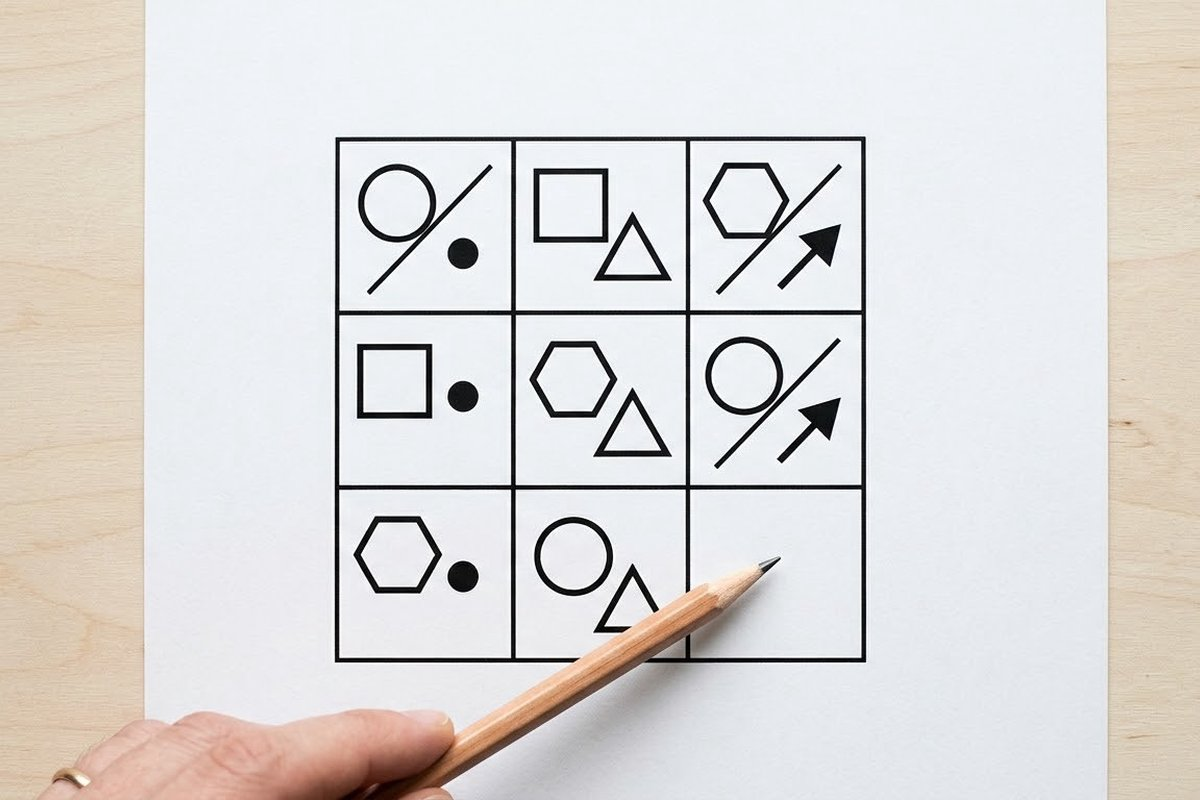
A grid of shapes with one cell missing. You pick the option that completes the pattern. Under the surface, nearly every matrix item runs on a short list of rules: rotation (elements turn 90° per step), progression (elements grow, shrink, or count up), distribution (each shape appears exactly once per row and column), and overlay (two cells combine by an AND/OR/XOR rule to produce the third).
Strategy: track one attribute at a time. Check orientation across the row, then shape count, then shading. Trying to "see" the whole pattern at once is how people get stuck.
2. Number Sequences
What comes next: 3, 7, 13, 21, 31, __? The differences are 4, 6, 8, 10 — growing by 2 each time — so the next difference is 12 and the answer is 43. Sequence items typically use arithmetic steps, geometric multiplication (2, 6, 18, 54...), alternating rules (two interleaved series), or recursive rules where each term depends on earlier ones.
Strategy: always check consecutive differences first, then ratios, then alternate terms. Three checks cover the overwhelming majority of sequence puzzles.
3. Verbal Analogies
Seed is to tree as egg is to __. The answer is not "shell" — shell is where the egg is, but seed-to-tree is a growth relationship, so the answer is bird (or hatchling). Analogy items test whether you can extract the relationship, not the dictionary meaning.
Strategy: before looking at the options, compress the relationship into a plain sentence: "a seed grows into a tree." Then test each option against that sentence. Options that fit the words but not the sentence are decoys.
4. Odd One Out (Classification)
Five items, four share a property, one does not. Apple, banana, carrot, mango, peach — carrot is the vegetable among fruits. Simple version, yes. But harder items hide the shared property: five shapes that all have an even number of sides, five words that are all anagrams of countries.
Strategy: generate the common property first, then verify it against every item. Hunting for what makes each item "weird" one by one is slower and error-prone.
5. Logical Deduction
"All roses are flowers. Some flowers fade quickly. What must be true?" Not much, it turns out — "some roses might fade quickly" is the only defensible conclusion. Deduction items present premises and ask for the conclusion that must follow. The traps are predictable: conclusions using "all" where the premise said "some," reversing statements ("all roses are flowers" does not mean "all flowers are roses"), and mixing up necessary with sufficient conditions.
Strategy: treat "some" as "at least one, possibly all," and never let a conclusion claim more than its premises license.
6. Spatial Reasoning
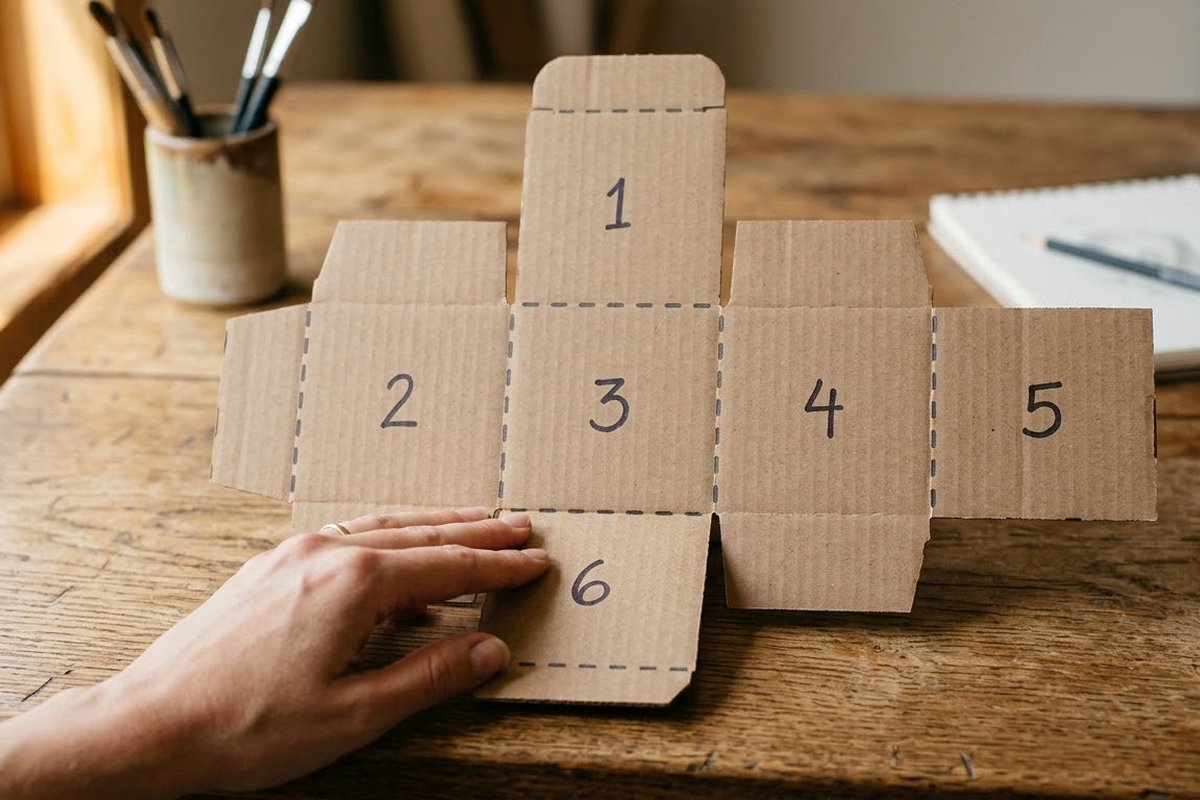
Two flavors dominate. Mental rotation: an arrow points north, turns 90° clockwise, then 180° — where does it point? (West, and yes, it is easier said than done under time pressure.) Cube folding: a flat net of six faces, and you choose which 3D cube it produces. For folding items, the reliable trick is adjacency: pick two faces that share an edge in the net, and eliminate any cube where those faces are not adjacent.
Strategy: for rotation, use landmarks (the arrow's tail, the cube's printed face) rather than rotating the whole object in your head.
7. Working Memory (Digit and Letter Span)
You hear or read a sequence — 7, 2, 9, 4 — and must reproduce it, sometimes reversed, sometimes reordered. Adult forward span averages around seven items, which is why the difficulty ramps fast. This is the one domain where a genuine, trainable technique exists: chunking. Group digits into pairs or threes, attach them to something meaningful (a date, a jersey number), and your effective span grows without your memory changing.
Strategy: never hold a raw string. Convert it to chunks the moment you see it.
8. Processing Speed (Symbol Coding)
A key pairs symbols with digits; rows of symbols follow and you mark the matching digit, as many as you can before time runs out. These items look trivial and they are — trivially fast. They measure how quickly and accurately your brain executes a routine lookup, and nobody finishes. Panic, not difficulty, is what costs points here.
Strategy: keep one steady rhythm and accept that unfinished is normal. Rushing into errors is the only way to lose ground.
A 4-Step Framework for Any Question You Don't Recognize
Sooner or later, a question appears that matches none of the eight templates. Work it like this:
Name the closest type. Even a rough match ("this is matrix logic with letters") activates the right strategy.
Scan the rule dimensions. Position, quantity, orientation, shading, overlap — almost every rule lives in one of these five. Check them in order and note which ones change between cells.
Eliminate before you solve. Often three options violate an obvious property (wrong rotation direction, impossible adjacency). Crossing those out shrinks the problem.
Set a timebox. About 60–90 seconds for a matrix item, 45 for a sequence. If the timebox expires, mark your best guess and move on. One abandoned question costs one point; three minutes spent staring costs three questions.
Can Practice Raise Your Score? What Research Says
Here is the honest version. Practice on the same question formats reliably improves performance — this is the well-documented practice effect — but researchers generally attribute the gain to format familiarity and faster strategy execution, not to a rise in underlying ability. You are not becoming smarter; you are removing the tax that novelty and confusion impose on your reasoning.

One supporting observation: the Flynn effect — the finding, named after James Flynn's 1987 work, that average iq scores rose steadily across the 20th century — shows that test performance responds to environment and exposure. Tests were periodically re-normed precisely because populations kept getting better at the formats.
So set expectations accordingly. A few practice sessions will not add thirty points, but they reliably reduce test anxiety, prevent format-surprise losses, and sharpen your timing — which together often account for the difference between a score that reflects your actual reasoning and one that doesn't.
Five Mistakes That Cost Points
Staring down one hard question. Timebox every item. Perfectionism is expensive.
Hunting the answer options first. On matrices and sequences, extract the rule from the stem first; options are for verification, not discovery.
Trusting "some." In deduction items, "some" claims almost nothing. Conclusions built on it are usually traps.
Leaving blanks. These tests do not subtract for wrong answers. A guessed question is free expected value.
Showing up sleep-deprived. Working memory and processing speed — half the battery — are the first cognitive functions sleep loss degrades.
The Takeaway
An IQ test is not a mystery box. It is a fixed set of eight recognizable formats wrapped in unfamiliar content, and the single highest-leverage thing you can do the week before a test is drill recognition: see the matrix, think rotation or distribution; see the sequence, think differences first; see "all," think does the conclusion claim too much?
Then practice under realistic conditions — timed, mixed formats, no re-reading the instructions. You can run a full free IQ test on iQiQGame's IqEqTest in a few minutes, and follow it with the platform's logic and number games to train the specific reasoning domains the eight types draw on. Familiarity is not cheating. It is the whole game.
References
Cattell, R. B. (1963). Theory of fluid and crystallized intelligence. Journal of Educational Psychology. https://psycnet.apa.org/record/1964-05014-001
Flynn, J. R. (1987). Massive IQ gains in 14 nations. Psychological Bulletin. https://psycnet.apa.org/record/1987-24408-001
Raven, J. (2000). The Raven's Progressive Matrices: Change and stability over culture and time. Cognitive Psychology. https://psycnet.apa.org/record/2000-15418-002
Wechsler Adult Intelligence Scale (WAIS-5) overview. Pearson Clinical. https://www.pearsonassessments.com