Do brain games work? A science-first review of near vs. far transfer, the ACTIVE trial, the Lumosity FTC case, and 2025 studies — plus how to play for real benefit.
The pitch is everywhere: play a few quick games a day, and your memory gets sharper, your focus gets stronger, your brain gets "younger." The brain-training industry was built on that promise, and it has sold millions of subscriptions on the strength of it.
In 2016, the US Federal Trade Commission hit Lumos Labs — the company behind Lumosity, one of the biggest names in the category — with a $50 million judgment (later reduced to $2 million) for advertising claims it could not back up. The FTC's objection was not that the games were bad. It was that Lumosity claimed its games could improve performance at work and school and delay age-related cognitive decline, and it did not have the science to say so.
So where does the honest line sit today, a decade after that settlement? What do brain games genuinely do for you, and what will they never do no matter how many levels you clear? The research is more interesting — and more useful — than either the marketing or the knee-jerk debunking suggests.
Near Transfer vs. Far Transfer: The Distinction That Decides Everything
Almost every argument about brain games comes down to one pair of terms from cognitive psychology.
Near transfer is improvement on the task you practiced, and on tasks that closely resemble it. If you drill a memory-match game for two weeks, your memory-match scores will climb. Nobody disputes this. It happens reliably, and it happens fast.
Far transfer is the promise that actually sells subscriptions: the idea that those gains will spill over into the rest of your life — remembering names at a party, staying focused through a long meeting, juggling a complicated budget spreadsheet.
In 2016, psychologist Daniel Simons and colleagues published a sweeping review of the brain-training literature in Psychological Science in the Public Interest, examining 374 studies cited by the industry's own leading products. Their conclusion: the evidence showed clear improvement on the trained tasks, and "little evidence that training enhances performance on distantly related tasks or that training improves everyday cognitive performance."
That pattern has held up remarkably well since. You will almost certainly get better at the games you play. Whether that makes you sharper everywhere else is where the evidence gets thin.

What the Large Studies Actually Found
The most cited document in the skeptical camp is the 2014 consensus statement organized through the Stanford Center on Longevity and the Max Planck Institute for Human Development, signed by around 70 cognitive scientists and neuroscientists. Their position: claims that software-based brain games improve general cognitive performance or prevent cognitive decline are "frequently exaggerated and at times misleading."
A later review in Psychonomic Bulletin & Review put the case even more bluntly, concluding that "the real effect size of cognitive training on far transfer is zero."
The picture is not one-sided, though. A 2025 meta-analysis pooling 16 randomized trials of commercially available brain games in healthy adults over 60 — more than 1,500 participants in total — found statistically significant gains in several measured domains:
- Processing speed: the largest effect (standardized mean difference of 0.40 — a moderate effect)
- Working memory: 0.21, a small but reliable effect
- Executive function: 0.21
- Verbal memory: 0.12, barely distinguishable from nothing
- Attention and visuospatial ability: no significant effect
The catch: those numbers are scores on cognitive tests, not improvements in everyday life. The meta-analysis measures the middle rung of a ladder. Near transfer is the bottom rung, far transfer is the top, and no study has convincingly demonstrated a climb from the bottom to the top.
One encouraging detail from the methodology debates: a large meta-analysis comparing studies with passive control groups (people who did nothing) against studies with active controls (people who did a different engaging activity) found the difference between the two was small and not statistically significant. In plain terms, the modest gains in the literature don't appear to be pure placebo — but they shouldn't be inflated into something bigger than they are, either.
The ACTIVE Trial: The One Serious Exception
If the story ended there, brain training would be a closed case. It doesn't, because of one unusually rigorous study.
The ACTIVE trial (Advanced Cognitive Training for Independent and Vital Elderly) randomized 2,832 independently living older adults to three types of training — memory strategies, logical reasoning, or speed of processing — or to a no-contact control group. Participants got ten training sessions, with four booster sessions at 11 and 35 months, and researchers followed them for ten years.
The results split sharply by training type:
- Speed-of-processing training — rapidly identifying objects and information on a screen — maintained the largest effect of the entire trial at the ten-year mark (effect size 0.66, which is substantial).
- Reasoning training also held up over the decade.
- Memory training, ironically the thing people most want, was the one that faded: its benefits disappeared within about five years.
More striking still, NIH-funded follow-up work using Medicare claims data found that participants in the speed-of-processing arm were diagnosed with dementia at a roughly 25% lower rate over the following decades. Neither of the other training arms showed this.
Be careful with that number, though. It's a single finding from one trial, based on insurance claims rather than clinical exams, and the training in question — an adaptive, speed-of-processing program with booster sessions — is not what most commercial puzzle apps deliver. It's a promising signal, not a prescription.

New Evidence: What 2025 Studies Changed
The science hasn't stood still, and two recent findings are worth your attention.
First, a 2025 randomized clinical trial from McGill University, published in JMIR Serious Games, did something no study had done before: it used PET imaging to look directly at brain chemistry. Ninety-two healthy adults aged 65 and older trained for 30 minutes a day over ten weeks on an adaptive, speed-based brain-training program, while a control group played recreational computer games. Only the training group showed increased cholinergic activity — a brain chemical system central to attention, learning, and memory that declines with age and deteriorates sharply in Alzheimer's disease. The researchers described the effect as restoring cholinergic health to levels typically seen in someone ten years younger. A follow-up study in people with early-stage dementia is already in the works.
Second, a long head-to-head trial published in NEJM Evidence followed 107 adults with mild cognitive impairment for 78 weeks and found that crossword puzzles outperformed computerized brain-training games — on cognitive measures and on brain shrinkage measured by MRI.
Read together, the honest summary is: the question is genuinely open, the strongest new evidence involves adaptive speed-of-processing training rather than generic puzzle apps, and even the category's best-supported products can lose to a newspaper crossword in a fair fight.
What Actually Protects Your Brain (Stronger Evidence Than Any App)
If your goal is a mind that works well for decades, the research points somewhere less convenient than a subscription. The interventions with the strongest evidence are unglamorous and mostly free:
- Aerobic exercise — the most consistently supported intervention for cognitive health in adults, with measurable effects on brain structure.
- Sleep — memory consolidation happens during it, and short sleep measurably degrades attention the next day.
- Learning something genuinely hard — a language, an instrument, a craft; complex, effortful, and sustained over months.
- Social engagement — consistently associated with better cognitive aging.
- Managing hearing loss and blood pressure — both appear repeatedly in the modifiable-risk-factor literature.
No puzzle game replaces any of these. If someone tells you a game is a substitute for exercise or sleep, close the tab.

So Should You Play Brain Games? An Honest Answer
Play puzzle games because you enjoy them, not because an app promised to make you smarter.
That's not a backhanded dismissal. Enjoyment is what keeps people coming back, and the research does support a few smart ways to play:
Rotate game types. No single game trains everything. memory games, logic puzzles, number games, and speed challenges each stress a different system — and "do something varied" is one of the most consistent findings in the whole literature. Grinding the same match-three you've already mastered does far less for you than a puzzle two notches above your comfort zone.
Chase novelty, not streaks. The benefit comes from effortful problem-solving — recall, pattern recognition, reasoning under mild pressure. Once a game becomes automatic, its training value drops close to zero. A new puzzle type restarts the challenge.
Keep expectations calibrated. Getting faster at a game proves you're getting better at the game. That's a real, satisfying, measurable improvement — just don't book it as dementia insurance.
Treat it as the dessert, not the meal. A few sessions a week of genuinely challenging puzzles is a fine addition to a routine built on exercise, sleep, and social connection. It just isn't a replacement.
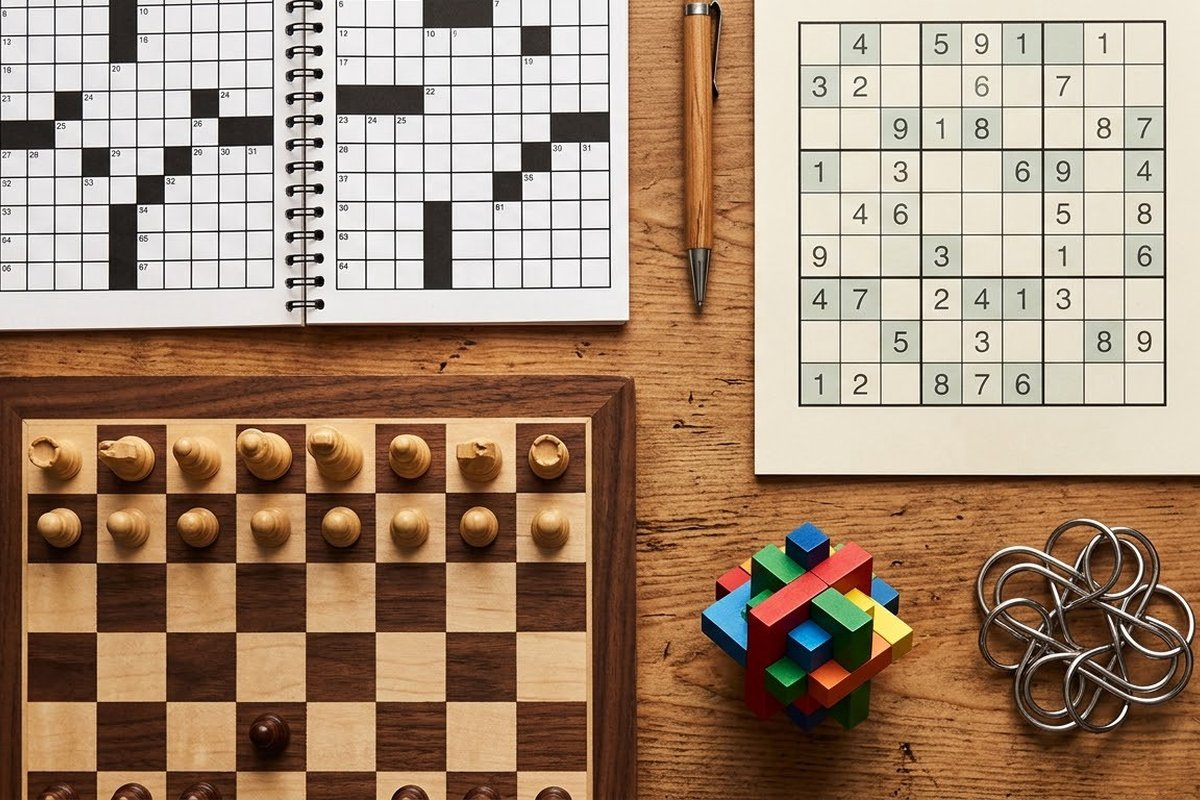
That's the standard we hold our own games to at iQiQGame. The memory-match, logic, and number puzzles on our site are built to stay challenging — the kind that stay fun precisely because they keep asking a little more of you each round. If you want to put the theory to the test, try a memory-match game or learn sudoku from scratch and watch your own learning curve show up within a week. Just know what you're buying: a good time and a small, real, specific skill gain — not a brain upgrade.
Frequently Asked Questions
Do brain games raise your IQ? There's no good evidence that they do. Fluid intelligence — the general reasoning ability iq tests measure — has proven remarkably resistant to training in meta-analyses. You'll improve on the specific skills the games train, which is not the same thing.
Can brain games prevent dementia? Not established. The most promising finding — a lower dementia diagnosis rate in the speed-of-processing arm of the ACTIVE trial — comes from one specific, intensive training protocol with booster sessions, not from commercial puzzle apps in general.
What's better for your brain: puzzle games or exercise? Exercise, by a wide margin, if you have to pick one. It's the best-evidenced intervention for cognitive health in adults. Puzzle games are a complement worth having — enjoyable, low-cost, and they train specific skills — but they don't substitute for the fundamentals.
References
- FTC. "Lumosity to Stop Advertising 'Brain Training' Programs' Alleged Benefits." 2016. https://www.ftc.gov/news-events/news/press-releases/2016/01/lumosity-stop-advertising-brain-training-programs-alleged-benefits
- Simons, D. J., et al. "Do 'Brain-Training' Programs Work?" Psychological Science in the Public Interest, 2016. https://journals.sagepub.com/doi/10.1177/1529100616661983
- Stanford Center on Longevity & Max Planck Institute for Human Development. "A Consensus on the Brain Training Industry from the Scientific Community." 2014. https://longevity.stanford.edu/a-consensus-on-the-brain-training-industry-from-the-scientific-community-2/
- Attarha, M., et al. "Effects of Computerized Cognitive Training on Vesicular Acetylcholine Transporter Levels... (INHANCE Randomized Clinical Trial)." JMIR Serious Games, 2025. https://doi.org/10.2196/75161
- "Online brain training reverses 10 years of aging in memory and learning." ScienceDaily, 2025. https://www.sciencedaily.com/releases/2025/10/251029002858.htm
- Kable, J., et al. "No Effect of Commercial Cognitive Training on Neural Activity During Decision-Making." The Journal of Neuroscience, 2017. https://www.jneurosci.org/content/37/31/7382