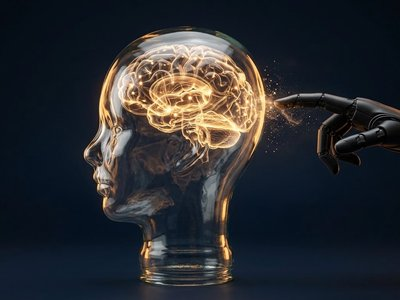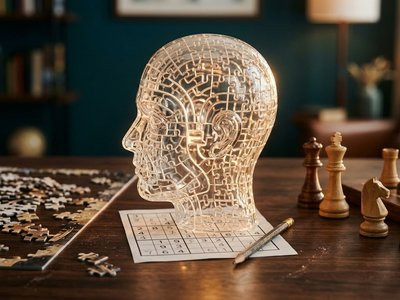
Brain scans since 2004 traced the aha moment to a 40 Hz gamma burst in the right temporal lobe. See what insight does in your brain, plus 5 ways to get more of it.
You know the moment. Ten minutes of staring at the same grid, nothing works — and then, all at once, the answer is just there. No careful derivation, no step-by-step logic you could narrate. The puzzle opens up, and you feel a small burst of satisfaction that borders on physical.
Psychologists call it insight. Players call it the aha moment. For most of the twentieth century it was treated as a fuzzy curiosity — something you could describe but never measure. That has changed. Neuroscientists have now caught the aha moment on fMRI scanners and EEG caps, traced it to a specific patch of brain tissue, and even tested whether sudden answers are more trustworthy than deliberate ones. The short version: that flash of relief when a puzzle clicks is a real, observable neural event — and knowing how it works can help you have more of them.
What Exactly Is an "Aha Moment"?
The American Psychological Association defines insight as "the clear and often sudden discernment of a solution to a problem by means that are not obvious" — a solution that arrives without a traceable path, sometimes so completely that you couldn't explain how you got there even if you tried.
What makes insight scientifically interesting is that the same puzzle can usually be solved either way. Cognitive researchers study this with verbal brain teasers called Compound Remote Associates, or CRAs. You get three words — say, pine, crab, and sauce — and you have to find a fourth word that pairs with all three. The answer here is apple: pineapple, crabapple, applesauce. You can grind through it analytically, testing candidates one by one, or the answer can simply pop into your head. Same puzzle, two completely different mental routes. As neuroscientist John Kounios explains in Scientific American, that flexibility is what makes CRAs the workhorse of insight research: people solve the puzzle, then report whether the answer arrived suddenly or step by step.

The phenomenon itself is old. A century ago, Wolfgang Köhler watched chimpanzees appear to suddenly understand that stacking boxes would reach the bananas — rather than stumbling into the solution through trial and error. He called it insight learning. What's new is that we can watch it happen inside a living brain.
What Happens in Your Brain When Insight Hits
The landmark study came in 2004, when a team led by Mark Jung-Beeman and John Kounios ran two complementary imaging methods in parallel — EEG for precise timing, fMRI for precise location — while people solved CRAs. The study, published in PLoS Biology, found that solutions arriving by insight carried a distinctive signature: a burst of high-frequency gamma-band activity, at roughly 40 hertz, in a small fold of the right temporal lobe called the anterior superior temporal gyrus, or aSTG.
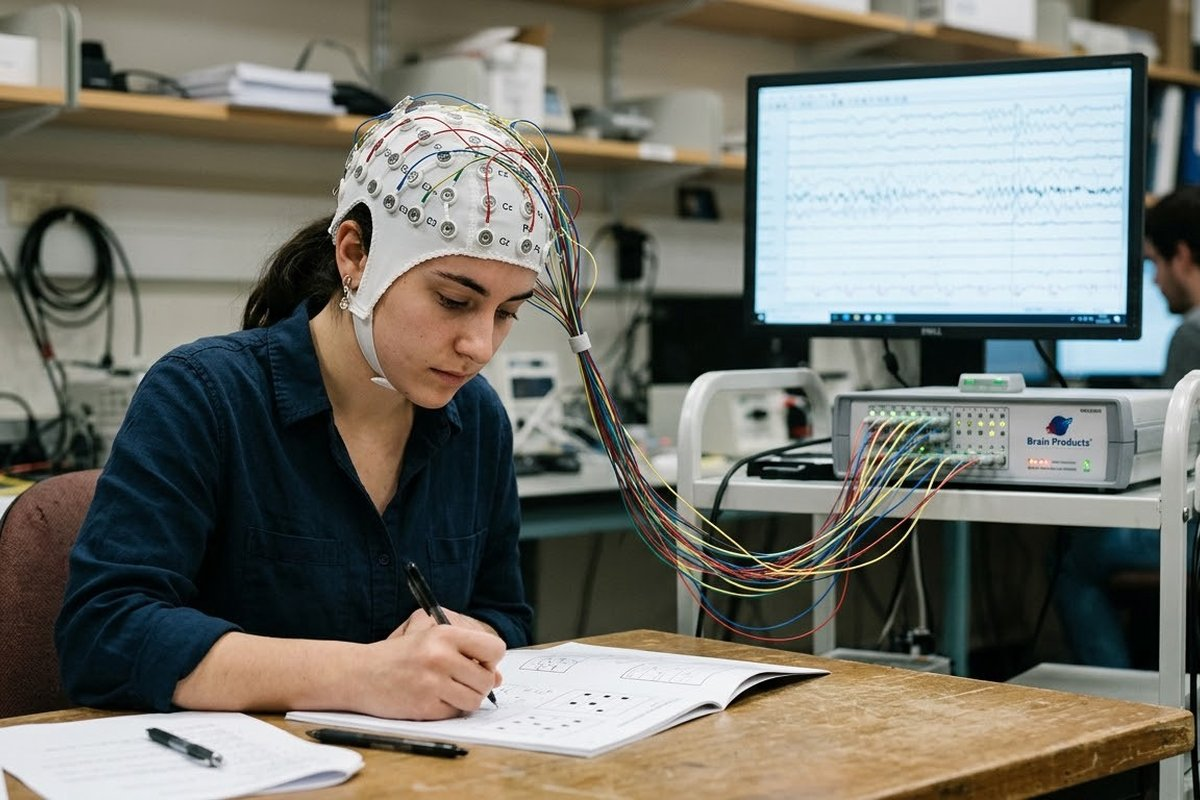
Why there? The right hemisphere, and the aSTG in particular, specializes in weak, distant associations — linking concepts that don't obviously belong together. That is precisely the skill a CRA demands: pine and crab live far apart in your mental dictionary, and only apple bridges them. During an aha moment, that region fires at the instant the solution surfaces, as if a connection that had been forming below awareness finally crossed the threshold into consciousness.
Which points to the second key finding: insight doesn't come from nowhere. It feels sudden, but the processing behind it is gradual and largely unconscious. As Kounios describes in his Scientific American feature on the aha! moment, solvers drift into a state of internally focused attention before an insightful answer — gaze wandering off the problem, blink rate shifting — a mental posture that lets loose associations run without the frontal lobes clamping them down. Analytical problem solving does the opposite: it recruits executive control regions in the prefrontal cortex, focused and systematic, efficient at eliminating options. Insight solving loosens that grip and lets the right hemisphere's distant-association machinery finish its work.
This is why answers arrive in the shower or on a walk. The puzzle doesn't need more willpower at that point. It needs less supervision.
The Review Evidence: Insight Is a Real, Distinct Cognitive Mode
One study is suggestive. A decade of replication and extension is something stronger. In 2014, Kounios and Beeman published a comprehensive review in Annual Review of Psychology consolidating what brain imaging had revealed about insight — and the picture is of a genuine cognitive mode, not just a subjective feeling.
Three findings stand out. First, insight has a preparatory state: people who solve problems insightfully show more internally directed attention before and during a task, and distinct resting-state brain activity. In one striking experiment, a few minutes of recorded resting-state EEG predicted whether a person would solve anagrams analytically or insightfully up to seven weeks later. Your default mental posture — tight and frontal, or loose and posterior — shows up in the brain even when you're doing nothing at all.
Second, mood matters. Participants reporting a more positive mood solved more problems by insight; anxious participants defaulted to analysis. The researchers' framing is worth remembering: fear makes you careful, and careful is the wrong mode for distant associations. A worried brain double-checks every move. A relaxed brain lets ideas wander into each other.

Third, insight is not fixed. Early studies using direct brain stimulation to modulate cortical excitability suggest the tendency to solve insightfully can be nudged — evidence that the aha moment is a trainable state, not a personality trait you're stuck with.
For puzzle players the practical reading is simple. If you want a brain that produces aha moments, you have to occasionally stop clamping down — and games are a low-stakes way to practice exactly that. A session of free Lights Out puzzles or a daily online sudoku keeps handing you problems that punish rigid strategies and reward letting go.
Can You Trust Your Aha Moments?
Here the research turns genuinely counterintuitive. Insight feels like intuition, and intuition is supposed to be the sloppy fast path — inferior to careful reasoning. The data says otherwise.
Psychologist Carola Salvi, working with John Kounios and colleagues, ran four experiments comparing the accuracy of solutions reached by insight against solutions reached by deliberate, step-by-step analysis. As the Association for Psychological Science reports on the team's findings in the journal Thinking & Reasoning, aha answers beat analytical answers in every single experiment. In one, solvers who experienced an aha moment were correct 94 percent of the time, against 78 percent for those who reasoned their way to the answer.
Why would the sudden path be the more accurate one? The researchers' interpretation: when a solution pops into awareness fully formed, a great deal of unconscious work has already happened — candidate answers were generated and filtered below the surface, and only one survived. When you build the answer brick by brick, each brick is a fresh chance to go wrong. The feeling of certainty that rides along with an aha moment isn't self-delusion. It's a readout of work your brain already finished.
One caveat deserves honesty: these results come from puzzles with verifiable answers. For open-ended real-world decisions, "it feels right" is not a validation method. But on a logic grid or a word puzzle, where a correct answer objectively exists, the flash of insight is a remarkably reliable signal.
How to Get More Aha Moments While Playing Puzzles
The research translates into concrete tactics. None of them require talent — they require letting a different part of your problem-solving apparatus take a turn.
1. When you're stuck, stop. This is the best-supported move in the whole literature. Insight solutions incubate during unfocused breaks — the shower, the walk, the coffee refill. If a puzzle has resisted your deliberate strategies for several minutes, walking away isn't quitting. It's handing the problem to your right hemisphere, which has been quietly working the whole time.
2. Loosen your grip on your first idea. Analytical solving commits to a hypothesis and tests it. Insight solving requires releasing dominant interpretations. In the CRA example, if pine keeps dragging you toward tree and cone, the answer isn't more thinking about trees. Drop the strongest association on purpose and let weaker ones surface.
3. Solve in a good mood. The Subramaniam finding — positive affect promotes insight, anxiety promotes analysis — is a reason to keep puzzle sessions low-pressure. Play when you're relaxed, not when you're grinding to prove something. A calm run of free online 2048 is a better insight workout than a tense one.

4. Don't over-verify in the moment. Solvers who interrupt every hunch to check it analytically cut off the insight pathway. Go with the sudden answer first; confirm it second. On puzzles, the evidence says the sudden answer has usually earned the trust.
5. Practice the release, not just the logic. Deliberate practice usually targets analysis — memorizing patterns, drilling techniques — and that matters. But the complementary skill is cognitive flexibility: approaching the same grid from a new angle. Memory supplies the raw material those aha connections draw on, so these science-backed working memory exercises pair well with puzzle time.
Your Brain on Puzzles
The aha moment turned out to be neither magic nor a metaphor. It's a burst of 40-hertz activity in the right temporal lobe, prepared by unconscious processing, favored by good moods and unfocused attention — and, on problems with real answers, more often right than the careful path. Every time a puzzle clicks for you, that cascade just ran.
So the next time you're stuck, remember what the scanners show: the fastest route to the answer is sometimes through not thinking about it. Pick any puzzle on the site, get stuck on purpose, and let your right hemisphere finish the job.
References
- American Psychological Association — Insight (APA Dictionary of Psychology)
- Jung-Beeman M, et al. (2004) — Neural Activity When People Solve Verbal Problems with Insight, PLoS Biology
- Kounios J & Beeman M (2014) — The Cognitive Neuroscience of Insight, Annual Review of Psychology
- Association for Psychological Science — Can You Trust a Eureka Moment?
- Kounios J & Kounios Y — The Brain Science of Elusive 'Aha! Moments', Scientific American
- Scientific American — The Aha! Moment