
ADHD and working memory: what the 2005 and 2015 meta-analyses found, why goals get dropped mid-task, and which daily fixes survive blinded evidence.
You walk into the kitchen and stop. The reason you came in is gone — not faded, gone, as if the last ten seconds were never recorded. Or you read a three-line instruction, and you can repeat lines one and three but not the order they went in. Or you spend forty minutes on a task, finish it beautifully, and then realise it was the wrong task.
The clearest description of this experience is one that shows up again and again in first-person ADHD accounts: "I don't forget what I was doing. I forget that I was doing it."
That sentence gets at something the standard advice misses. When people with ADHD describe memory problems, they are usually not describing a small buffer. They are describing a buffer that keeps getting interrupted — and an interruption that lands on the goal rather than on the data. This piece explains the mechanism, then ranks what the research actually supports. It is educational, not diagnostic; nothing here replaces an assessment.
What working memory actually does
Working memory is the mental scratchpad: a small amount of information held in an active, usable state for a few seconds while you do something with it — reorder it, compare it, update it, use it to decide the next step. Two features matter. It is brief, and it is operational. A phone number you repeat to yourself while dialling is working memory. The same number stored in your contacts is not.
In the model most clinicians still teach, three parts do the work: a phonological loop that holds the inner voice (roughly two seconds of speech, refreshed by rehearsal), a visuospatial sketchpad that holds the mind's eye, and a central executive that decides what stays and what gets pushed out. The ceiling is lower than folk psychology suggests — once rehearsal is blocked, most people hold around four items, not seven.

One detail from the clinical literature is worth pausing on. The ADHD charity CHADD, summarising Russell Barkley's model of executive function, lists four domains: nonverbal working memory, internalisation of speech (verbal working memory), self-regulation of affect and motivation, and reconstitution, or planning. Working memory is not a memory module bolted onto the executive suite. In this framework it is one of the executive functions — which is why it shows up in so many ADHD profiles, and why "just pay attention" is not a fix.
What the effect sizes say about ADHD and working memory
The most cited numbers come from a 2005 meta-analysis of 26 studies by Rhonda Martinussen and colleagues, published in the Journal of the American Academy of Child and Adolescent Psychiatry and indexed on PubMed. Children and adolescents with ADHD showed deficits across multiple working-memory components, and the pattern was uneven:
| Component | Effect size (Cohen's d) |
|---|---|
| Spatial storage | 0.85 |
| Spatial central-executive (storage + manipulation) | 1.06 |
| Verbal storage | 0.47 |
| Verbal central-executive | 0.43 |
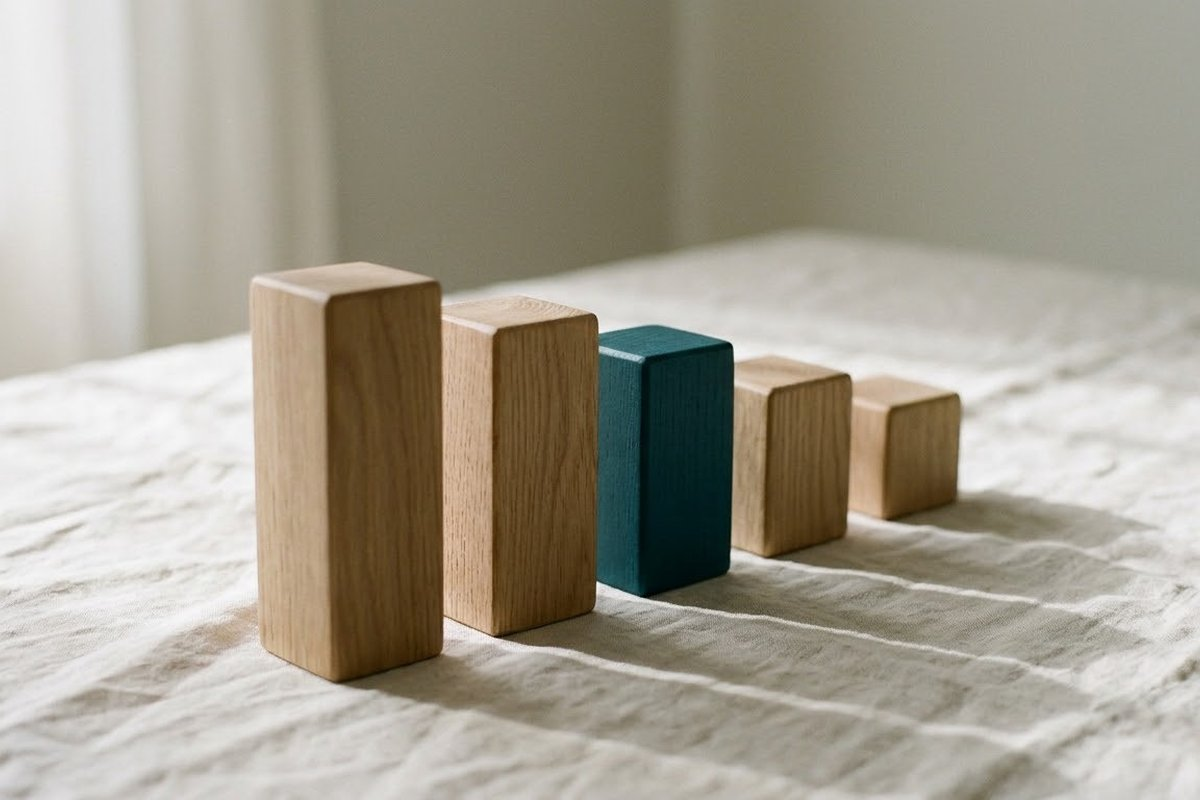
Two things follow. First, the gap is largest where you have to hold something and move it — spatial tasks that require updating, not just retaining. Second, plain verbal span is only mildly reduced. This is why a person can repeat a sentence back correctly and still lose the thread of a conversation: repeating is storage. Following is storage plus updating, under a stream of new input.
The deficits held even after accounting for co-occurring language and learning difficulties and for general intellectual ability. That matters, because it rules out the simplest explanation — that the memory gap is a side effect of struggling with reading, or of scoring lower on iq tests.
Now the caveat most articles skip. These are group averages. The distributions overlap heavily, and a substantial minority of people with ADHD score in the normal range on working-memory tests. A large effect size tells you what is common in a group. It cannot tell you what is happening in one head. That is one reason a working-memory score is an input to diagnosis rather than a diagnosis in itself — the National Institute of Mental Health's overview of ADHD assessment lists tests of working memory and executive function as one part of a broader evaluation that also covers history, rating scales, and impairment across settings.
There is a mechanistic story that ties this together. In Barkley's account, the primary deficit is in behavioural inhibition — the pause between impulse and action. That pause is where working memory does its job: holding the recent past and the intended future side by side long enough for you to choose. Remove the pause and you get the familiar profile. Not "bad memory" — no hold. The plan never stays on the desk long enough to be executed.
Storage versus manipulation: the distinction most advice misses
Try two tasks. First: hold 4-8-1-5-9-3 in mind for ten seconds. Second: hold it and say it backwards. Most people find the second one collapses fast. The digits did not change. The operation did.
This is the difference between storage and manipulation, and it explains why the most common piece of advice works only halfway. "Just write it down" is an excellent storage fix. It is a poor manipulation fix, because a note holds data but not intent. If the note says dentist, you have preserved a fact and lost a goal. If it says open calendar, find Tuesday 3pm, dial the number in the confirmation email, you have preserved the goal and attached a next physical action.
In daily life, ADHD-shaped failures cluster on the second kind:
- Data loss: the name, the number, the fourth item on the shopping list.
- Goal loss: the task that got completed, competently, in the wrong direction.
The second is what people usually mean when they say their memory is broken. And it needs a different fix. Externalising the objective — visibly, physically, in the order it must happen — beats any amount of rehearsing the facts.
Why the standard advice backfires
Four common recommendations make the underlying problem worse, and it is worth knowing why.
"Try harder to focus." Monitoring your own attention is itself a working-memory task. You are now holding the task and a supervisor evaluating your performance on the task. Effort is a load, not a free input. This is the mechanism behind the well-known experience of concentrating intensely on concentrating and getting nothing done.
Long to-do lists. A thirty-item list is a thirty-item working-memory task you have handed yourself, plus a prioritisation problem, plus a guilt tracker. The list did not offload anything; it moved the load somewhere more visible.
Task switching. Every switch forces a reload of context — where you were, what the next step was, why it mattered. The reload is precisely where goals get dropped, which is why an interruption at minute three costs more than the interruption itself.
Sleep debt. The NIMH's ADHD overview notes that sleep problems affect up to 70% of adults with ADHD. Sleep loss degrades working memory, and tasks that depend on updating suffer most — so a short night does not just make you tired, it makes the exact function you are relying on less reliable, and every other strategy on this page harder to run.
What the evidence supports, ranked
Here is where most articles go soft. The honest ranking, from best evidence-to-cost ratio to worst:
Tier 1 — External scaffolds and behavioural strategies. Written capture, visible time, a single inbox, one task per session, cues placed where the failure actually happens. This is not a consolation prize. The NIMH describes effective treatment as usually a combination of elements, and behavioural approaches are treated as a core component rather than an optional extra. These tactics also have the advantage of working on the first day, with no side effects and no subscription.
Tier 2 — Medication. Medication, usually a stimulant, is one of the two most common treatments for adults with ADHD, and it reduces symptoms. Its effect on laboratory working-memory measures is real but modest — it improves the conditions under which the buffer operates rather than expanding the buffer. Whether to use it is a clinical decision, and not one this article can make for you.
Tier 3 — Working-memory training. This is where the marketing and the evidence diverge most sharply. A 2015 meta-analysis of 16 randomised controlled trials (759 children with ADHD) by Samuele Cortese and colleagues, available in full on PubMed Central, found training produced real gains on laboratory working-memory tests: standardised mean difference 0.52 for verbal working memory, 0.47 for visual, and 0.35 on parent-rated executive function. Then the numbers that matter for daily life. When outcomes were rated by probably blinded assessors, the effect on total ADHD symptoms fell to 0.20, inattention to 0.32 with a confidence interval crossing zero, and hyperactivity-impulsivity was not significant. Academic outcomes showed no significant effect. The authors' own summary is blunt — there were "no effects of working memory training, specifically on ADHD symptoms."
An earlier meta-analysis reached the same place from a different angle. Melby-Lervåg and Hulme reviewed 23 studies with 30 comparisons and concluded that training improved performance on the trained tasks but did not transfer to verbal skills, attention, reading, or arithmetic — a conclusion the American Psychological Association publicised directly, with the lead author noting that loading the brain with exercises "will not lead to better performance outside of the tasks presented within these tests."
So the defensible claim is narrow: training makes you better at the thing you train. Near transfer, yes. Symptom relief, no.
Tier 4 — Commercial brain-game claims. In 2016 the US Federal Trade Commission fined Lumosity $2 million over advertising claims it could not support. Reporting in Scientific American's review of who actually benefits is more balanced than the headlines were: it documents genuine working-memory gains in children with attention deficits while also noting that most programs can only show improvement on the skills they trained. Both halves are true. Neither supports "sharper brain in ten minutes a day."
| Intervention | What it changes | Evidence strength | Cost |
|---|---|---|---|
| External scaffolds | Where information lives; task design | Strong, pragmatic; core in clinical guidance | Near zero |
| Medication | Symptom severity; conditions for attention | Strong for symptoms; modest for lab WM | Clinical, ongoing |
| WM training | Trained tasks, near transfer | Moderate for tasks; weak for symptoms | Time, some money |
| Brain-game marketing | Trained tasks only | Weak; regulatory action taken | Subscription |
A 20-minute daily protocol
If the buffer cannot be enlarged, the useful project is reducing what you ask it to hold. This protocol takes twenty minutes and costs nothing. It is built from the tiers above, weighted toward the one with the best evidence.

Minutes 0–2 — Capture. One page, everything currently circulating in your head. Not organised, not prioritised. The point is to get it out of the buffer and into the world where it does not decay.
Minutes 2–5 — Convert one item. Pick exactly one. Rewrite it as a single visible next physical action: not "sort out insurance" but "open the PDF, find the policy number, paste it into the form." This is the storage-to-manipulation move that most advice skips.
Minutes 5–15 — One adaptive drill. Pick a task that forces updating rather than storage. An n-back trainer is the classic: you see a stream of items and judge whether the current one matches the one from n steps back, which means constantly discarding and re-indexing. A memory-match game leans on the visuospatial side, where the 2005 meta-analysis found the largest gaps. Aim for roughly 70–80% accuracy — hard enough to require effort, easy enough to stay on task. Two or three short rounds is plenty.
Minutes 15–20 — Log the break. Write one line: where did the thread break today, and what was happening? Over two weeks this log is worth more than the drills, because it identifies the specific interruption pattern — the notification, the transition between tasks, the moment after a phone call — that your scaffolds should target.
Two honest caveats. The drills improve the drills; per the meta-analyses above, that is the realistic return, and anyone promising more is selling something. And the transferable part of this protocol is not the training. It is the habit of putting the goal somewhere other than your head. For a wider set of exercises, our guide to science-backed working-memory exercises covers the storage side in more depth.
When to get a proper assessment
Self-recognition is useful; self-diagnosis is not. The NIMH's criteria for adult ADHD are specific: several symptoms present before age 12, at least five symptoms of inattention or hyperactivity-impulsivity for adults over 16, symptoms in two or more settings, a duration of at least six months, and clear interference with work, study, or relationships. A ten-question internet quiz cannot establish any of that, and neither can a working-memory score on its own.
What helps an assessment go well: concrete examples with dates and settings ("three missed deadlines at work in October, two forgotten school pickups"), old school reports if you have them, and if possible a person who has watched you across different contexts. Bring the log from the protocol above — it is exactly the kind of evidence a clinician can use.
For the broader question of what game-based training can and cannot do, our analysis of whether brain games actually work covers the transfer problem in detail.
FAQ
Is ADHD basically a working-memory disorder? No. Working-memory differences are common in ADHD and produce moderate-to-large group effects, but they are neither necessary nor sufficient for the diagnosis. Plenty of people with ADHD test in the normal range, and plenty of people with poor working memory and ADHD-like distraction do not have ADHD at all. It is one affected domain among several, not the definition.
Does n-back training raise IQ? This is one of the most contested claims in the field. Early studies reported fluid-intelligence gains; later, better-controlled work has struggled to replicate far transfer. Treat "n-back raises IQ" as unproven, and "n-back improves n-back" as well established.
Do brain-training games help at all? For the trained tasks, yes, reliably. For ADHD symptoms, the blinded-outcome evidence is weak. The realistic use of these games is as a short, structured practice of holding and updating under mild load — not as a treatment.
Can adults have ADHD? Yes. Symptoms must have begun in childhood, but many adults are diagnosed for the first time in their thirties or later, often after a change in demands exposes difficulties that were previously masked. The NIMH's adult criteria are the place to start.
References
- NIMH — Attention-Deficit/Hyperactivity Disorder: What You Need to Know
- Martinussen, Hayden, Hogg-Johnson & Tannock (2005) — A meta-analysis of working memory impairments in children with ADHD
- Cortese et al. (2015) — Cognitive training for ADHD: meta-analysis of randomised controlled trials
- Melby-Lervåg & Hulme (2012) — Is working memory training effective? (APA release)
- CHADD — Executive Function Skills
- Scientific American — Who Really Gains from Brain Training?