Screen attention fell from 2.5 minutes to 47 seconds, yet a 2024 meta-analysis of 21,291 people found capacity intact. Learn 5 evidence-backed ways to refocus.
You sit down to focus. Three minutes later you are reading a different tab, and you cannot fully explain how you got there. If that sounds familiar, you have probably searched for how to increase attention span, and you have probably found two kinds of answers: pep talks about discipline, and listicles that all recommend the same seven tips.
This article takes a different route. We will look at what attention researchers actually measured over the past two decades, separate two things that get constantly confused — your attention capacity and your attention behavior — and then go through five changes with real evidence behind them. Fair warning: none of them involve willpower, and one involves putting your phone in a different room.
What an Attention Span Actually Is (and What It Isn't)
"Attention span" sounds like one thing, but researchers treat it as several. The version most people mean — staying engaged with one task over time — is sustained attention. Alongside it sit selective attention, the ability to prioritize some information and ignore the rest, and executive control, the ability to steer attention toward your goal instead of whatever is more tempting.
That distinction matters because of a second one. There is a difference between your capacity to pay attention — what your brain can do under controlled conditions — and your real-world behavior, or what you actually do at your desk with six tabs open. As a Scientific American review of the research points out, surveys show people feel less able to concentrate, yet controlled lab tests tell a more nuanced story about what has actually changed.
Keep both distinctions in mind. Almost every argument about "shrinking attention spans" falls apart, or gets resolved, the moment you ask which attention and which measure.
Is Your Attention Span Really Shrinking? The Data Says: Sort Of
The strongest evidence for change comes from real-world observation, not the lab. Informatics researcher Gloria Mark at the University of California, Irvine has tracked how office workers use computers for over two decades. In the mid-2000s, people spent about two and a half minutes on a single screen task before switching. By the 2010s that was down to 75 seconds, and in recent years it has averaged around 47 seconds — with independent studies landing at 44 and 50 seconds. Her team's data, described in a University of California feature, paint a pattern she calls "kinetic attention": constant, rapid movement between screens and tasks.
So behavior has changed dramatically. Capacity is another story. A 2024 cross-temporal meta-analysis published in Personality and Individual Differences pooled 287 samples — 21,291 people across 32 countries tested between 1990 and 2021 — using the d2 test of attention. Children's scores held steady across three decades, and adult performance actually edged upward. The brain's raw ability to concentrate did not collapse; habits changed around it.
And the famous "goldfish" comparison? It traces back to a 2015 Microsoft Canada marketing report claiming human attention dropped to 8 seconds — supposedly worse than a goldfish's 9. It was a marketing report, not a peer-reviewed study, and the same report noted people were processing information more efficiently. As the Scientific American review dryly notes, goldfish are unfairly maligned; studies show they retain information for months.
Both things are therefore true at once: screen behavior has gotten faster and more fragmented, and the underlying machinery is intact. That combination is good news, and the next section shows why.
Why Focus Breaks: The Real Cost of Switching
If capacity is fine, why does focusing feel so hard? Because switching is expensive, and we switch constantly.
Mark's team found that information workers switch projects roughly every 10 and a half minutes, and after an interruption it takes about 25 and a half minutes to return to the original task. Worse, interruptions are not just notifications — people are about as likely to interrupt themselves as to be interrupted from outside, and roughly half of all interruptions are self-generated. Removing notifications only solves half the problem. Switching also carries a measurable performance cost: as Mark puts it in the Scientific American review, people who switch rapidly make more errors, take longer to finish tasks, and report more stress.
There is also a stickier effect known as attentional residue. Read something upsetting, then try to return to work, and part of your mind is still processing the upsetting thing. Every switch leaves residue that interferes with whatever comes next. The American Psychological Association's interview with Mark on why attention spans are shrinking adds the stress angle: rapid multitasking feels productive, but it keeps the body's stress response switched on.

The picture that emerges is not a broken brain. It is a healthy attention system trained, over years, into a switching habit. Habits can be retrained — which brings us to the practical part.
How to Improve Attention Span: 5 Moves With Real Evidence
None of these require an app subscription. Each targets a specific mechanism from the sections above.
1. Change the environment before you change yourself. When alternatives offer immediate rewards, focusing on effortful work gets genuinely harder — neuroscientist Michael Esterman makes exactly this point in the Scientific American review. So make the rewarding alternative unavailable instead of resisting it: phone in another room, inbox tab closed rather than minimized, one project's files open at a time. Since roughly half of interruptions are self-generated, environment design attacks the half that notification blockers cannot touch.

2. Give your focus sessions a "forecast." In her tips for sharpening attention in the new year, Mark recommends writing down tomorrow's concrete, realistic goals the night before and revisiting them during the day. A written goal works like a forecast for attention: when a distraction appears, you already know what you are returning to, which makes the return cheaper.
3. Schedule deep work with your attention's rhythm, not against it. The APA interview describes how focused, engaged-and-challenged attention peaks at predictable times — late morning, and again in the mid-to-late afternoon — while rote activity spreads evenly across the day. Put your hardest single task in one of those windows and save email and admin for the troughs.
4. Take real breaks, and protect your sleep. Her advice on breaks is blunt: step away from screens entirely — stand up, go outside, look at something far away — rather than "resting" by scrolling, which is just more switching. Sleep is the other foundation: without it, the cognitive resources attention runs on are not there the next day. If you constantly feel foggy no matter how you schedule, start with our guide on how to get rid of brain fog.
5. Single-task, and leave yourself a return path. Since every interruption costs about 25 minutes of full recovery, cut the switches instead of trying to speed up recovery. One task, one window, and a note saying exactly where you stopped and what you will do first when you return. Attention and working memory work as a team here — a written return path offloads what working memory would otherwise have to hold. Our working memory exercises guide covers the other half of that system.
Train It Like a Skill: Deliberate Attention Practice
Environment design removes the drains. Deliberate practice adds structured usage — short sessions with fast feedback, the way athletes train.
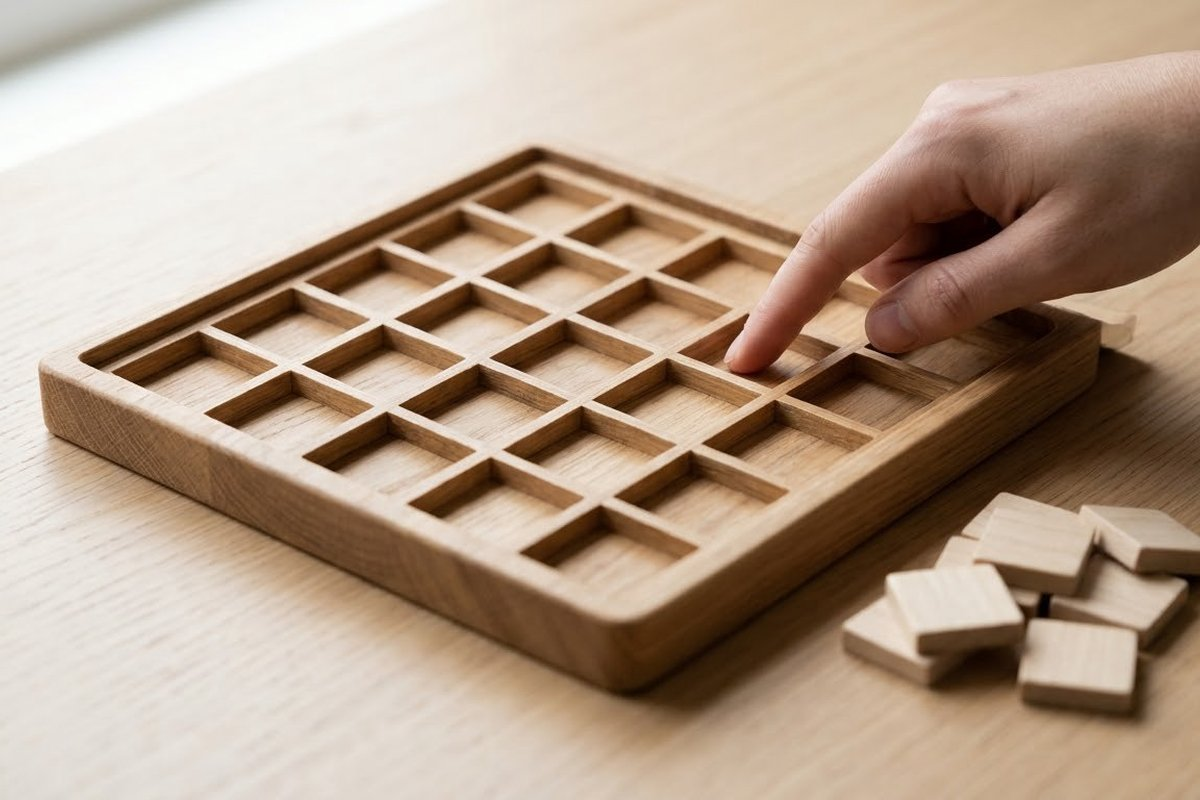
Two formats map directly onto the attention components from the first section. schulte grid training — finding numbers in a scattered grid, in order, as fast as possible — is a clean workout for sustained attention and visual search, and it is self-scoring, so you can watch your time drop over weeks. Stroop-style tasks, where you must name the ink color of a mismatched color word, train selective attention and interference control: the exact skill that lets you ignore a tempting alternative long enough to remember your goal.
Honest boundary: puzzle practice reliably improves performance on tasks like the ones you practice, and it builds a focusing habit — but the evidence that it transforms unrelated real-world skills is thin. We covered that evidence in do brain games actually work. The honest framing: games are the training floor, environment design is game day. Try a round of Schulte grid attention training or the stroop effect test before your next deep work block — as a warm-up that starts the session with one target, not five tabs.
FAQ
Can you fix a short attention span? If "fix" means repairing damaged capacity — there is nothing to repair. Lab-measured capacity has held steady across three decades. What you can retrain is behavior: fewer switches, better-timed sessions, environments with fewer instant rewards. That is how to fix attention span in practice.
How long until my focus improves? Switching habits respond within weeks of consistent single-tasking, because you are removing friction rather than rebuilding brain hardware. The 47-second screen statistic took over a decade of digital habits to form; give your counter-habit more than a weekend.
Is it too late if I feel permanently distracted? No. The same research program that measured the 47-second average also found focused attention still peaks on a daily rhythm even in heavy screen users. The machinery responds when you change the conditions it runs in.
References
- Scientific American — Are attention spans really shrinking? What the science says
- Personality and Individual Differences — Is there a Flynn effect for attention? (Andrzejewski, Zeilinger & Pietschnig, 2024)
- University of California — Can't pay attention? You're not alone
- University of California — How to sharpen your attention and meet your goals in 2024
- American Psychological Association — Speaking of Psychology: Why our attention spans are shrinking, with Gloria Mark
- UC Irvine Donald Bren School of ICS — Regaining Focus in a World of Digital Distractions